Charles R. Goulding and Preeti Sulibhavi explore how Joby Aviation’s Dayton expansion signals a turning point in scalable eVTOL manufacturing.
Joby Aviation’s steady expansion into Dayton, Ohio, signals more than just geographic growth. It reflects a deliberate strategy to scale production, deepen defense ties, and position electric vertical takeoff and landing (eVTOL) aircraft closer to real-world testing environments. For our readers who have followed the evolution of additive manufacturing and advanced aerospace ecosystems, Joby’s latest moves reinforce how location, partnerships, and production readiness are converging in the next phase of aviation.
A Growing eVTOL Leader
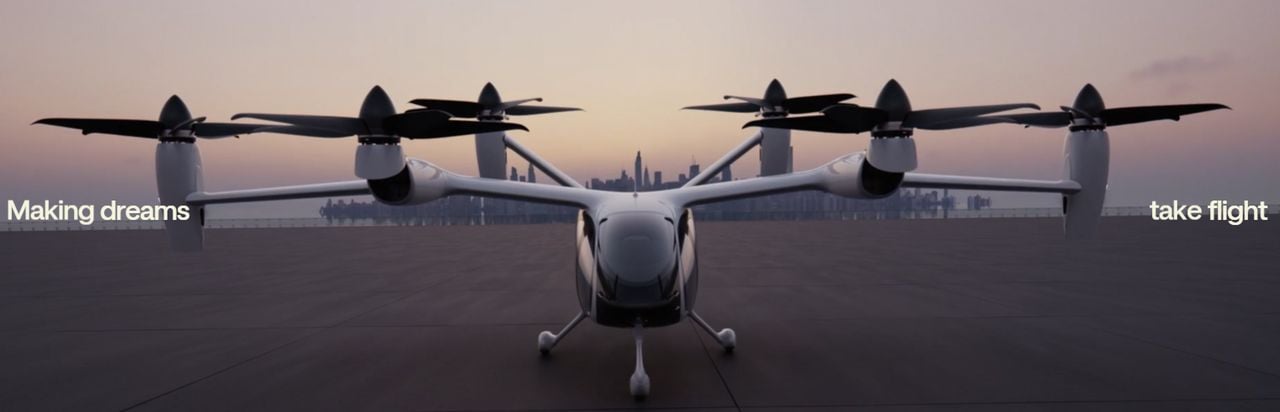
Joby Aviation is best known for its all-electric eVTOL aircraft designed for urban air mobility. Its flagship product is a piloted, five-seat aircraft (four passengers plus pilot) capable of speeds approaching 200 mph and ranges near 100 miles. The aircraft is intended for short-range, on-demand air taxi services, with early commercial deployments already planned in markets like Dubai and the United States.
Beyond its core aircraft platform, Joby has built out a broader portfolio that includes vertically integrated manufacturing, avionics (through its acquisition of Avionyx), and operational infrastructure for aerial ridesharing. This level of integration is critical in a sector where certification, safety, and production scale must align simultaneously.
In terms of scale, Joby has grown into a sizable aerospace employer, with thousands of employees across California and Ohio and plans for significant workforce expansion tied to its manufacturing ramp. Its Dayton initiative alone is expected to create up to 2,000 jobs over time. Revenue generation is still in the pre-commercial phase, but the company has secured substantial investment and partnerships, including backing from major players like Delta Air Lines and government programs supporting advanced air mobility.
Dayton, Ohio: From Symbolism to Strategy
Joby’s decision to anchor its first scaled manufacturing facility in Dayton initially drew attention because of the city’s aviation heritage. As the home of the Wright brothers and a historic center of aerospace innovation, Dayton carries symbolic weight. But the real story is strategic.
The company selected a 140-acre site at Dayton International Airport with the capacity to eventually support up to two million square feet of manufacturing space and produce as many as 500 aircraft annually. That scale alone signals Joby’s intent to move quickly from prototype to production.
More recently, Joby doubled down on this commitment by acquiring a second facility in the Dayton region, adding over 700,000 square feet of manufacturing capacity. This expansion supports a dual-site manufacturing strategy, with Ohio complementing its California operations and enabling the company to target increased output, including plans to double production rates by 2027.
For our readers, this is a familiar pattern: distributed manufacturing ecosystems that combine innovation hubs with scalable production centers. Dayton is evolving into the latter, with room to grow and a workforce aligned with aerospace and advanced manufacturing needs.
The Wright-Patterson Advantage
In one Fabbaloo article, we examined the importance of Wright-Patterson Air Force Base as a nexus for emerging aerospace technologies. Joby’s proximity to this installation is not incidental.
Wright-Patterson hosts the U.S. Air Force Research Laboratory and plays a central role in programs like Agility Prime, which aim to accelerate the development of advanced air mobility platforms. Joby has already benefited from this ecosystem, gaining access to testing resources, regulatory pathways, and defense-oriented collaboration opportunities.
This proximity also reinforces a key theme we’ve discussed in prior Fabbaloo eVTOL coverage: being near an airport or test facility is essential during the prototype and certification phases. Aircraft development cannot occur in isolation. It requires frequent flight testing, rapid iteration, and close coordination with regulators and potential customers.
By situating manufacturing and development activities near both Dayton International Airport and Wright-Patterson, Joby effectively shortens the loop between design, testing, and production. That kind of proximity can shave months or even years off development timelines.
Manufacturing Meets Mobility
Joby’s Ohio footprint also highlights how eVTOL production differs from traditional aerospace manufacturing. These aircraft combine elements of aviation, automotive, and electronics production, requiring flexible, scalable facilities.
The Dayton sites are expected to handle everything from component manufacturing to final assembly, supporting the company’s pilot production lines in California. As production ramps, Ohio will likely take on a larger share of full aircraft builds.
This is where additive manufacturing and digital production tools come into play. While Joby has not publicly detailed all of its manufacturing methods, the complexity of eVTOL components—lightweight structures, integrated propulsion systems, and custom avionics—strongly suggests the use of advanced fabrication techniques, including 3D printing.
For Fabbaloo readers, the takeaway is clear: eVTOL is not just a new aircraft category. It is a new manufacturing paradigm, one that blends aerospace precision with automotive-style scalability.
The L3Harris Connection
Another dimension of Joby’s growth is its partnership with L3Harris Technologies, a major defense contractor. This collaboration focuses on developing hybrid and autonomous VTOL platforms for military applications, extending Joby’s technology beyond commercial air taxis.
The partnership aligns with broader defense interest in smaller, more flexible aerial systems capable of operating in contested environments. These platforms could support logistics, surveillance, and electronic warfare missions, leveraging Joby’s electric propulsion expertise and L3Harris’s integration capabilities.
We have covered L3Harris, highlighting its role in advanced defense electronics and systems integration. The connection to Joby underscores how eVTOL technology is increasingly seen as dual-use, with applications spanning both civilian mobility and defense operations.
This dual-use potential also strengthens the case for locating production near military research hubs like Wright-Patterson. It creates opportunities for joint testing, rapid prototyping, and technology transfer between commercial and defense programs.
Why Location Still Matters
One of the recurring themes in Fabbaloo’s eVTOL coverage is the importance of geography. Unlike software, aircraft development is deeply tied to physical infrastructure.
You need runways, airspace, testing facilities, and regulatory oversight. You need skilled labor familiar with aerospace standards. And increasingly, you need proximity to both commercial partners and government stakeholders.
Joby’s Dayton expansion checks all of these boxes. It places the company in a region with a deep aerospace talent pool, strong government support, and direct access to testing environments.
It also reflects a broader trend: the decentralization of advanced manufacturing away from traditional coastal hubs and into regions with lower costs and stronger industrial ecosystems.
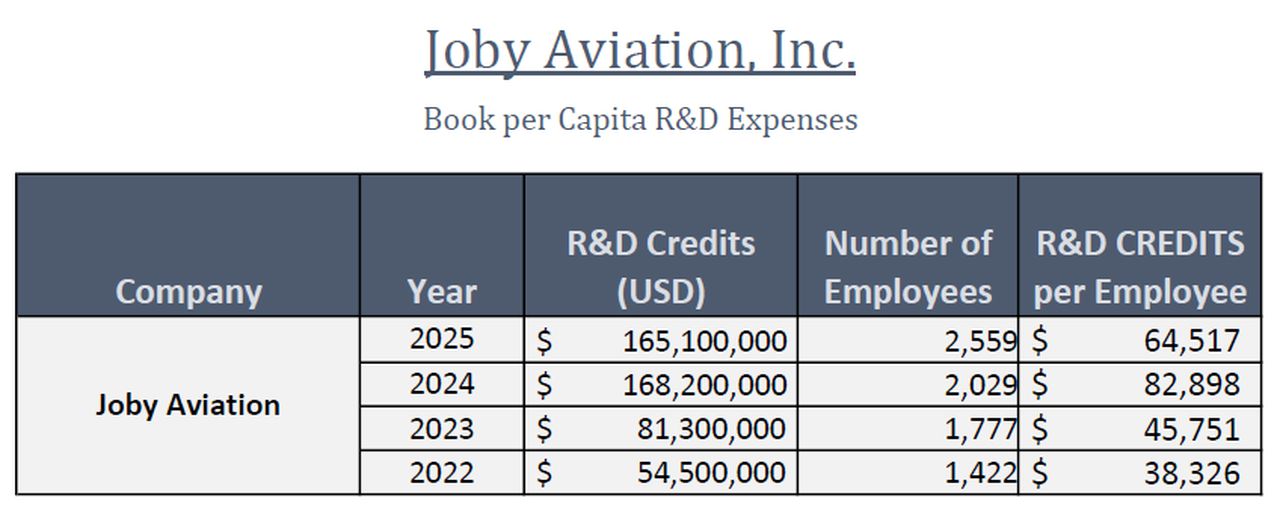
Below is a table that represents the total federal and state R&D credits, not the expenses, but the actual dollar credits Joby has claimed in the past four years. In terms of investing in research and development (R&D) and innovative technologies, Joby is among the premier elite.
The Research & Development Tax Credit
The now permanent Research & Development Tax Credit (R&D) is available for companies developing new or improved products, processes, and/or software.
3D printing can help boost a company’s R&D Tax Credits. Wages for technical employees who create, test, and revise 3D printed prototypes can be included as a percentage of eligible time spent for the R&D Tax Credit. Similarly, when used as a method of improving a process, time spent integrating 3D printing hardware and software counts as an eligible activity. Lastly, when used for modeling and preproduction, the costs of filaments consumed during the development process may also be recovered.
Whether it is used for creating and testing prototypes or for final production, 3D printing is a strong indicator that R&D-eligible activities are taking place. Companies implementing this technology at any point should consider claiming R&D tax Credits.
Those companies doing business in California should certainly consider both federal and state R&D credits as California has a very lucrative credit, even more generous than the federal and both can be used in tandem.
Additionally, Ohio has an R&D credit that is nonrefundable and calculated uing the Alternative Simplified Credit Method. Since Ohio has not corporate income tax, the R&D credit can offset Commercial Activity Tax (CAT) liability.
Looking Ahead
Joby Aviation’s progress in Dayton is still unfolding, but the trajectory is clear. The company is moving from prototype to production, from concept to commercialization, and from a single-site operation to a distributed manufacturing network.
On April 27, 2026, Joby Aviation completed the first-ever, point-to-point eVTOL demonstration flight in New York City’s history, heralding a new era of flying air taxis and urban air mobility in our metropolises.
For our readers, the story is not just about flying taxis. It is about how emerging technologies scale. It is about how manufacturing strategies evolve. And it is about how location, partnerships, and infrastructure come together to shape the future of an industry.
Dayton, once defined by its aviation past, is now positioning itself at the center of aviation’s next chapter. Joby Aviation is helping to write that story.