
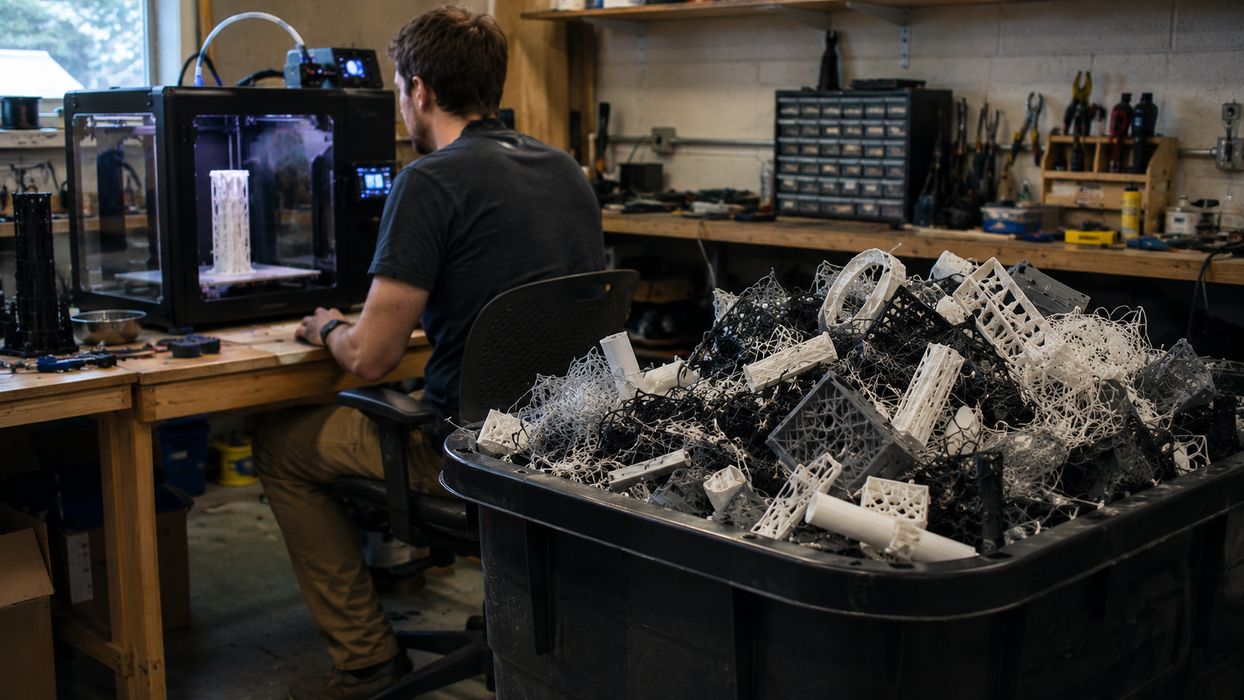
New research adds a troubling new dimension to 3D printing waste: it may be contributing not only to pollution, but also to climate change.
The Washington Post points to a growing body of research suggesting that microplastics do more than just accumulate in water, soil, animals, and human bodies. They may also interfere with the planet’s heat balance in ways that amplify warming. That’s not a 3D printing story itself, but it should be for anyone paying attention to the rapidly increasing amount of material waste generated by 3D printers.
Most desktop and industrial polymer 3D printing processes generate some level of waste. In FFF, that means purge towers, brims, rafts, failed prints, support structures, filament scraps, and empty spools. In resin printing, there are failed parts, supports, contaminated consumables, and half-cured leftovers that are even more problematic from a handling perspective. Powder bed systems avoid some of that, but not all of it. In other words, additive manufacturing is not automatically a low-waste process simply because it is additive.
The industry usually talks about the waste issue as a local and manageable task: clean up scraps, recycle where possible, and try your best to avoid sending too much plastic to the local landfill. That already wasn’t the whole picture, as the waste would eventually turn into microplastics.
If microplastic fragments are now known to be part of a larger climate problem, then the cost of waste is now much larger than many equipment manufacturers and material producers thought.
There is also a scale problem here. A single failed desktop print is a trivial issue. The problem is that now there are millions of 3D printers generating waste across schools, makerspaces, small print farms, service bureaus, and corporate prototyping labs. Our industry has spent many years celebrating speedy devices and high part throughput, but a lot less time measuring waste.
Could Waste Reduction be a Feature?
If the climate angle continues to gain awareness, then waste reduction stops being just a pretty sustainability check mark and could transform into a more serious design priority. That could point us toward systems that minimize support use, avoid purge-heavy multi-material workflows, avoid purging altogether, improve first-print success rates, and automate calibration to cut down on trial-and-error waste.
Some of this is already happening, but usually for cost reasons. Operators do dislike waste material because it costs money, labor and time anyway. Now there may be an even stronger environmental case as well. You might imagine future purchasing decisions being influenced by simple questions: How much scrap does this workflow generate per usable part? How much purge is required? What happens to support waste after the job is done?
That said, it’s important not to overstate this news. The Washington Post article summarizes emerging science on microplastics and planetary warming, but it does not quantify 3D printing’s specific share of that problem, which will be a small, but growing piece. We don’t have a clean number showing how much printer-derived plastic becomes climate-active microplastic, or how that compares with other major microplastic sources.
Still, the implication is hard to ignore: every unnecessary gram of plastic waste may carry more environmental consequence than previously understood. For 3D printing, that could change how we think about waste. Waste is no longer only about disposing of a mess, and questionable recycling projects. It should be about CO2 emissions too.
