
German researchers used laser powder bed fusion to create modular metal fan blades that slash the cost and time of aeroacoustic experiments.
A big bottleneck in fan noise research is building and balancing a whole new rotor for every tweak to the leading edge. That slows iteration and burns budget, especially when exploring serrations, slits, or porous concepts.
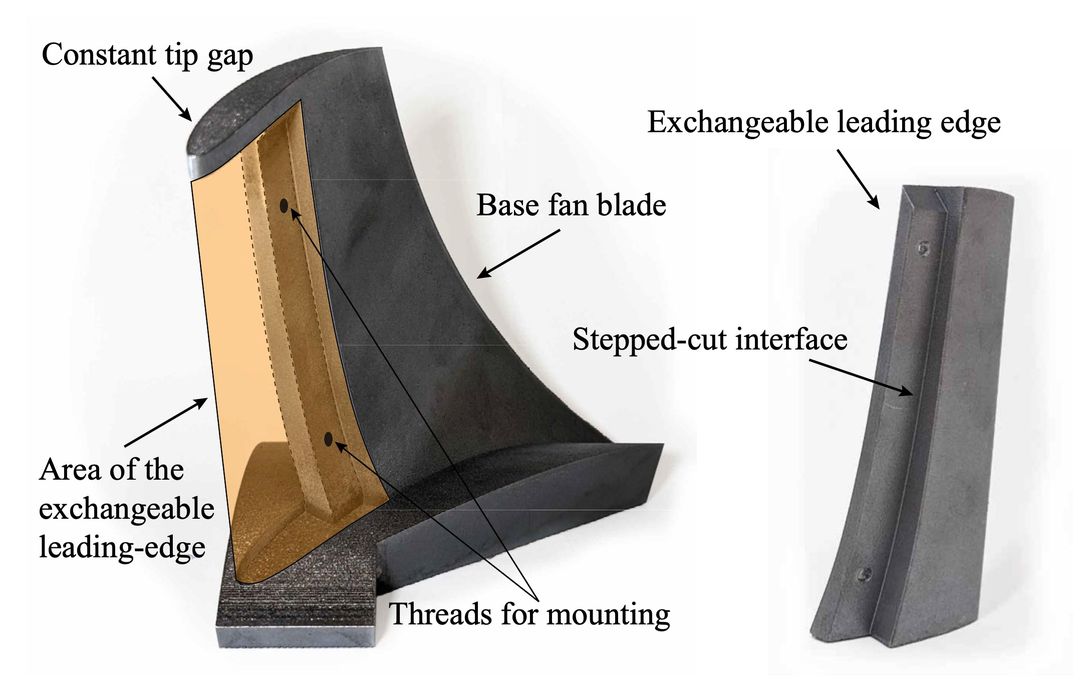
The team from Aalen University and the University of Erlangen-Nuremberg designed an axial fan with a swappable leading edge manufactured with the LPBF process. The goal was simple but ambitious: enable rapid leading-edge changes without hurting aerodynamics or adding noise.
Fans running downstream of heat exchangers are notorious for generating extra noise. Prior work shows bio-inspired serrations and porous edges can help — but producing full blade sets for each variant is painful. Additive manufacturing’s design freedom suggested a different approach: make only the noise-control region modular and leave the rest alone.
A Modular Blade Built For Iteration
The five-blade, 498 mm diameter reference rotor was split at about one third of the chord near the tip. A stepped-cut interface and lateral countersunk bolts tie the printed leading-edge module to the base blade, while an integrated 3 mm tip strip stays with the base to lock the tip gap at 1 mm. That avoids tip-clearance effects confusing the acoustic data.
Both parts were printed in AlSi10Mg on an SLM 280HL (280 x 280 x 280 mm) with the platform at 200C. The team used a dual layer-height strategy: 30 microns for contours to protect surface finish and 60 microns effective for infill to cut build time. Blade bases were oriented about 45 degrees to limit supports and thermal distortion; only the tip feature needed support. Practical detail: a single build plate could hold about fifty leading-edge pieces, while four base blades fit per build, meaning two builds per full rotor — but dozens of leading-edge variants in one go.
On a test rig with microphones in an anechoic chamber, the modular rotor matched a monolithic one. Static pressure rise deviations were below 2 Pa across the design flow range and peaked at 4 Pa only in partial load.
In other words, the interface did not “print” its own signature into the aeroacoustics.
This is a very interesting move because modularity lowers the cost factor in aeroacoustic studies: you don’t have to manufacture and balance new rotors for every idea. With LPBF, labs can print fifty candidate leading edges, keep the hub and balance intact, and swap modules on the test rig in minutes. That increases throughput and makes it feasible to systematically map serration geometries, slit patterns, or porous architectures.
The researchers plan to test serrations, slots, and porous structures, and mention extending modularity to the trailing edge. Validation under disturbed inflow — the real pain case behind heat exchangers — will be the big test, along with lifetime testing and any pathway to production blades where certification and cost control bite hard.
This is a very interesting way to leverage 3D print technology to reduce costs and speed up an otherwise tedious workflow.
