
A new Czech patent application from Prusa Development describes a new way to clean dirty nozzles.
The patent, CZ-2025134-A3, is titled “a system for the cleaning of a 3D printer nozzle.” That sounds simple, and it is. But simple does not mean unimportant.
Anyone who has run a desktop FFF 3D printer knows about the issue. The nozzle can carry a blob of filament, ooze during heating, or drag residue across the build plate at the wrong moment. Sometimes that causes only a cosmetic mark. Sometimes it ruins the first layer, and therefore the print. Clean nozzles are required.
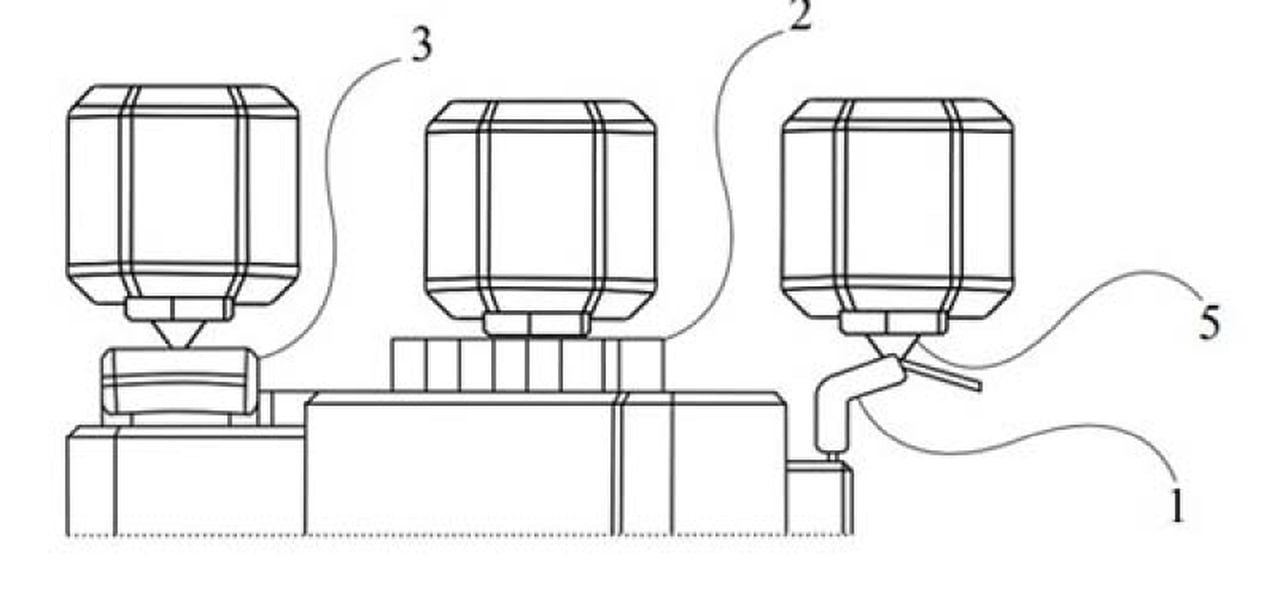
Prusa’s proposed system combines three elements positioned in the travel path of the nozzle: a shearer, a brush, and a parking surface. The nozzle passes through them in sequence while staying vertical.
In other words, this is not a complex robotic cleaning station. It is a mechanical cleaning path that uses the machine’s normal motions.
The shearer is described as having a leading edge shaped like two fingers, a cutting edge, a cutout, and a support surface. That suggests it is intended to physically remove larger pieces of filament or hardened residue from the nozzle before the nozzle reaches the brush. This is an intriguing two-step approach.
The brush then performs the more familiar wiping function. The patent says the brush includes a base and flexible polymer bristles. Finally, the nozzle reaches a parking surface, presumably after the larger debris and smaller residue have been cleared.
This is a very “Prusa” kind of idea. Prusa has long competed in a market where reliability matters a great deal. Build volume, speed, and multicolor capability get attention, but print farms, home operators, and schools often care more about whether the machine starts cleanly and repeats without failures.
A passive nozzle cleaning sequence as described could help with that. It might reduce failed first layers, lower manual intervention, and make automated or semi-automated workflows more predictable. That becomes more important when a printer uses material changing, soluble supports, abrasive filaments, or unattended print queues.
It also fits a larger trend in desktop FFF machines. The market has been adding features that reduce operator time: automatic bed leveling, nozzle wiping, filament detection, clog detection, pressure advance tuning, input shaping, and camera-assisted monitoring. None of these features alone makes a printer dramatically different. Together, they change how much attention a user must give each print. This idea is another one to add to that list.
But there’s one issue: this is only a patent application.
The filing does not mean Prusa will ship this exact mechanism, or that it will appear on a future machine, since patents often describe ideas that never become products. They can also protect design space around concepts already tested internally.
Still, the arrangement is interesting because it appears mechanically simple. A shearer, brush, and parking surface are easily implemented at low cost. The real engineering challenge would be wear, filament compatibility, debris management, and ensuring the cleaning system does not itself become a source of contamination.
The geometry of the shearer may be the more important piece of this puzzle. A brush can smear soft filament. A cutting or shearing feature could remove the blob first, making the brush’s job easier. A very interesting approach, indeed.
For Prusa, the business value is not so much the cleaning device by itself. It is the added reliability. Cleaner starts mean fewer failed prints, fewer support tickets, and better results in print farms where one person may supervise many machines.
Via Espacenet
