
Researchers have developed a recyclable photopolymer resin that can be printed, melted, and printed again.
High resolution resin 3D printing has a sustainability problem. The very chemistry that makes SLA, DLP, and two photon lithography useful also makes printed parts difficult to undo.
Most vat photopolymer materials cure by forming highly crosslinked polymer networks. That gives the part shape and strength, but it also tends to make the final object a one way trip. Once cured, the material generally cannot be returned to a liquid resin suitable for another print job.
These thermosets are quite different from the thermoplastics used in FFF 3D printing, which can be melted and reformed several times.
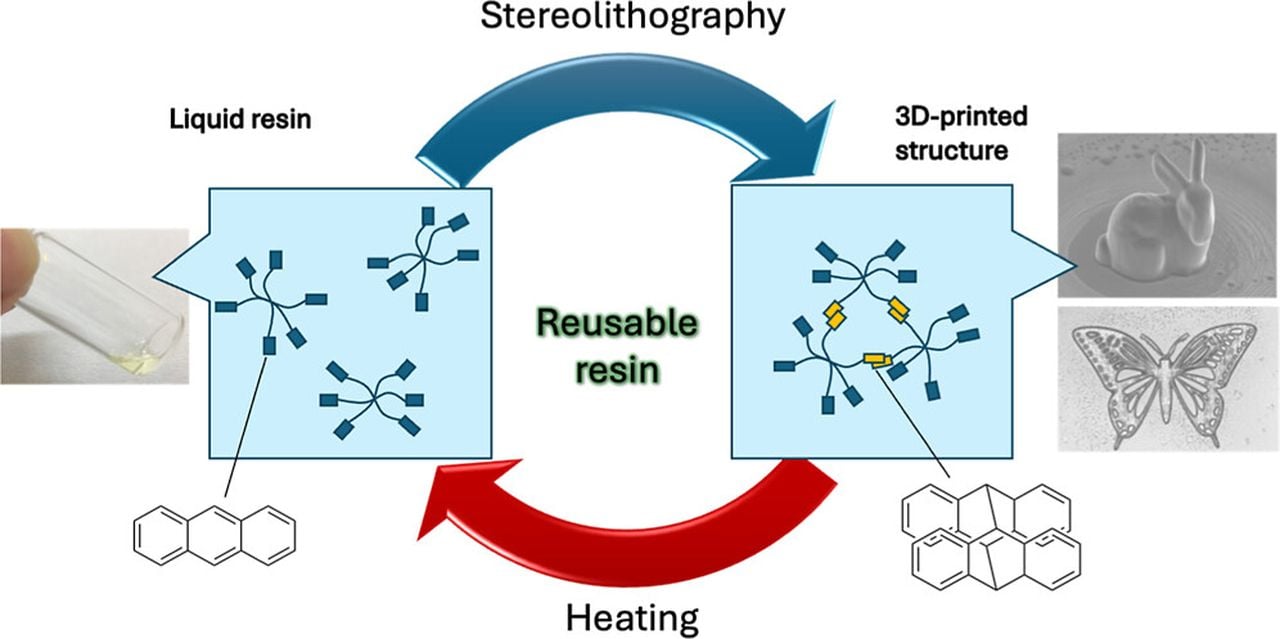
A team from Yokohama National University and Tokyo University of Science has proposed a different approach: an initiator free anthracene based photocurable resin that uses reversible photodimerization instead of conventional chain growth photopolymerization.
A Resin That Goes Backward
Wait, what does that mean?
Anthracene can form dimers when exposed to light. In this resin, that reaction creates a polymer network and turns the liquid into a solid printed structure. When heated, the anthracene dimers dissociate, breaking the network and returning the material toward a liquid state.
In other words, light solidifies the material, and heat breaks it down.
That is quite different from most “recyclable” photopolymer approaches. Previous systems have often required chemical additives, fresh precursor resin, purification steps, or reactions that change the material after each cycle. Those approaches may technically recycle material, but they are not always convenient or complete in a practical additive manufacturing workflow. Basically, no one does this.
The new resin is also notable because it does not require photoinitiators, unlike every other 3D print resin I’ve heard of.
The researchers used the material in both two photon lithography and single photon microstereolithography. In two photon work, they printed a butterfly pattern, microneedles, and a small bunny model. The paper reports a minimum curing line width of 0.61 microns and a curing depth of 1.26 microns under tested conditions.
That places this method in the microfabrication world, not the desktop resin printer world. But that is also where expensive materials and tiny production volumes can make recycling unusually interesting.
The Catch Is Heat And Time
The recycling demonstrations are the most interesting part of this research.
The researchers printed a cube, heated it at 150C for 15 minutes, and reused the melted resin to print a disk. They also demonstrated a “rewrite” experiment, repeatedly drawing and erasing letters in resin using two photon lithography and infrared heating. At least ten rewrite cycles were achieved.
This sounds great, but there is still an issue. The material did not return perfectly to its original state. After light curing and heating at 180C for 20 minutes, the resin regained fluidity but became more viscous than before. The paper suggests possible causes such as thermal decomposition, oxidation, or ester exchange reactions, though NMR did not show clear chemical changes.
Mechanical properties also shifted. The reported reduced elastic modulus rose from 2.43 GPa before recycling to 2.66 GPa after one recycle and 2.85 GPa after two recycles. After ten cycles, the measured reduced modulus was 5.39 GPa. That may not be catastrophic, but it does show the material somewhat evolves through these cycles.
For some applications, a stiffer recycled resin might be acceptable. For others, especially optics or precision biomedical devices, repeatability matters more than recyclability alone.
Single Photon Possibilities
The team also tested single photon microstereolithography using a 405 nm laser. That wavelength is common in commercial resin systems, though the work here used a custom laboratory setup rather than an off the shelf DLP printer.
They printed a four tier pyramid about 1 mm high using a bottom up process, frosted glass as the top substrate, and PFA film at the bottom of the resin chamber. The model reportedly matched the design closely, although larger single photon parts appeared more yellow than the smaller two photon structures.
This is a very interesting development. Instead of dealing with cured photopolymer waste, the researchers are instead figuring out how to make the cured network reversible.
While this work seems to focus on microfabrication, I am interested to see if this method could scale up to be used with larger scale objects. Having a recyclable resin could be extremely useful — and more sustainable.
Via ACS Omega (PDF)
