
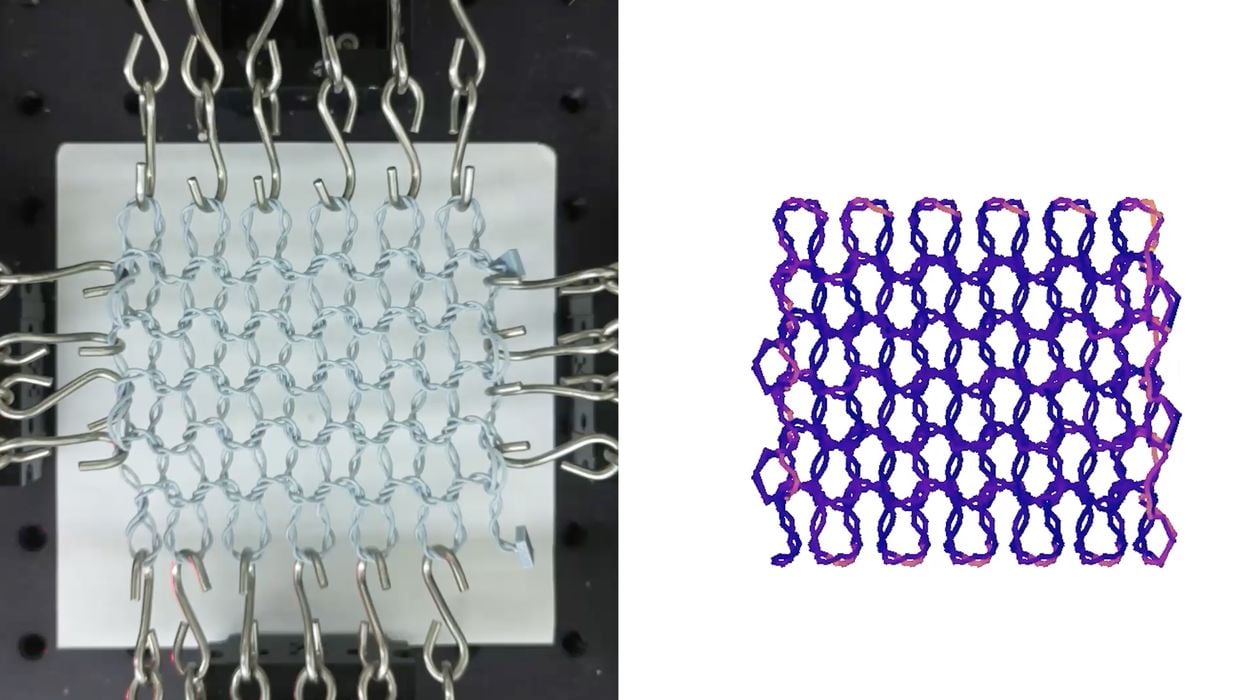
A new research paper reports multiscale 3D printed knits that use entanglement to deliver programmable mechanical responses.
Knits are not just fabrics; they are architectures. Unlike typical strut lattices that rely on rigid nodes, knitted loops slide, rotate, and catch under load. That mobility can produce highly nonlinear behavior such as strain stiffening, energy absorption, and even reversible jamming — all without changing base material.
Additive manufacturing has been playing with textiles for years. We have seen flexible chainmail, TPU mesh from Selective Laser Sintering (SLS), and resin lattices from Digital Light Processing (DLP) that mimic foam. The appeal is obvious: textiles deliver comfort, conformability, and impact control that solid parts cannot. But true knit behavior is hard to print because it depends on how loops entangle and make contact, not just on beam geometry.
This study claims exactly that: 3D printed knit architectures whose responses are driven by loop entanglement across scales, rather than by monolithic stiffness. In other words, the part’s mechanics emerge from controlled sliding and frictional contact, and only later from material stretch.
From Lattices To Knits
What changes when you print a knit instead of a lattice? At small strains, loops can rearrange and distribute load as they slide. At higher strains, those same loops tighten, increase contact, and dissipate energy. Past a threshold, the network can “jam” into a stiffer state. That sliding-to-jamming transition is the essence of entanglement-driven behavior, and it can be designed into the architecture by choosing loop size, crossing angle, and local density.
By nesting loop motifs at different scales — yarn-scale interactions within stitch-scale patterns within fabric-scale topologies — the researchers can, in principle, layer responses: early cushioning followed by late-stage stiffening, or vice versa. It is a clever way to get multiple set points and hysteresis from one printable polymer, with no embedded hardware.
This sounds great, but fabrication constraints will decide how broadly it applies. The paper’s abstract does not state the printing platform, materials, or minimum feature size. Elastomeric photopolymers could deliver the resolution for tight loops, while SLS with TPU could scale the area but may blunt fine contact control. Throughput and support strategy also matter: dense, interlocked loops are notorious for trapped resin, powder removal, and cleaning. If the design depends on precise friction, surface finish and post-processing will make or break consistency.
Why This Could Matter
If the approach holds up, it could unlock more predictable, comfortable, and durable 3D printed wearables and soft goods. Think helmet liners, shoe midsoles, prosthetic sockets, and protective sports padding that cushion gently at first and then stiffen decisively. Soft robotics could exploit reversible locking without extra actuators, while industrial grippers could gain passive compliance that toggles under load.
Economically, getting more function from geometry alone is a win. But design tools will be the bottleneck. Most lattice engines optimize beam diameters and unit cell tiling, not frictional contacts and sliding constraints. Accurate simulation here means modeling contact, friction, and path-dependent behavior — challenging, but not impossible. Validation data will be crucial: stress-strain curves at multiple strain rates, cycle life under fatigue, energy dissipation per unit mass, and thermal or humidity sensitivity.
Via PNAS
