
A Chinese patent application describes a multi nozzle composite 3D printer that tries to fix what happens when hot material is left in a nozzle.
The application, CN122143331A, was published on 5 June 2026 , and the assignee is Shandong Zhongke Intelligent Equipment Co., Ltd.
The patent is titled “A Multi Nozzle Switching Composite Material 3D Printer”, and the idea is aimed at FFF style composite printing using multiple print heads. The machine is described as handling different filament paths, with each filament feeding its own nozzle assembly.
That would be useful when printing with multiple materials, colors, matrix polymers, or potentially fiber reinforced materials. But it also creates a problem.
When one nozzle stops printing and another takes over, the inactive nozzle may still contain hot, pressurized material. Gravity, residual pressure, and the thermal state of the melt can cause it to ooze. In composite printing that ooze is not just a cosmetic annoyance. It can contaminate the part, create blobs, drag fibers, or spoil a toolpath that depends on clean material transitions.
The usual answer in desktop FFF systems is retraction. Pull the filament back slightly and reduce pressure at the nozzle. More ooze means more retraction is required.
But there’s one issue.
The patent argues that in composite material printing, retraction can pull partly melted material, old residue, fiber dust, or carbonized particles back toward cleaner upstream material. In other words, the act of preventing a drip could contaminate the feed path.
The proposed system avoids that by cleaning externally instead of pulling material backward.
The printer includes a support frame, linear module, magnetic build platform, lifting mechanism, multiple filament spools, and a multi nozzle print body. Each nozzle is attached to a telescoping tube, allowing the selected nozzle to move downward into the active printing position.
The switching mechanism is magnetic. The nozzle body carries a permanent magnet, while the printer frame includes corresponding electromagnets. When a nozzle is needed, the relevant electromagnet attracts it into the working position. When the nozzle is no longer needed, the electromagnet releases it, and the telescoping mechanism helps return it upward.
The more interesting part is what happens during that return.
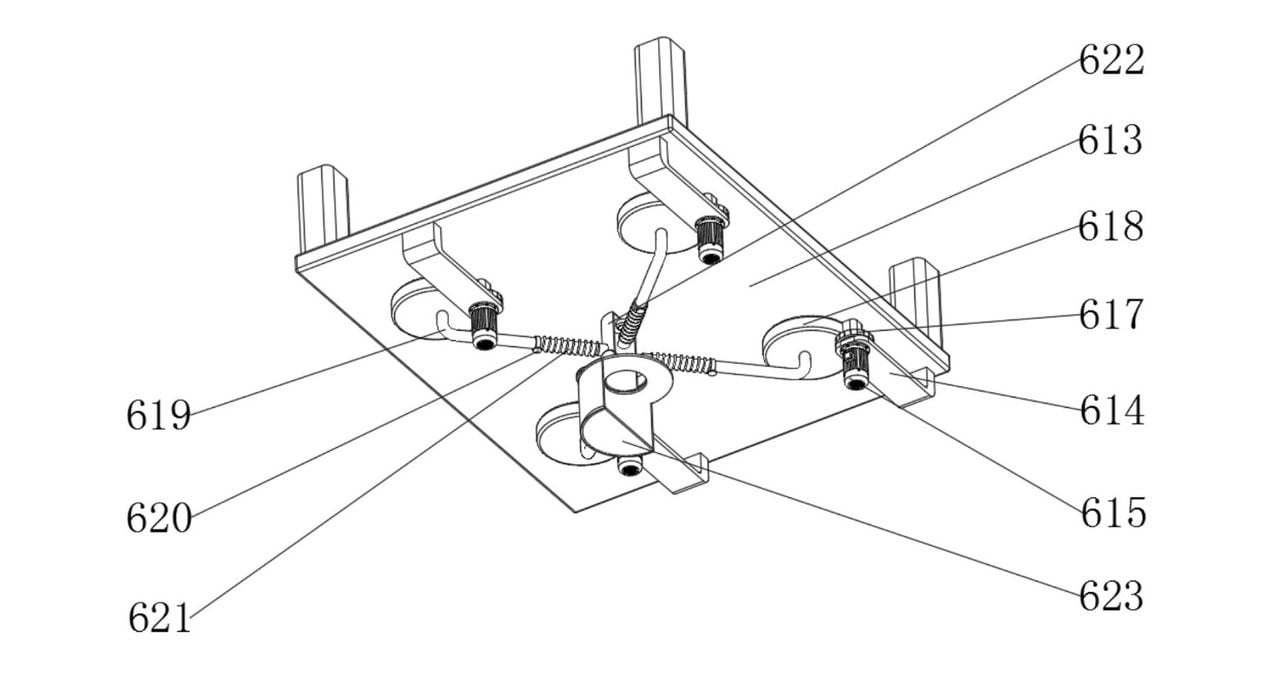
The patent describes a cleaning assembly with rotating collection boxes positioned under the nozzles. When a used nozzle retracts upward, the matching collection box rotates underneath it. Waste material can then drop into the box instead of onto the print.
Then the system applies negative pressure through suction tubes connected to a vacuum chamber and collection chamber. Valves, bellows tubes, a pressure sensor, and an air pump manage the suction. The goal is to draw remaining waste material from the nozzle mouth into the collection system.
A suction based nozzle cleanup system could reduce operator intervention and improve print reliability if it works consistently. It could also make multi nozzle composite printing less wasteful than large purge structures, depending on how much material must be removed during each switch.
There are some practical questions. Composite filaments can be abrasive and messy. A vacuum path handling melted polymer and fiber filled residue could clog quickly if temperatures and flow paths are not well managed. The collection boxes themselves would need cleaning, and the nozzle sealing geometry would have to be very reliable.
Via Espacenet
