
A new digital twin for metal AM can perform real-time defect prediction in Laser Powder Bed Fusion.
The work comes from Rami Alfattani and Majed M. Hotami at Umm Al-Qura University and has been accepted by Scientific Reports. The research validates mostly on LPBF using NIST’s AM-Bench data for IN625 and Ti-6Al-4V.
Defect prediction is an eternal issue when using metal additive manufacturing, where most quality assurance still requires on post-build CT and sectioning. That is expensive and after the fact. Real time monitoring does indeed exist, but many of those systems are single-sensor, offline, or too slow to enable real closed-loop control.
This research paper proposes a digital twin architecture that goes beyond single-scale thermal models by coupling the melt pool, porosity formation, and part-level stress into one inferencing stack. In other words, it tries to “see” why a pore or crack will occur, not only when the camera catches it after the fact.
How This Digital Twin Works
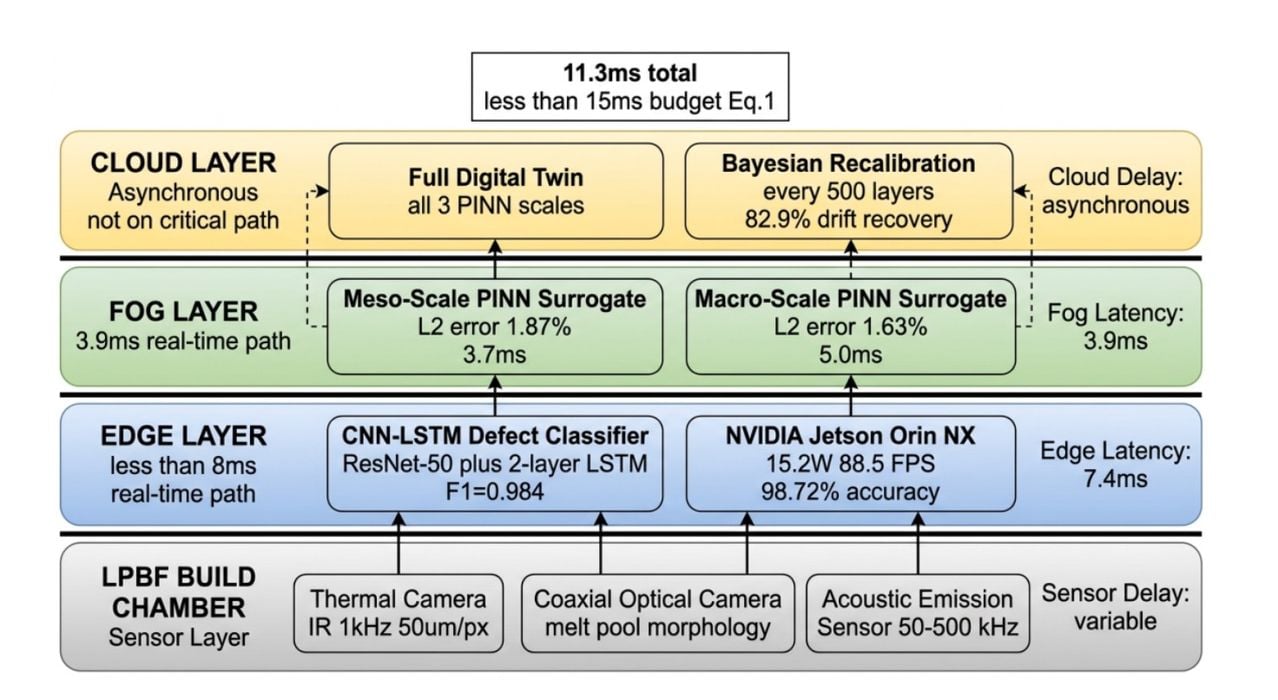
The architecture ties together three physics-informed models — micro, meso, and macro — each trained as a Physics-Informed Neural Network (PINN) with a Fourier Neural Operator backbone. They replace heavy CFD and FEM solutions, delivering what the researchers say is about a 1,100x speed-up while keeping relative error near two percent.
On the data side, thermal imaging, coaxial optical monitoring, and acoustic emission are linked by a CNN-LSTM to classify six defect types: porosity, lack of fusion, cracking, balling, keyholing, and delamination. The digital twin runs across edge, fog, and cloud: a Jetson Orin NX at the machine makes the latency-critical decision in only 11.3 ms per frame, fog aggregates multiscale queries, and the cloud performs Bayesian recalibration to track process drift.
Results on AM-Bench are quite strong: 98.72% accuracy, macro-averaged F1 of 0.984, and the authors report recovering roughly 83% of accuracy lost under simulated drift (powder ageing, laser power shifts). They also simulate production KPIs, suggesting a 34.6 percent scrap-rate reduction and 18.7 minutes of predictive lead time — with minor throughput and energy penalties — if the twin is used as a decision aid.
What is actually new here is the multiscale coupling in real time. The micro surrogate feeds a melt pool depth-to-width ratio as a keyholing precursor, the meso level estimates porosity fraction from G and R, and the macro level predicts residual stress for cracking risk.
If this approach is ever commercialized, service bureaus and aerospace suppliers could cut down their human labor doing inspections and move instead to more adaptive control. The 11.3 ms edge latency seems correct for LPBF closed loop, at least for local adjustments. Vendors such as EOS, SLM Solutions, and Renishaw already ship in-situ monitors; integrating a multiscale, physics-informed twin could be the next competitive step for their systems.
All experimental validation was LPBF-only on IN625 and Ti-6Al-4V, and although promising, additional materials should be tested on the system.
We may at some point see real hardware testing with commercial LPBF systems, and whether the approach is still valid even under messy, real life factory conditions.
In the end it’s software of this sort that should provide the best prediction for whether a job will succeed or fail.
