
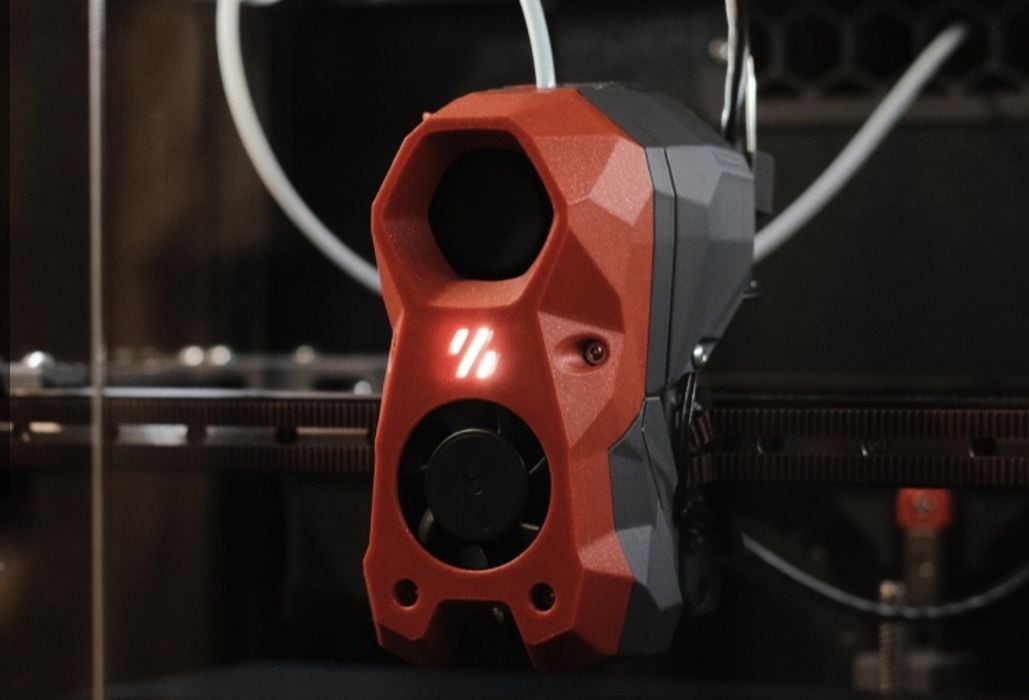
Voron has released Trident R2, a design refresh that focuses on belts, idlers, and motion alignment.
The Trident is one of Voron Design’s best-known community-developed CoreXY platforms, positioned between hobby-class kits and commercial prosumer machines. It is typically built from self-sourced components or vendor-supplied “kits”, and it has earned a stellar reputation for speed and print quality, when tuned well.
The Trident R2 design continue the rigid framed CoreXY with a moving bed on Z. The R2 release is a mechanical revision that reworks key subassemblies in the XY and Z motion systems, plus some quality-of-life changes for parts and hardware choices. For existing Trident owners, Voron says their online configurator now includes a bill-of-materials (BOM) delta for upgrading from Trident R1.
What Changed In Trident R2
Voron says Trident R2 includes a reworked XY and Z motion system, starting with new “BAdrives”. These are updated drive units with an improved belt path and double-shear support for motors with longer shafts. In other words, double-shear mounting tends to reduce flex and misalignment at the motor interface, which can translate into more consistent belt tracking and fewer vibration artifacts when the machine is pushed really hard. And that’s something Voron operators tend to do.
R2 also introduces new XY joints and new front idlers. The front idlers are “inspired by Beefy Front Idlers”, a popular rigidity-minded approach in the community, but implemented with single-screw tension adjustment. This could be important during assembly and during later retensioning, especially for Voron builders that do not want to disassemble panels or struggle with cramped tool access to get belt tension correct.
Belting is a major theme in R2. Voron says belting is “way easier” with built-in guides that push the belt where it needs to go, and that overall belt length was shortened by about 53 mm. A shorter belt run can be better for stiffness and resonance behavior, but the bigger hit may simply be removing a typical error: twisted belts, rubbing belts, or belt paths that require “three hands” to install.
There is also a subtle geometry tweak: the gantry is allowed to gain a few millimeters at the front and back to enable small overtravel. That extra reach can be useful for practical add-ons like nozzle brushes or purge setups, which are often added by Voron users but can be tight on travel limits.
Z Axis And Hardware Quality-of-Life Tweaks
On the Z side, Voron says the motor mounts now lower the motors to better accommodate 320mm leadscrews and leadscrew couplers. This could reduce awkward setups and improvised spacing that sometimes show up when builders mix and match parts.
Voron also notes a printing-oriented detail: the side where the motors touch the printed plastic part is oriented to print on the build plate, avoiding top-surface artifacts that could skew the motor interface. That is a very “Voron” kind of fix, because printed parts are functional components, and that surface quality is not cosmetic.
Other changes include a reworked spool holder and PTFE guide, and a hardware swap from M5 hex nuts to M5 heatset inserts. Heatset inserts can improve serviceability and reduce the risk of plastic threads loosening over time, but they do add a small tooling step and require consistent installation technique.
For builders deciding whether to jump to R2, the big question is how “mandatory” these changes feel in day-to-day printing. We’ll have to see what comes from community build logs and upgrade experiences. If the revised belting and idlers simplify assembly, they might not be of immediate use, but if they simplify long-term maintenance, that may be a lot more meaningful.
