
Bosch has published three related German patent applications that point toward a rather interesting 3D printing concept: a pellet-based extrusion system designed to keep printing while its printheads are being refilled.
That may sound like a small operational detail, but it could be quite important.
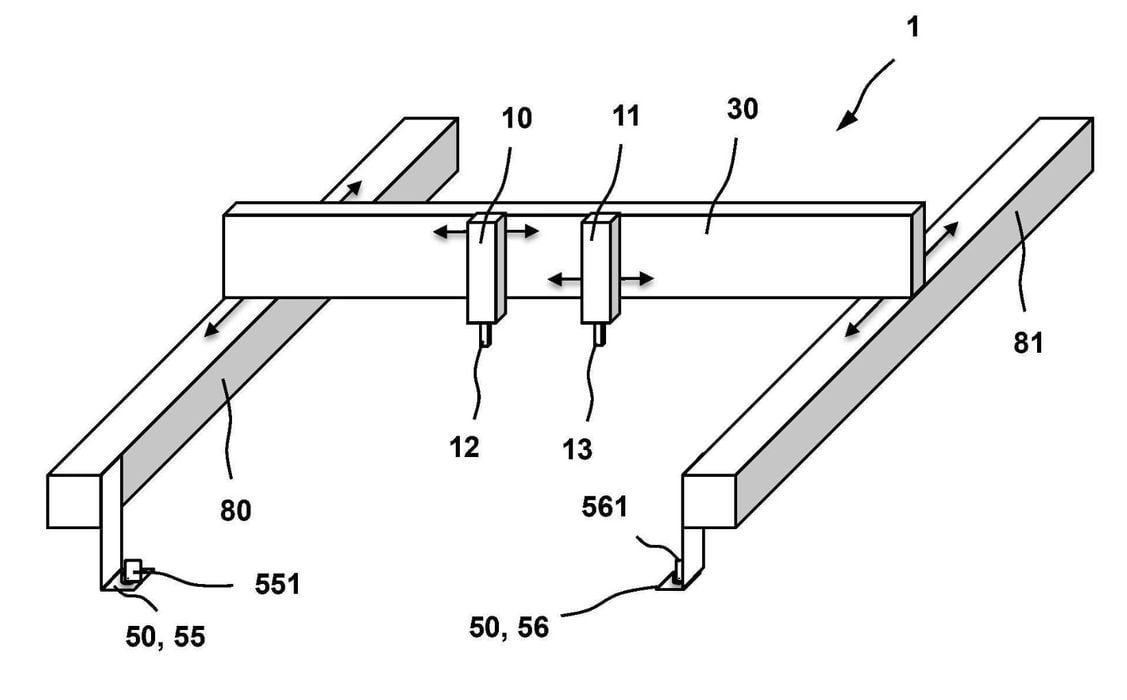
The patents, DE102024211873A1, DE102024211875A1, and DE102024211876A1, were assigned to Robert Bosch GmbH, a known company, but not one that is known for building large 3D printers. The patents were just published and were among multiple other patents awarded to Bosch the same week. The three key 3D print-related patents describe different aspects of a 3D printer using one or two printheads mounted on a moving bridge, with particular attention paid to motion control, refill handling, and nozzle closure.
This is not about large-scale FFF 3D printing. The patents repeatedly refer to granulate 3D printers and piston extruders, where pellet or granulate material is plasticized in a heated zone and then extruded. That is a different class of machine from the filament machines most 3D printer operators use every day.
Granulate extrusion has an obvious attraction: material (pellets) can be far cheaper than filament, and many useful industrial polymers are often already available in pellet form. That can make the process ultra-attractive for large parts, fixtures, tooling, or internal manufacturing applications.
But there’s one issue.
Some pellet or piston extrusion arrangements must pause to refill, compact, or re-melt material. Those pauses can leave marks on the printed object, disturb extrusion consistency, and reduce part quality. That’s an effect that FFF operators see whenever a filament spool change occurs. Bosch’s patents appear to be solving this issue.
The most straightforward of the three patents describes a method using two printheads. One head prints while the other can enter a refill process. When the active head requires refilling, the second head takes over the first head’s position and continues the print. In other words, Bosch is trying to make a refillable pellet extrusion system behave more like a continuous printing process.
A second patent deals with the messier mechanical detail: what happens to the nozzle during refill. Bosch describes a separate closure device for each printhead, used to close the nozzle during a refill process. The closure device could be mounted on the guide rails, on the moving bridge, or directly on the printhead, and may use an elastic sealing element.
If one printhead is refilling while the other is printing, the idle head cannot be allowed to leak, ooze, or otherwise contaminate the build area. A reliable nozzle closure could be the difference between a clever concept and an unusable machine.
Interestingly, many FFF machines suffer from the same issue and could use a nozzle closure solution. I wonder if Bosch’s patent would prevent other FFF machines from implementing a nozzle closure system?
The third patent focuses on motion control. The proposed printer uses a bridge moving in Y, driven by two motors, while X motion is independently controlled by two additional motors. Some of these motors are mounted on the machine frame rather than on the moving bridge, reducing moving mass. However, that creates motion dependencies requiring compensation in software.
This suggests Bosch is not thinking only about printhead swapping. It is also considering the machine architecture needed to move a relatively complex dual head system quickly and accurately.
This could matter because high-throughput polymer extrusion is a persistent gap in additive manufacturing. Filament systems are tidy and precise, but slow and costly in material. Large pellet systems can be cheaper and faster, but they can be less refined and more difficult to control. Bosch’s concept appears to cover that middle ground: industrial material cost with better continuity and more controlled motion.
Of course, these are patents, not a product announcement. There is no evidence here that Bosch intends to sell such a machine commercially. Large industrial companies often patent internal production equipment, supplier concepts, or defensive ideas that never reach the market.
The three filings definitely show significant interest in additive manufacturing by the company. Bosch appears to be thinking seriously about automated, continuous pellet extrusion, not merely a single isolated mechanism.
Via Espacenet
