
A new patent proposes a more practical way to switch materials in resin 3D printing.
The patent, CN122210937A, was filed by Hefei Zhongjian 3D Technology Co., Ltd. and published on 16 June 2026. It describes a multi-material light curing 3D printer and a matching print method intended to reduce one of the big problems in multiresin SLA or DLP operations: cross-contamination.
Single resin machines are pretty straightforward. A part is built from a single photopolymer resin, and all the mechanical and optical properties come from that resin. But many applications need more than one material: soft and rigid zones, colour changes, functional gradients, or localised performance differences.
In theory, multiresin printing should unlock those parts. In practice, sticky liquid resin makes everything very complicated.
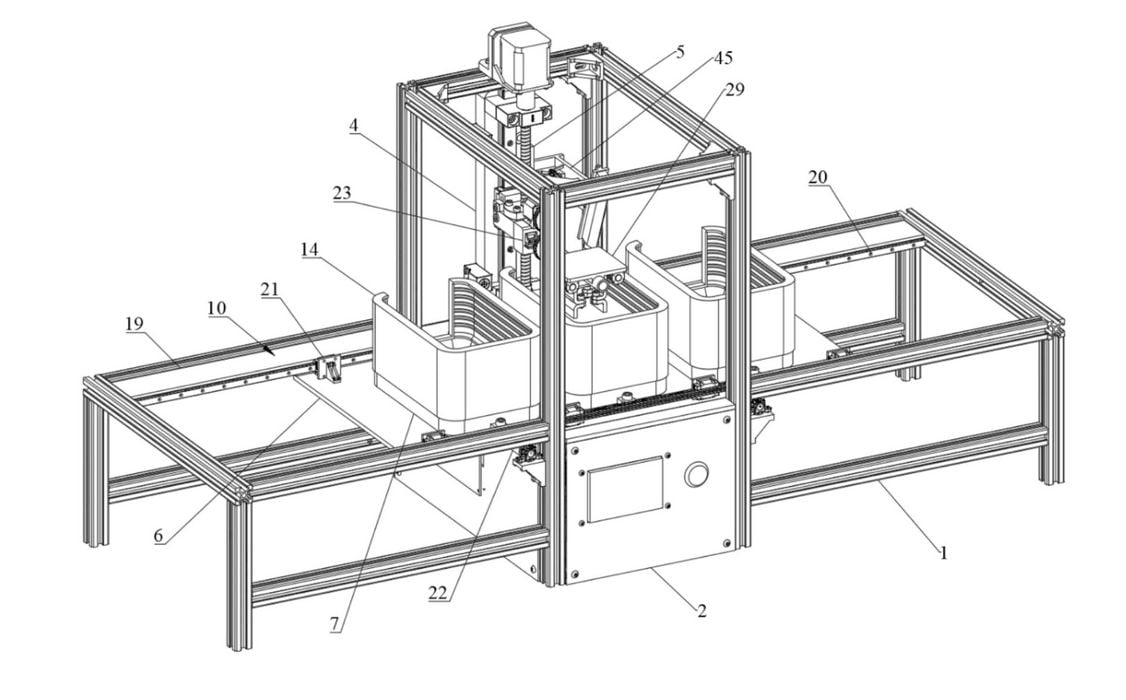
The Hefei Zhongjian design uses multiple resin boxes mounted at regular spacing on a moving print platform, as shown in the diagram at the top. A Z-axis system positions the build plate, while a light source in the curing chamber exposes the current layer. A switching mechanism moves the required resin box under the build plate when another resin is needed.
That part we’ve seen before. There are a few systems like this.
The more interesting bit is what happens during the material change.
The patent describes a build plate that can rotate 90 degrees after a layer or material segment is complete. The idea is to tilt the plate and model so that excess resin drips off the print and back into the original resin box rather than being carried into the next one.
Then a vibration generator shakes the build plate along a horizontal guide. This helps dislodge resin clinging to the model and the plate. After that, an air knife blows across the part and plate to remove remaining resin.
In other words, the system tries to clean the part — in mid-print — without using a liquid wash step.
A spray or wash system could work, but it would require pumps, plumbing, solvent or cleaning fluid, drying time, waste management, and generate contamination of its own. For a compact resin machine, those additions would become more complex than the printer itself. Here the patent describes a much simpler approach for cleaning loose liquid resin off a print during a job.
The patent also adds C-shaped shields around each resin box. These shields are intended to catch droplets generated during the air knife cleaning step. The inner surfaces include grooves for capturing and guiding resin back into the corresponding vat, while raised edges and hooks help block splatter.
Air knives are effective, but they can also throw toxic resin into places it should never go: optics, rails, motors, adjacent vats, and enclosure walls. And perhaps operators, too, if they are not careful.
This patent suggests a path toward fully unattended multiresin printing, something that I have not seen in the industry yet.
But there are still a lot of unanswered questions.
How clean is clean enough? A trace amount of rigid resin in a flexible region could mess up that portion. A small amount of coloured resin could be extremely visible in a transparent or light-coloured material. Deep holes, thin gaps, and textured surfaces may still retain resin even after rotation, vibration, and air blowing.
There is also the issue of time. Every material change would require lifting, rotating, draining, vibrating, blowing, repositioning, and then switching vats. That sequence may be acceptable for occasional material changes, but it could become painfully slow if used on every few layers. It reminds me of the delays that happen on filament swapping FFF systems when complex colour models are printed.
The mechanical complexity is also non-trivial. The patent includes motors, gears, rails, guide rods, springs, bellows, electromagnets, shields, an air knife, and positioning pins. That is a lot to keep aligned and resin safe. And it likely makes the machine more expensive to build and buy.
Multi-material resin printing has always looked attractive on paper, but contamination and cleaning have been operational barriers. Hefei Zhongjian’s patent does not prove the problem is solved, but it does show a possible solution.
Via Espacenet
