
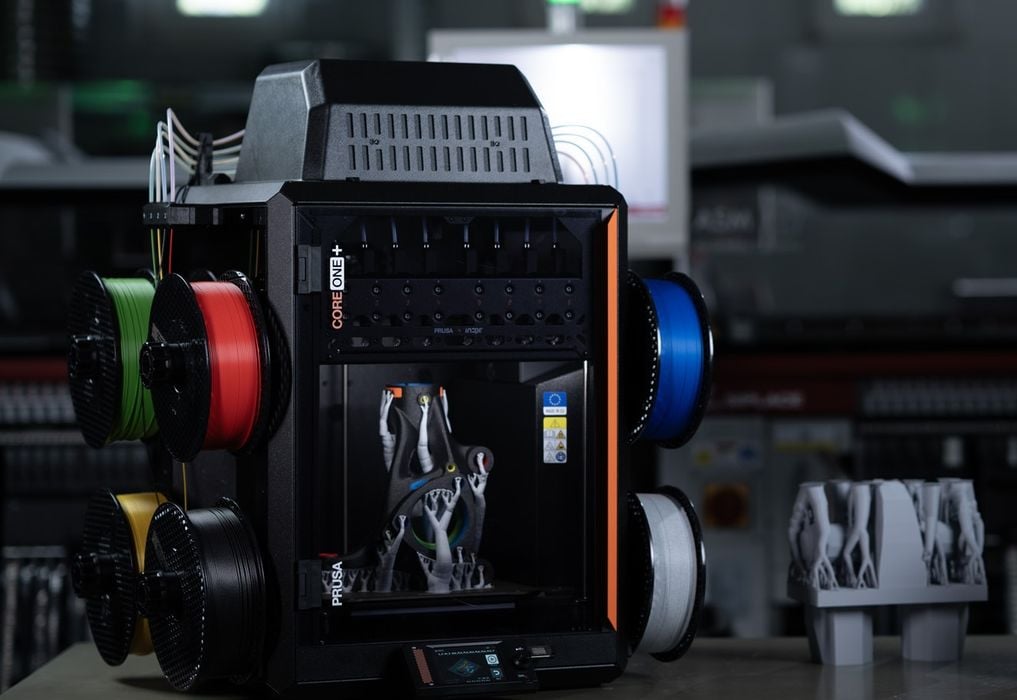
Prusa Research says Bondtech’s INDX Founder’s Edition is now shipping, and the standard INDX Conversion Kit for the Prusa CORE One+ is next.
The INDX technology is really interesting not only because of its ability to print without waste, but also because it offers a multi-tool upgrade path for an existing platform. Instead of doing multi-color with a single nozzle and long purge sequences, INDX uses up to eight toolheads, each with its own nozzle, parked in a dock and swapped in as needed. That approach is familiar to anyone watching the Original Prusa XL toolchanger, but the key here is packaging similar behavior as a conversion kit for the CORE One/+.
According to Prusa’s latest July 2026 status update, the Founder’s Edition units are “out in the wild” through Bondtech, while Prusa continues to tune the overall experience. The next milestone is shipping the standard conversion kit, with the first units scheduled to leave Prusa’s factory by the end of July and the full first batch targeted to ship by the end of August. Prusa notes that delays to the Founder’s Edition pushed this timeline back.
What Changed Since The INDX Reveal
Prusa says the biggest ongoing effort is software and profiles: improving PLA results, adding support for more advanced materials, and expanding nozzle diameter options. That matters with toolchangers because the tool swap mechanism is only half the battle; the slicer needs to deliver reliable tool change motions, purging behavior, and have material presets that do not require fiddling.
There are also hardware changes for improved day-to-day usability. A redesigned front docking panel is “less dense,” offering a clearer view into the printer and the parked tools. Visibility can be a real issue in enclosed 3D printers, especially when you are trying to confirm whether a tool is properly seated or diagnose a “misdock” without stopping a job.
More important is the new waste bin and silicone nozzle cleaner concept. Because INDX purges very small amounts during tool changes, Prusa says a conventional wipe tower would be unstable unless it purged far more material, and that goes against the low waste concept. Their alternative approach is to prime into a bin and physically wipe the nozzle, keeping the tip clean. Prusa also says firmware already includes a menu option for an “extended” waste bin, and a larger official design is being prepared to fit into a side panel location.
Waste, Calibration, And ColorMix
Prusa’s update focuses on waste comparisons, and for a good reason: purge waste is the achilles heel of many low-cost multi-color systems. In one comparison Prusa describes, a final 81.7g model could generate as much as 696.4g of waste on some machines using default vendor profiles. INDX, they claim, produced 29g of waste for that model. In another example, a “Rocket Engine” print produced nearly 30 times less waste on INDX than the most wasteful option, with the worst case cited at 842g of wasted filament.
These examples sound outrageous, but in fact they are very common. I’ve personally run into situations where the waste weighed 20X the weight of the final print. It’s not surprising Prusa is focusing on this aspect: it’s a big problem that 3D print operators are starting to recognize.
Prusa also provides a specific number for INDX purge output: the average “priming pellet” weight is around 0.013–0.015g. Those pellets are the small bits deposited in the bin to stabilize nozzle pressure before printing resumes. That priming step is essential for consistent surfaces across tool changes, but the implementation and amount required is what determines whether multi-color feels practical or painfully expensive.
Another notable addition is automatic tool offset calibration using what Prusa calls a Tool Offset Sensor board. Instead of relying on a calibration pin or a camera, their system uses an inductive sensor to scan in X and Y, with a Z reference calibrated using the printer’s loadcell. Prusa says it repeats scans multiple times at different speeds to reduce measurement lag error, and runs the calibration at every print start after a nozzle clean.
On the software side, Prusa lists updated EasyPrint and PrusaSlicer workflows that support ColorMix. ColorMix uses halftoning to create many tones from a limited set of filament colors, and Prusa suggests an eight-tool setup can cover the CMYKW spectrum plus RGB for a wide color palette. They also mention a Color Mix Shading app that can bake in virtual lighting effects, which we took a look at a few weeks ago.
Now the remaining question is execution: Prusa says it is resolving any remaining issues, pushing more PrusaSlicer profiles, and has already released firmware 6.6.1, with four more profiles “very soon.” The company did not provide pricing in this update, and the status note does not address every CORE One family variant timeline, so anyone looking to buy an INDX system will likely watch for clear messaging on compatibility and lead times as shipments begin.
Via Prusa Research
