
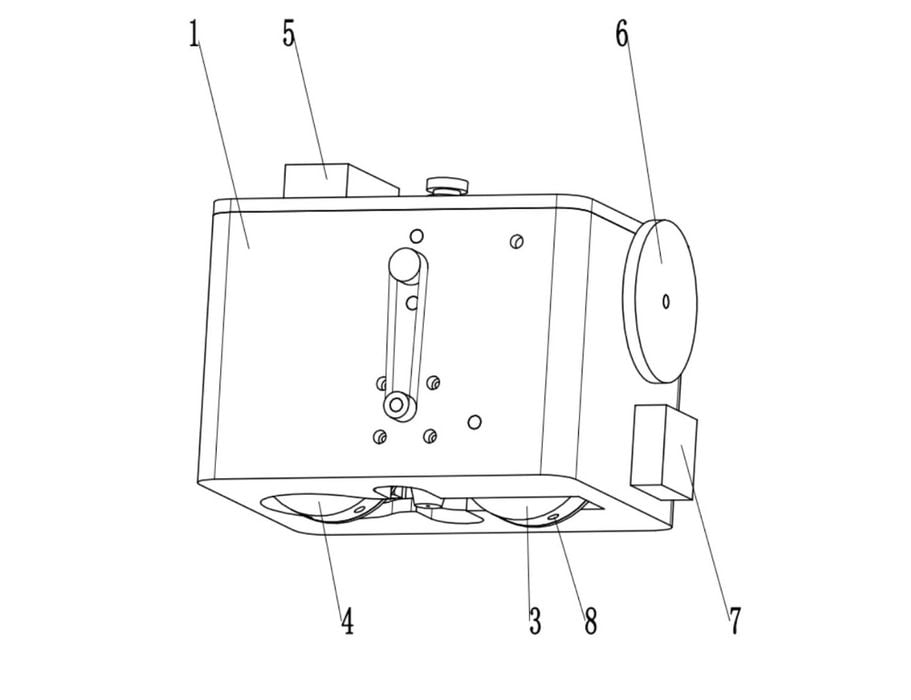
A Chinese patent application describes a crawling FFF 3D printer that can print beyond a fixed build volume.
The patent, CN122299925A, is assigned to North China Institute of Aerospace Engineering and was published on June 30, 2026. It describes what it calls a “crawling 3D printer”, essentially a mobile extrusion system that carries its own print head across the part being built.
The idea here is straightforward: instead of making the printer itself larger, make the printer move. That creates a much larger effective build volume.
Conventional FFF machines are limited by their gantry and motion system. If a part exceeds that mechanical volume, 3D printer operators have to split the model into sections, print those pieces separately, and then assemble them together afterwards.
That works, but it introduces seams, alignment errors, weaker joints, more manual labor, and a lot of finishing problems. Large format FFF machines avoid some of this, but they do so by becoming physically enormous, very expensive, and far less convenient to install.
This patent suggests a very different way to achieve a larger build volume.
A Printer That Walks On The Print
The proposed system includes a main frame, extrusion print head, drive wheel, steering wheel, and a balance wheel. The drive and steering wheels move the machine over the print surface, while the print head extrudes material as the machine follows the required toolpath.
In other words, the machine itself becomes part of the motion system.
Mobile 3D printing robots have been proposed before, and the concept always runs into the same problem: stability. If the printer is crawling across a newly printed structure, even a small tilt, slip, or vibration can ruin extrusion accuracy. How can the mobile printer always be in the correct position in 3D space?
The patent addresses this with a powered balance wheel. The balance wheel spins to generate angular momentum, and the document says this can provide an opposing torque when the main frame is subjected to a tilting moment. That should help keep the print head more stable as the robot moves.
There is also a vacuum adhesion concept. The drive wheel can include suction openings connected to a negative pressure pump. As the wheel rotates, openings can create suction against the support surface, improving traction and helping keep the machine attached to the layer below.
That is a pretty clever idea, at least on paper. The patent even describes internal wheel spaces and partitions so suction can be applied only where the wheel contacts the surface.
A crawling printer could theoretically produce very large FFF parts without requiring a giant gantry machine. That could reduce machine cost, facility requirements, and the need to divide large components into sections.
It could also lead to distributed or field manufacturing. A compact printer that can crawl across a large workpiece would be easier to transport than a large format machine.
But there’s a lot of potential issues. One is that the printed material must become strong enough quickly enough to support the printer. The patent notes that FFF material can harden rapidly and that cooling can be assisted by a fan, but real materials vary enormously. PLA, PETG, ABS, ASA, filled polymers, and high temperature materials all behave differently. I can’t see a thin bridge structure, for example, supporting a mobile printer. This implies the possible print geometries could be limited.
There are also serious software questions. A mobile printer would need much more complex path planning that accounts not only for extrusion, but also wheel placement, suction zones, machine balance, and avoiding unsupported areas. Standard slicers are not built for that, of course, so new software would be required.
This is therefore best viewed as a patent idea, not a product. If someone can make mobile extrusion stable and reliable, it could open a very different category of large format FFF.
However, I’m pretty skeptical that this concept can work, at least not without a ton of testing in a wide range of environments, geometries and materials.
Via Espacenet
