
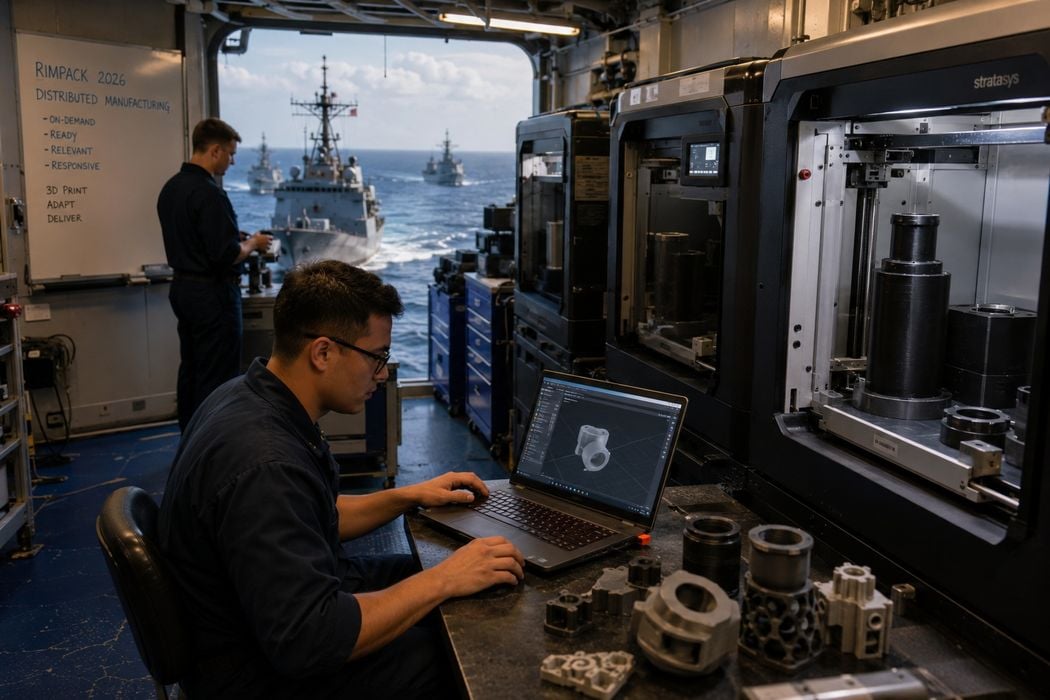
The US Navy is testing a new way to 3D print spare parts.
According to a report on Marine Insight, the technology was used in a rather different manner during the recent RIMPACK 2026 naval exercise.
Marine 3D printing attempts to leverage the on-demand capability of the technology. Normally, when a spare part is required, it has to be carried along the ship, occupying space and weight. If not, a part would have to be transported at great expense to the ship, or the ship would have to travel to a port where the part is available.
All of these are not great options. But then consider the possibility of using 3D printing: a ship could, in theory, print the spare part on site, short-circuiting the entire process.
There have been some commercial ventures attempting to do this, and that type of business is still evolving.
Here, however, we have the US Navy attempting something a bit more involved. The experiment involves placing a number of 3D printers in several ships at sea. The report says:
”This would function as a distributed factory network across several domains and assets.”
This is quite different from the initial scenario where each ship would have its own print facility. Here we have a network of printers, distributed across the ocean. The idea would be this: a part request arrives, and is then dispatched to the nearest ship that has the correct capabilities and availability.
This is quite analogous to how modern manufacturing networks operate. Network participants present their capabilities (3D printing processes, materials, finishing capabilities, etc.) to the network, which routes customer requests to them as appropriate.
In the US Navy scenario, the participating factories are actually mobile: it would actually be possible for the factory itself to deliver the part! However, I suspect in most cases parts would be flown from the nearest factory to the requesting ship.
This is definitely a case of a well-understood commercial pattern being adapted for military use. In these times, that’s not surprising.
What other commercial patterns might be adapted for military use?
Via Marine Insight
