Charles R. Goulding and Preeti Sulibhavi explain how renewed investment in U.S. shipbuilding is laying the foundation for a stronger defense supply chain powered by advanced manufacturing and industrial 3D printing.
America’s shipbuilding industry has spent decades in decline, losing market share, manufacturing capacity, and much of the skilled workforce that once made U.S. shipyards among the world’s most productive. Now, a combination of government policy, private investment, and renewed national security priorities is attempting to reverse that trend.
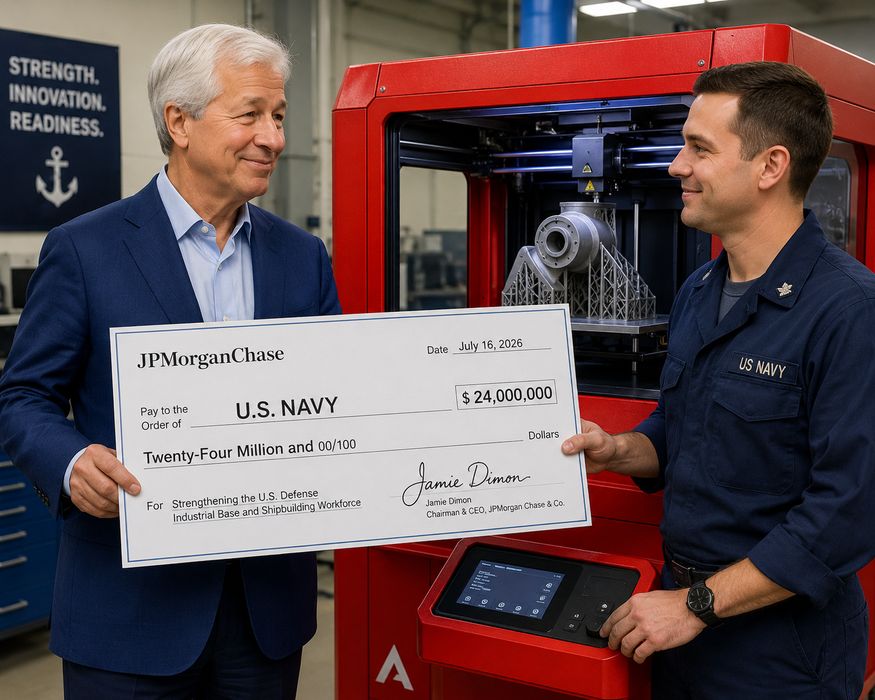
One of the latest developments comes from JPMorgan Chase, which recently announced a US$24 million commitment to strengthen Philadelphia’s shipbuilding workforce and reinforce the U.S. defense industrial base. The investment combines US$18 million in loans and investments with US$6 million in philanthropic grants, targeting workforce development, supplier growth, and new manufacturing capacity at the historic Philadelphia Navy Yard.
At first glance, this may seem like another financial story centered on defense manufacturing. However, beneath the headlines lies something much more interesting for the additive manufacturing industry. Shipbuilding is entering a period of modernization, and that modernization increasingly depends on digital manufacturing technologies, including industrial 3D printing.
A Manufacturing Ecosystem, Not Just a Shipyard
The JPMorgan initiative goes well beyond financing a single project.
Funding will support workforce training programs, apprenticeship expansion, access to capital for smaller suppliers, and regional collaboration throughout Philadelphia’s maritime manufacturing sector. Rather than simply helping build more ships, the initiative aims to rebuild an industrial ecosystem capable of supporting sustained naval and commercial ship production.
That ecosystem approach matters.
Modern shipbuilding involves thousands of suppliers producing everything from structural steel assemblies to electrical systems, pipe fittings, tooling, fixtures, and replacement components. Many of these suppliers are precisely the kinds of companies already adopting additive manufacturing to improve flexibility and shorten production cycles.
As supply chains become more localized, manufacturers that can rapidly produce customized components gain a competitive advantage.
How the Financing Will Work
More than 30 entities will spend about US$10 billion in defense technologies, research and development and job creation, President Donald Trump announced Wednesday, July 15, 2026, at the inaugural Pennsylvania Defense and Innovation Summit in Carlisle. Below is a table that represents the approximate distribution of the US$10 billion in investments.
Rhoads Industries is listed in the table below as the top investor and we will describe how this monumental investment will impact the shipbuilding industry further in this article.
| Companies | Investment (USD) | Number of new jobs | Category |
| Rhoads Industries and General Dynamics Electric Boat | $2.5 billion | 1,350 | Defense Industrial Base |
| Hanwha Philadelphia Shipyard | $1.5 billion | 2,000 | Defense Industrial Base |
| JP Morgan | $24 million | 450 | Defense Industrial Base |
| Day & Zimmermann | $2.3 billion | Not disclosed | Defense Industrial Base |
| EOS Energy Enterprises | Not disclosed | Not disclosed | Defense Industrial Base |
| JWF Industries | Over $500 million | 200 | Defense Industrial Base |
| Mack Defense | $221.8 million | Not disclosed | Defense Industrial Base |
| Air (formerly Govini) | $450 million | 40 | Defense Industrial Base |
| Attalon | $30 million | 100 | Defense Industrial Base |
| Kratos Defense | $7 million | Not disclosed | Defense Industrial Base |
| Karman Space & Defense | $2.7 million | 20 | Defense Industrial Base |
| Advanced Cooling Technologies | Not disclosed | 100 | Defense Industrial Base |
| Sphere Brake Defense | $4.5 million | Not disclosed | Defense Industrial Base |
| Acutronic Group | Up to $30 million | 100 | Defense Industrial Base |
| U.S. Metal Powders / AMPAL | $10 million | 15 | Defense Industrial Base |
| Firepoint Energy | Up to $2 billion | 50 | Defense Industrial Base |
| Qintel | $84 million | Not disclosed | Defense Industrial Base |
| Lockheed Martin | Over $60 million | 700 | Defense Industrial Base |
| Blade Diagnostics | Not disclosed | Not disclosed | Fielding Emerging Technology — AI, Autonomy & Space |
| Carnegie Robotics | Not disclosed | Not disclosed | Fielding Emerging Technology — AI, Autonomy & Space |
| Reflection | Not disclosed | Not disclosed | Fielding Emerging Technology — AI, Autonomy & Space |
| Voyager Technologies & Astrobotic | Not disclosed | Not disclosed | Fielding Emerging Technology — AI, Autonomy & Space |
| Deepwave Digital | Not disclosed | Not disclosed | Fielding Emerging Technology — AI, Autonomy & Space |
| Aalyria Technologies | Not disclosed | Not disclosed | Fielding Emerging Technology — AI, Autonomy & Space |
| Parallax Advanced Research & RIDC | $10 million | Not disclosed | Fielding Emerging Technology — AI, Autonomy & Space |
| Voicd | Not disclosed | Not disclosed | Fielding Emerging Technology — AI, Autonomy & Space |
| Re:Build Manufacturing | $81 million | 300 | Fielding Emerging Technology — AI, Autonomy & Space |
| Penn State | Not disclosed | Not disclosed | Building the R&D and Workforce Pipeline |
| Penn State National Security Institute | Not disclosed | Not disclosed | Building the R&D and Workforce Pipeline |
| University of Pittsburgh | Not disclosed | Not disclosed | Building the R&D and Workforce Pipeline |
| Trivedi Institute, University of Pittsburgh | Not disclosed | Not disclosed | Building the R&D and Workforce Pipeline |
| Carnegie Mellon University, Carnegie Foundry, ViDARR, and Envision Technolog | Not disclosed | Not disclosed | Building the R&D and Workforce Pipeline |
| Keystone Space Collaborative | Not disclosed | Not disclosed | Building the R&D and Workforce Pipeline |
| Voyager Technologies & Geisinger Health | Not applicable | Not disclosed | Building the R&D and Workforce Pipeline |
| Voyager Technologies & Penn State | Not disclosed | Not disclosed | Building the R&D and Workforce Pipeline |
| Lackawanna College | $20 million | Not disclosed | Building the R&D and Workforce Pipeline |
| QE Manufacturing & Bucknell University | $70,000 | Not disclosed | Building the R&D and Workforce Pipeline |
| Pennsylvania College of Technology & BAE Systems | $10,000 | Not disclosed | Building the R&D and Workforce Pipeline |
| U.S. Army AI2C & FUZE | Not disclosed | Not disclosed | Building the R&D and Workforce Pipeline |
| Southwest Pennsylvania Defense Ecosystem | Not disclosed | Not disclosed | Building the R&D and Workforce Pipeline |
The Rhoads Industries Connection
One of the largest beneficiaries of the announcement is Rhoads Industries, a long-established Philadelphia industrial manufacturer specializing in shipbuilding, heavy fabrication, machining, welding, industrial repair, and complex manufacturing services for both commercial and defense customers.
The company is constructing a 95,000-square-foot submarine manufacturing and assembly facility at the Philadelphia Navy Yard. The project is expected to create approximately 450 permanent jobs while expanding production capacity for submarine modules and related defense work. JPMorgan’s financing includes support for this facility as part of the broader investment package.
Although Rhoads Industries is best known for large-scale metal fabrication, its capabilities represent exactly the type of operation that can benefit from additive manufacturing integration.
Its work includes precision machining, complex assemblies, industrial engineering, heavy welding, modular construction, and advanced manufacturing services. These are areas where metal additive manufacturing is increasingly finding practical applications, whether through production tooling, replacement components, custom fixtures, or low-volume metal parts.
Industrial companies rarely replace conventional fabrication entirely with additive manufacturing. Instead, they incorporate 3D printing where it provides measurable advantages in cost, lead time, or production flexibility.
Shipbuilding Is Becoming Digital Manufacturing
Large shipyards have traditionally relied on extensive inventories of replacement parts, custom jigs, and specialized tooling.
Many of these items are expensive to store yet used only occasionally.
This is where additive manufacturing has already demonstrated value.
Rather than maintaining physical inventories, manufacturers can increasingly maintain digital inventories of qualified parts, producing components only when needed. This approach reduces warehouse costs while improving responsiveness for maintenance and repair operations.
The U.S. Navy has been exploring these concepts for years, evaluating additive manufacturing for onboard repairs, obsolete components, and rapid prototyping. Commercial shipbuilders have followed similar paths, particularly in Europe, where certified metal printed marine components have already entered operational service.
As Philadelphia’s shipbuilding capacity expands, opportunities for similar digital manufacturing workflows are likely to grow.

Workforce Development Also Benefits 3D Printing
One of the more interesting aspects of JPMorgan’s announcement is its emphasis on workforce development rather than simply infrastructure.
The initiative supports training programs for welders, electricians, pipefitters, machinists, and other skilled trades that remain in critically short supply across U.S. shipbuilding.
This focus aligns closely with broader trends in advanced manufacturing.
Today’s machinists increasingly work alongside CNC programming, robotic systems, digital inspection technologies, and additive manufacturing equipment. Engineers entering shipbuilding are more likely than previous generations to encounter hybrid manufacturing environments where conventional machining and 3D printing complement one another.
Training workers for modern shipyards therefore means preparing them for digital manufacturing workflows, not just traditional fabrication techniques.
Hanwha Adds Another Layer
The JPMorgan announcement also arrives amid a broader transformation occurring at the Philadelphia Navy Yard.
Following Hanwha’s acquisition of Philly Shipyard, the South Korean industrial giant announced plans to invest US$5 billion to dramatically expand production capacity, modernize facilities, and significantly increase annual ship output.
That level of investment changes the conversation.
Instead of isolated improvements, Philadelphia is beginning to resemble a growing maritime manufacturing hub with expanding opportunities for suppliers, technology providers, workforce training organizations, and advanced manufacturing companies.
As production scales, pressures to reduce lead times, improve supply chain resilience, and increase manufacturing flexibility also increase.
Those pressures are exactly where additive manufacturing performs best.
Defense Manufacturing Is Driving Innovation
Much of the current investment stems from renewed concern about the health of America’s defense industrial base.
Industry analysts note that the United States now produces only a tiny fraction of the world’s commercial ships, while demand for naval vessels continues to rise. Labor shortages, aging infrastructure, and fragmented supply chains have become strategic concerns.
Private-sector investment has followed.
JPMorgan’s broader Security and Resiliency Initiative commits up to US$1.5 trillion over ten years toward sectors considered strategically important, including advanced manufacturing, critical materials, aerospace, energy, and shipbuilding.
For additive manufacturing companies, this creates an environment where innovation increasingly aligns with national priorities.
Whether producing lightweight metal components, rapid tooling, replacement parts, or digitally managed inventories, additive manufacturing supports many of the resilience goals now driving industrial investment.
The Research and Development Tax Credit
The developments described may create opportunities for some of the companies involved – including Rhoads – to evaluate whether portions of their work could qualify for federal R&D tax credits under IRC § 41.
In general, the IRC § 41 research credit may apply when a company undertakes qualified research to develop or improve a product, process, technique, formula, invention, or software component. In practical terms, qualifying work often involves trying to resolve technical uncertainty – such as whether a design can meet performance requirements, how to manufacture a component more efficiently, or which materials or methods will work best. The company generally must use a process of experimentation, such as modeling, prototyping, testing, evaluating alternatives, or refining designs, to reach a technological solution. These concepts are reflected in the IRC § 41 qualified research framework.
For companies involved in advanced manufacturing, shipbuilding, workforce pipeline development, or related technical initiatives, potentially eligible costs may include certain employee wages, supplies consumed in development or testing, pre-production testing costs, and qualifying contract research expenses.
However, eligibility depends on the specific facts, supporting documentation, and contract terms. In particular, partner- or customer-funded work may require analysis of the funded research rules, including whether payment is contingent on success and whether the company retains substantial rights in the research. Companies should consult a qualified tax professional for advice tailored to their specific activities, records, and agreements.
An Opportunity Beyond Shipbuilding
The Philadelphia initiative should not be viewed simply as a local economic development project.
Instead, it represents part of a larger effort to rebuild domestic manufacturing capability through coordinated investment in infrastructure, suppliers, workforce development, and industrial technology.
Historically, periods of industrial expansion often accelerate manufacturing innovation. New factories adopt newer production methods because they are building processes from scratch rather than replacing decades-old workflows.
That creates opportunities for additive manufacturing suppliers, software developers, materials companies, and service bureaus to become part of the next generation of American shipbuilding.
The ships themselves may still rely primarily on steel plate, welding, and traditional fabrication. But the tools used to build them, the replacement parts that keep them operating, and the digital manufacturing systems supporting the supply chain are becoming increasingly sophisticated.
For the 3D printing industry, JPMorgan’s US$24 million investment is less about banking and more about where advanced manufacturing is headed. As shipbuilding evolves into a more digitally connected manufacturing ecosystem, additive manufacturing is well positioned to become one of the technologies helping power that transformation.