
Rutgers researchers report a deep learning method that spots LPBF meltpool anomalies in real time.
Laser Powder Bed Fusion (LPBF) works when the meltpool is consistent throughout the print job, and it’s notoriously sensitive to geometry, heat buildup, and the scan strategy. When the meltpool runs too cold metal doesn’t fuse enough; if it’s too hot, you risk keyholing. Both phenomena usually appear only after the build.
The obvious question is whether we can catch these conditions early enough to correct them. Many metal systems already ship with some form of meltpool monitoring, but operators still struggle with data overload, uncertain signals, and need automatic, trustworthy control actions that can recover when something goes south.
Enter a study from Rutgers University’s Manufacturing and Automation Research Laboratory led by Tuğrul Özel. The team trained convolutional neural networks (CNNs) to classify meltpool states from high-frame-rate, off-axis camera footage on an EOS M270 running nickel alloy 625. This is actually a smarter use of video you can already capture on many LPBF systems.
Inside The Monitoring Stack
The setup used a visible-light Photron camera positioned off-axis at roughly forty-four degrees, capturing up to a huge 24,000 frames per second. The build ran at 182 W laser power and 800 mm/s scan speed, with 0.10 mm hatch and 0.02 mm layers, yielding a volumetric energy density of 113.75 J/mm3. A fixed region of interest was analyzed to avoid tracking the scan path, simplifying compute but introducing some perspective distortion that the authors corrected with some calibration.
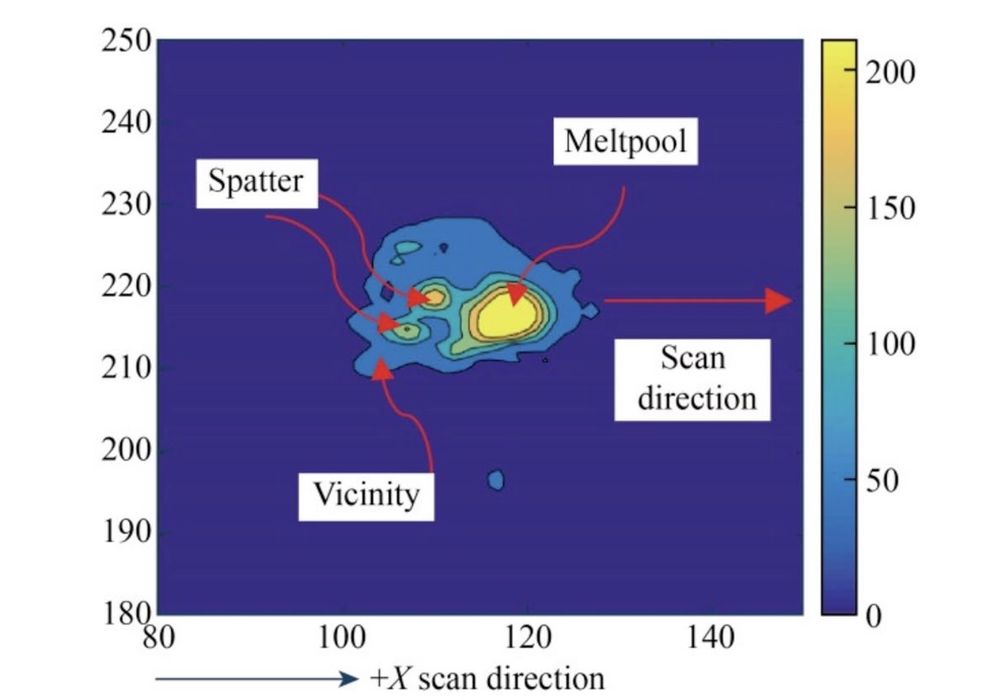
Images were denoised and segmented into meltpool core, plume, and spatter using multi-thresholding and maximally stable extremal regions. The neural network was fine-tuned on a labeled dataset of 1,500 meltpool images, extracted features that fed a support vector machine (SVM) classifier. The model sorted frames into three buckets: normal, underheated (low density), and overheated (high density/keyhole prone). Reported accuracy hit 97.87%, with strong precision and recall across all classes and area-under-curve values above 0.98.
This workflow should flags images that correlate with porosity modes. The researchers argue it is ready to sit in a real-time loop that nudges energy input when a drift is detected. For example, briefly reducing power as heat accumulates deep in a part, or adding energy in a region.
Nothing here is wired into a machine’s parameter controller yet. Their classification algorithm can run quickly, but the paper notes that some measurements are slower than the video stream. The suggested compromise — compute heavy features only on flagged frames — makes sense, but one wonders how easily this could be integrated into a commercial metal LBPF system.
A robust, camera-only classifier that reliably distinguishes conduction from emerging keyhole behavior could reduce operator effort, reduce destructive testing, and shorten parameter development time.
This method just might be another way to increase print quality on future metal systems.
Via Springer
