
A new doctoral study proposes a comprehensive quality control framework that could make concrete 3D printing considerably more predictable.
Concrete additive manufacturing can produce large structures with unusual geometries while reducing formwork and potentially manual labor. But printing a wall is only useful if the resulting wall actually matches the digital model closely enough for construction.
That is the problem tackled by Karam Mawas at Technische Universität Braunschweig. His 2026 dissertation examines quality control for extrusion based concrete printing and Shotcrete 3D Printing (SC3DP), focusing on non destructive optical inspection.
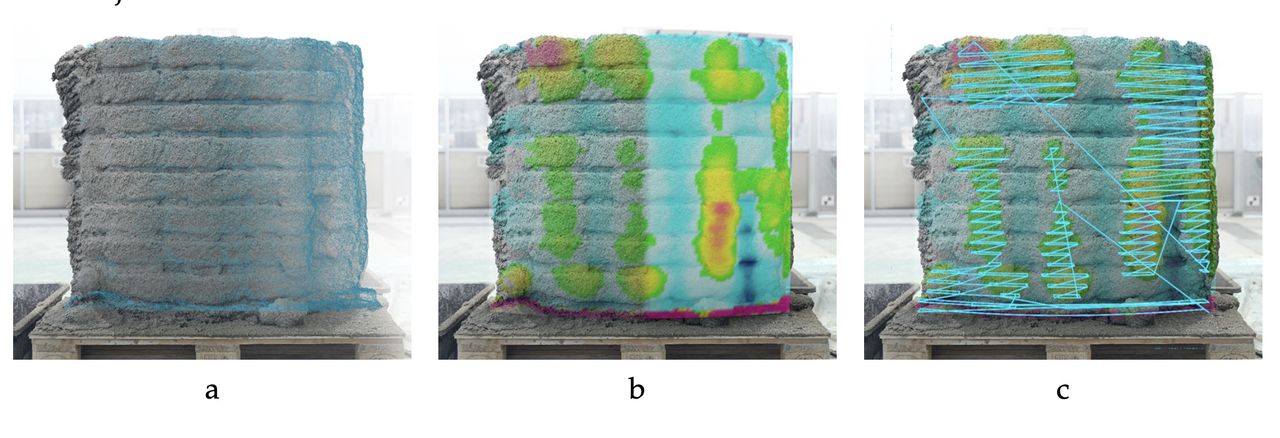
Instead of inspecting a completed component immediately before delivery, Mawas proposes a cyclical process. Inspection can occur during printing, after layers are deposited, before assembly and during assembly. Measurements are then compared with BIM or fabrication models so problems can potentially be detected much earlier.
That could be pretty important because discovering a dimensional problem after several tonnes of concrete have been deposited is an expensive way to perform quality control.
One particularly interesting element is automatic registration between the physical object and its digital counterpart.
Mawas mounted a terrestrial laser scanner on a robot and established transformations between the scanner, robot Tool Center Point and model coordinate systems. This allows captured point clouds to arrive already positioned relative to the intended geometry, reducing manual registration work.
The resulting geometry can then be analyzed using Cloud to Cloud, Cloud to Mesh and M3C2 comparison techniques. Mawas found M3C2 generally produced better results when large deviations were present, although it requires parameter tuning. Cloud to Mesh is easier to deploy, but can overlook certain missing features on continuous surfaces.
This sounds rather technical, but the implication is straightforward: the printing system can automatically ask, “Did I actually build what the CAD model specified?”
The research also goes down to the individual deposited filament.
An earlier computer vision approach achieved an average precision of 76% when identifying filaments in a shotcrete wall. However, its fixed processing window struggled with discontinuous filaments and more complicated geometry.
Mawas therefore developed a sensor agnostic deep learning workflow using a small YOLO11 segmentation model. RGB images can be processed directly, while point clouds from structured light scanners, photogrammetry or TLS are projected into images using a virtual camera.
This is quite clever because the same analysis pipeline can consume data from multiple sensing technologies. Tests included extrusion and shotcrete samples, fresh and cured materials, concrete and clay.
Processing required about 13 milliseconds per image, equivalent to approximately 76 frames per second. That is easily fast enough for online monitoring. However, the test results were far from perfect: the better SGD model achieved a mask mAP50 of 0.4541, and perspective distortion remained problematic. More training data is clearly required.
There is also an important metrology lesson here. Different sensors cannot simply be substituted without considering fabrication tolerances. In experiments using a ±1 mm total tolerance, photogrammetry and handheld structured light generally met requirements, while TLS did not. Sensor choice therefore depends on object size, required accuracy, environment and budget.
The long term destination is closed loop construction printing, where inspection results update the digital model and eventually influence robot operation while fabrication continues.
That could be the real breakthrough: concrete printers that do not merely deposit material, but continuously check their own work.
Via OpenAlex
