
Ford is looking at something much more interesting than 3D printing another automotive part.
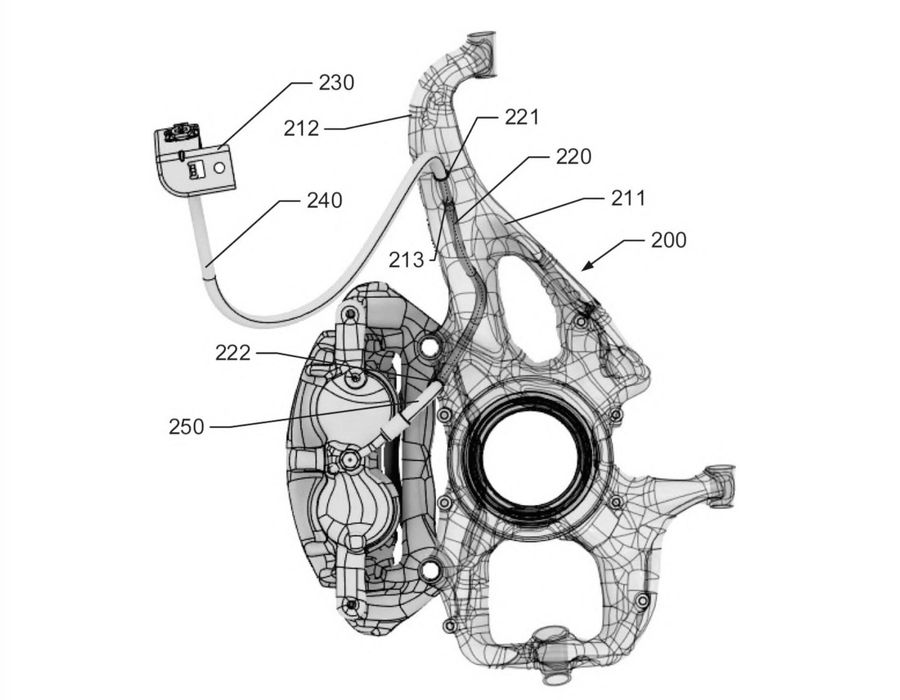
Patent DE102026105285A1, assigned to Ford Global Technologies, describes additively manufactured suspension parts. The patent describes suspension parts with fluid passages built directly into their structure. The examples include steering knuckles and control arms carrying brake fluid or coolant through internal channels.
That is a significant change in how such parts could be designed.
Normally, a suspension component does one job while hoses, tubes, brackets, clips and fittings handle another. Ford’s concept begins combining those functions into a single manufactured object. No hoses, tubes, brackets, clips or fittings!
The patent describes forming part of the suspension component, creating the internal fluid channel, and then continuing the build until the passage is completely enclosed.
The resulting part could route hydraulic brake fluid through a steering knuckle, for example, greatly shortening the external brake line. Ford notes that suspension movement can reach as much as 15 inches, so reducing the amount of flexible plumbing around those moving components could simplify the entire assembly.
Another example puts coolant passages through a control arm to feed an electric motor or another nearby system.
Ford even considers changing the diameter of the internal passage along its route. A larger section could hold additional fluid and act as a buffer against pressure fluctuations.
Parts That Don’t Exist Without AM
Automotive companies have used additive manufacturing for prototypes, tooling and specialized production parts for years. But those applications often involve replacing something that could, at least theoretically, have been manufactured another way.
Ford’s proposed suspension components are very different.
A load bearing steering knuckle containing a curved hydraulic passage buried deep inside the structure would be extremely difficult to manufacture conventionally as a single piece. Add embedded sensors, wiring and additional internal features, and conventional manufacturing becomes even less realistic.
Ford describes exactly that possibility in the patent.
The manufacturing system could use several printing operations or a machine with multiple deposition systems. One stage could produce the structural material, another could form internal features, and conductive ink printing could potentially add electrical circuits.
Sensors could also be embedded during production. The patent specifically discusses strain sensing that could measure forces acting on the suspension and send that information to vehicle control systems.
Now the suspension component starts becoming something considerably more sophisticated than a forged or cast piece of metal.
It could simultaneously carry structural loads, transport fluids, contain wiring and monitor its own operating conditions. This is the kind of advanced design we’ve always wanted to see with additive manufacturing.
A Bigger Automotive AM Step
The really interesting point here is where this could lead.
Automotive manufacturing operates at enormous volumes, which has traditionally made slower additive processes difficult to justify. Casting, forging, stamping and machining remain extraordinarily efficient when millions of identical parts are required.
But AM changes the equation when the part itself becomes impossible to make using those processes.
If Ford engineers begin designing production vehicles around internally routed fluids, embedded sensors and integrated electrical features, additive manufacturing stops being an alternative manufacturing method.
It becomes a required one. That would be a major shift.
Instead of asking whether a 3D printed component can economically replace a forged suspension part, the question becomes whether the vehicle’s design requires capabilities that only additive manufacturing can provide.
Ford’s patent suggests its engineers are thinking seriously about that AM-flavored future.
And once vehicle designs begin depending on AM exclusive geometries, there may be no way back to conventional manufacturing.
Via Espacenet
