
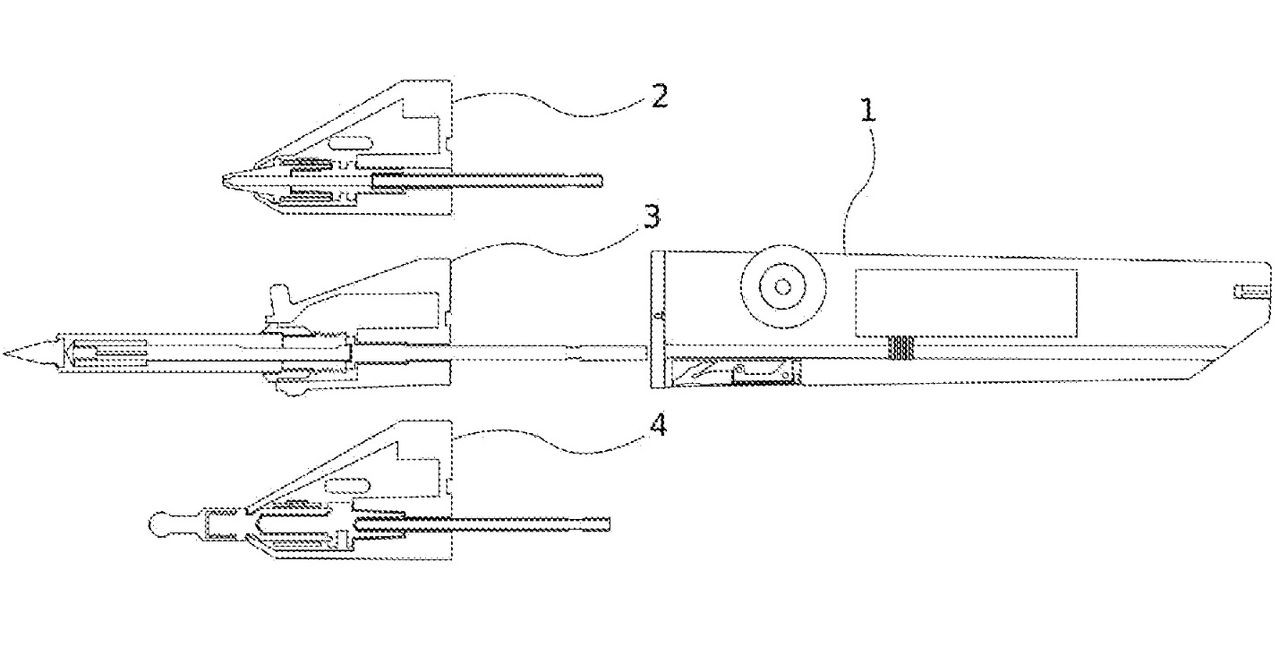
Prusa has filed a patent a handheld multitool intended specifically for repairing and finishing 3D prints.
International patent publication WO2026166569A1 describes what is essentially a powered handle with interchangeable heated tool heads. The application was published on 13 August 2026. The assignee is Prusa Development.
Hold on, is that the same as Prusa Research, the company we all know that manufactures 3D printers?
It is. The company is actually split into four parts: Prusa Development a.s., Prusa Manufacturing a.s., Prusa Polymers a.s., and Prusa Research a.s., and this patent is assigned to the development arm.
The idea in the patent immediately caught my attention because 3D print repair is still pretty medieval. When an FFF print has a crack, seam, small gap or damaged feature, the usual solution involves some combination of a soldering iron, 3D printing pen, glue, filler and considerable improvisation. Or just reprinting the item entirely.
Prusa Development’s concept would put several of those functions into one purpose built device.
Three Tools In One Handle
The patent describes three interchangeable heads: a filament extrusion head, a soldering head and a smoothing head.
The main body contains the filament movement mechanism, controls and power system. Swap the head, and the same handheld device changes jobs.
The extrusion head is effectively a compact 3D printing pen. Filament runs through the body and into a heated extruder, allowing an operator to deposit additional material into gaps, cracks or missing regions.
The soldering head takes a different approach. It uses a heated solid tool that can locally melt existing plastic, presumably allowing cracks or separate printed components to be fused together.
The smoothing head uses a heated forming tool that can be pressed against a surface to reshape or smooth printed material.
Those three tools together could be pretty useful. Instead of reaching for three different tools, an operator could repair a damaged print, add material and then clean up the resulting surface with the same device.
There is more engineering here than just attaching different tips.
The patent describes different mechanical structures for the heads because their loads aren’t the same. The extrusion and smoothing heads use a C shaped longitudinal channel. This provides a passage for filament where required and also accommodates thermal expansion.
The soldering head instead uses a solid metal rod. That makes sense because a soldering operation can involve considerable sideways force as the operator pushes the hot tool against a part.
The extrusion channel is also open along its length, making stuck filament and residue easier to remove. It seems they’ve thought this design through.
Faster Tool Changes
There’s another interesting detail involving cooling.
For the extrusion and smoothing heads, the patent specifies that more than 50% of the heating element’s outer surface should remain exposed. This allows heat to dissipate rapidly when the tool is switched off.
For extrusion, faster cooling could produce a cleaner end to deposited material. For smoothing, it could reduce the time an operator must wait before safely removing or exchanging the head.
The big question is whether Prusa intends to turn this into an actual accessory product. As this is merely a patent document, there’s no pricing, product name or production schedule. In fact, Prusa may NEVER create a product from this design.
There is also an interesting wrinkle in the patent history. The international search report lists Korean patent KR20220023278A as particularly relevant to all five original claims in the patent. It seems that a Korean company had previously patented something similar to this concept back in 2022, and the patent examiner flagged it. Prusa’s patent claims were later amended, with the revised first claim adding more specific geometry for the interchangeable head connector. Presumably the amendment was to make their patent sufficiently different from the Korean patent.
I could easily imagine this type of device finding a place beside an FFF 3D printer. Failed prints aren’t always completely failed, and increasingly expensive or large prints can be worth repairing rather than restarting.
An effective 3D print repair tool might become a new item on the Prusa product shelf.
Via Espacenet
