
What if a metal printer could use the molten metal itself as both the printing material and the actuator?
That is the unusual idea in a recent Lawrence Livermore National Security, LLC patent application, WO2026173624A2, titled “Z-Pinch Magnetohydrodynamic Metal Jetting.” The filing describes a liquid metal jetting system that produces droplets by sending a high-current pulse directly through the metal.
The Molten Metal Becomes Its Own Magnetic Pump
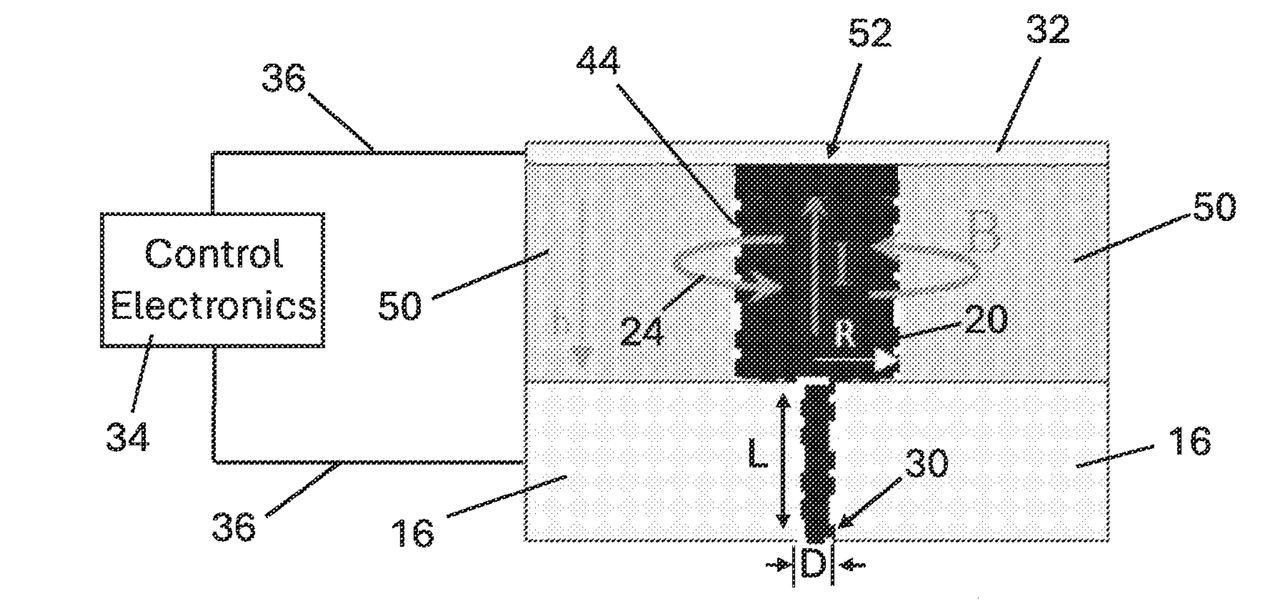
In a typical liquid metal jetting design, the difficult part is generating a fast, repeatable pressure pulse. The application proposes creating that pressure inside the molten metal column instead of pushing it with a conventional piston, pneumatic system, permanent magnet, or external conductive coil.
Two electrodes contact the liquid metal at opposite ends of a narrow pressure chamber. When control electronics deliver a current pulse, the current flowing along the metal creates a magnetic field that circles the column. The field interacts with the current and produces radially inward Lorentz forces.
Those forces squeeze the metal from the sides. Because the liquid is largely incompressible, the compression generates pressure along the chamber. A small orifice positioned downstream then receives the pressure pulse and ejects a metal droplet.
For someone standing beside the machine, the sequence would be simple: keep a reservoir of molten metal hot, allow it to fill the pressure chamber, and fire an electrical pulse whenever a droplet is required. The document discusses current pulses ranging from 50 to 2,000 amps and pulse durations from 0.1 to 10 milliseconds. One example uses roughly 100 amps for about 0.5 milliseconds.
The proposed droplet size is tied to the orifice, with claims covering droplets from 0.05 to 1 millimeter. The application estimates that the small temperature rise from Joule heating should decay over a few milliseconds, allowing droplet frequencies in the hundreds of hertz in some implementations. Those are described operating targets, not reported production results.
A Tiny Valve Handles The Refill Problem
The more interesting mechanical detail appears in the refill system. Several versions described use a reservoir connected to the pressure chamber through one or more fill lines. Since the chamber is being pulsed, the designers want metal to flow into it without sending pressure back into the reservoir.
The proposed passive fill valve is made from shaped internal walls and an inserted central component. Together they form a narrow, zigzagging channel. The contours are intended to let metal move from the reservoir toward the chamber while making reverse flow more difficult. Curved dead-end extensions give liquid entering the wrong direction a path that turns it back toward the main channel.
That approach avoids putting a conventional moving valve directly into a hot, reactive liquid metal path. It also adds a small precision fluidic structure that must remain open, sealed, and dimensionally stable at temperature. The application mentions insulating chamber walls, copper gaskets or o-rings, external or embedded heaters, and optional gas pressure to assist filling.
Their claimed architecture could make a compact droplet generator possible because it does not require a large magnet or actuator around the hot zone. The tradeoff is a demanding electrical and materials problem: electrodes must carry short pulses of hundreds of amps while maintaining reliable contact with molten metal, and the chamber must survive heat, corrosion, leakage, and repeated pressure cycling.
For metal additive manufacturing, the appeal is precise placement of small volumes without relying on powder. A printer could potentially build parts from alloys such as tin, indium, gallium, aluminum, copper, or other metals listed in the filing, although each material would bring its own melting, wetting, oxidation, and solidification issues.
WO2026173624A2 could be extremely interesting in the future. If this can be miniaturized, one could see a kind of “inkjet print head for metal”, which would itself open up a whole new universe of metal 3D printers.
Via Espacenet
