Bambu Lab has confirmed they are releasing a 3D scanner.
After our sneak peek at an FCC listing a few weeks ago, we knew that something was up at Bambu Lab. The FCC listing showed a diagram of what appeared to be a handheld device called a “DS001”.
Now we know for sure that the device is actually called the S1, since the company just released some information about the “Bambu Lab S1 3D Scanner”.
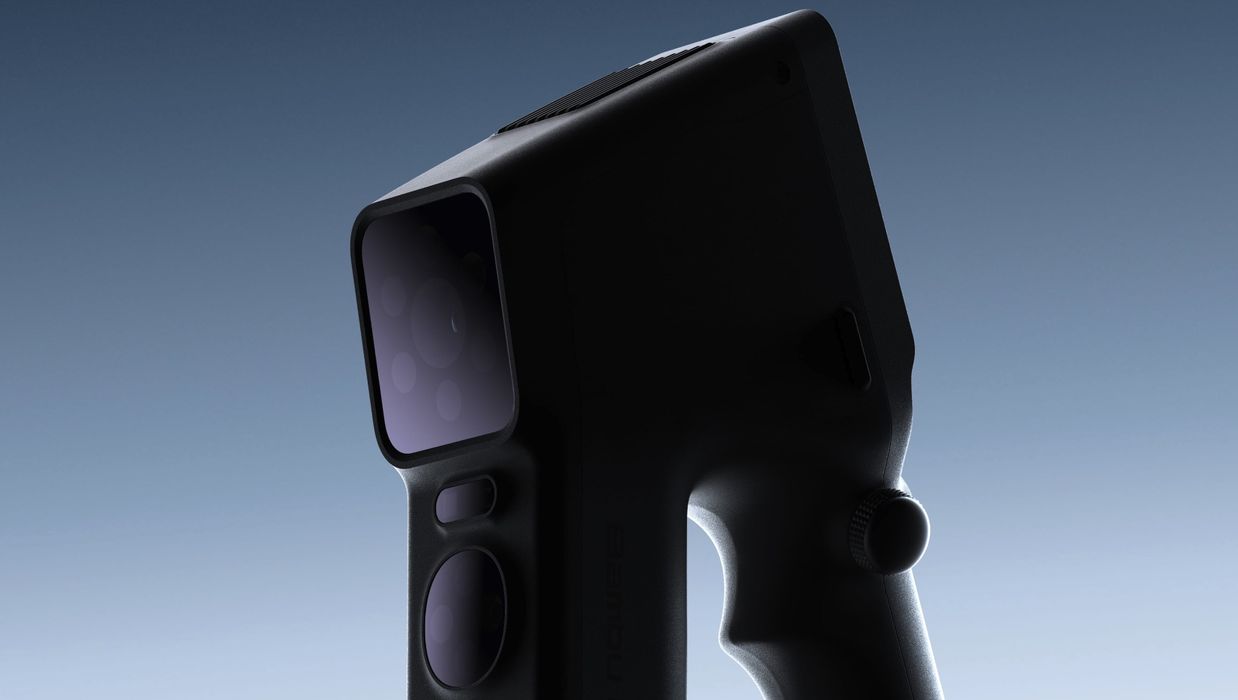
When I say “information”, I am being generous. Literally all they provide is a half-image of the device and this text:
“Bambu Lab S1 3D Scanner
Easy in Hand. Pro in Every Scan.
November 2026 Coming soon”
Sigh. I guess we’ll have to wait until November to learn all the details.
My analysis of the FCC filing suggested that:
- It’s a handheld 3D scanner (now confirmed)
- It could use dual scanning technologies
- It’s probably fully standalone (no PC required)
Is there anything we can learn from the image? It’s definitely not the greatest image, and it’s only half of the device. Let’s take a closer look.
The front of the scanner is on the left, and we can see quite a few sensors. In the main glassed-in window there is a single large central item, perhaps a camera, and six smaller items around it. These may be light sources for structured light 3D scanning, for example.
Below the main area there are more items. These could be for lasers or cameras. What is clear is that it is almost certainly a dual-mode 3D scanner. This means it combines two or more types of 3D scanning approaches, for example laser and structured light. Both have advantages and disadvantages, but a device that has both has all of the advantages.
We can’t see it, but at the top right there is clearly a square housing that must hold a touchscreen for operation of the S1.
There is also what appears to be a control knob on the right-hand side of the handle. It looks like something you could rotate, as there are some grippy textures on it. This could be a thumbwheel that you’d use to adjust settings on the S1 during operation.
This does not confirm, but supports the notion of the S1 being able to operate completely standalone from a PC: you’re adjusting things ON the device, rather than on the PC.
At the top, we can see some vents that presumably release hot air from the considerable processing taking place inside. That also provides some confidence that this is a standalone 3D scanner.
By the way, standalone 3D scanners are desirable not only because you don’t need a PC, but also because there would be no wires constraining your movements when operating the scanner. However, standalone 3D scanners tend to be heavier and can be tiring to use for big scan jobs.
That’s about all I can wring out of this half image. We’ll learn more next month, and probably see the device in person at Formnext.
Via Bambu Lab