
A new study from Romania turns discarded Scots pine cones into PLA filament and finds that the best recipe uses a surprisingly small amount of forest waste.
From Forest Floor to Filament
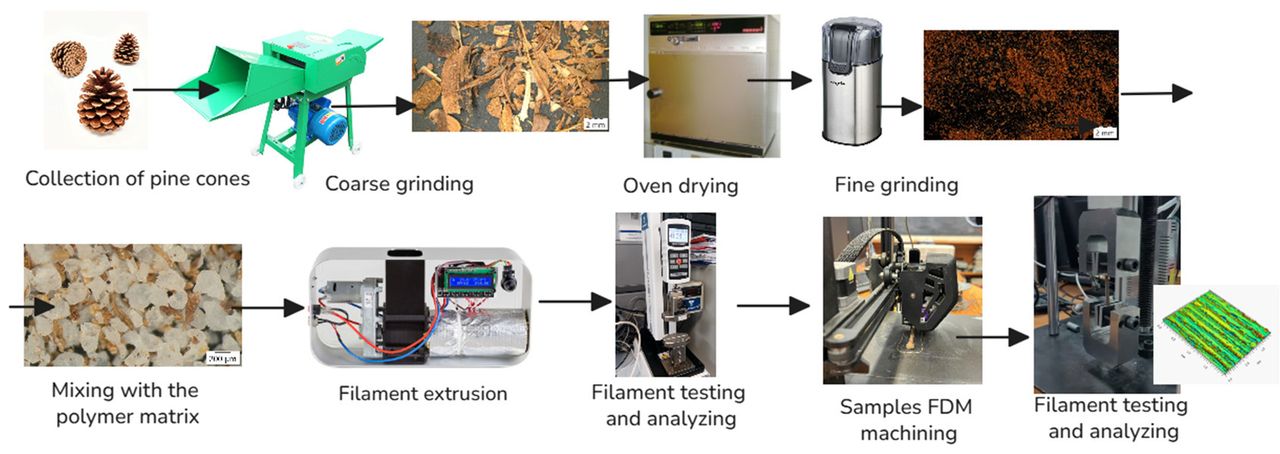
Published August 27 in Sustainability, the study by Irina Beșliu-Băncescu, Florin Ursachi and Gelu-Marius Rotaru of Ștefan cel Mare University of Suceava examines a straightforward idea: grind pine cones into flour and mix the powder with PLA, the familiar plastic used in many desktop 3D printers.
The cones came from the Suceava region of northeastern Romania. The researchers dried them, ground them and kept particles between 125 and 180 micrometers. They then made two versions of the material, containing 5% or 10% pine cone flour by weight.
The mixtures were heated and pushed through a small single-screw extruder to make 1.75-mm filament. The team reported that attempts to go above 10% caused thicker, less manageable material, clumping and clogging at the nozzle. This means there was a limit to how much pine cone the process could handle.
They printed test pieces on a Creality Ender 3 V2 using fused filament fabrication (FFF). The parts were made solid, with a 0.2-mm layer height and a 25 mm/s print speed.
The Sweet Spot Is Five Percent
The lower loading performed better in most of the tests. The 5% filament had an average tensile strength of 21.06 MPa, compared with 18.51 MPa for the 10% version. Its elongation before breaking was also higher: 7.35%, versus 4.69%.
The researchers believe the untreated pine flour behaves more like a filler than a reinforcement. Pine biomass attracts moisture, while PLA is comparatively water-resistant, so the two materials may not join together tightly. That mismatch can leave tiny gaps around the particles, creating weak points when the filament is pulled. The paper presents this as a likely explanation, not a directly measured finding.
Printing weakened both materials further, as usually happens when a solid filament becomes a part made from many deposited roads. The 5% specimens reached roughly 18 MPa and the 10% specimens about 14.5 MPa, retaining approximately 85% and 79% of their original filament strength.
The printed samples appeared slightly more stretchable than the raw filament, but that result needs caution. The researchers measured movement from the testing machine rather than using an optical strain gauge, and only three printed specimens were tested for each formulation. The authors therefore describe the results as preliminary.
The surface results were mixed. The 10% material produced somewhat smoother sides, possibly because the added particles changed how the melted plastic spread after leaving the nozzle. Its top surfaces, however, were rougher, with more visible bumps and irregular gaps. The 5% material produced a cleaner filament and a more consistent printed surface.
That gives the pine cone material a pretty sensible, but limited, role. The 5% version could be good for decorative objects, architectural models, light-duty packaging and other parts that do not carry serious mechanical loads. It is not ready to replace conventional engineering filament, and the study did not include a neat-PLA control made under the same conditions, so its strength comparisons should not be treated as a head-to-head product test.
The next step is to improve the process between the pine and the plastic. Washing, dewaxing or adding a coupling agent might help the particles stay bonded to the PLA, but that would add processing steps and cost. Larger print batches, direct measurements of internal voids and more detailed examination of broken parts would also be needed.
For now, the result is straightforward: pine cones can enter the FFF material formulation, but just leave most of the pine cone out.
Via Sustainability
