Charles R. Goulding and Preeti Sulibhavi look at OTTAVA’s evolution from surgical robotics to intelligent healthcare automation, and why the 3D printing industry should be watching closely.
For more than two decades, robotic surgery has largely meant one thing: da Vinci.
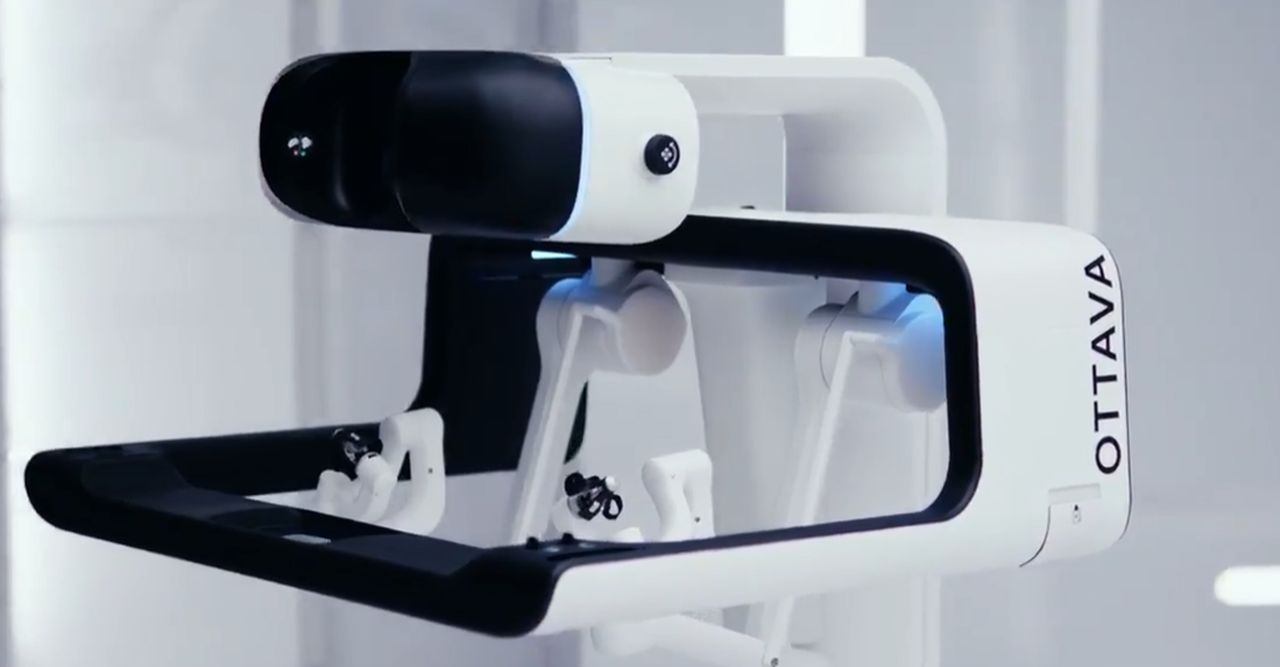
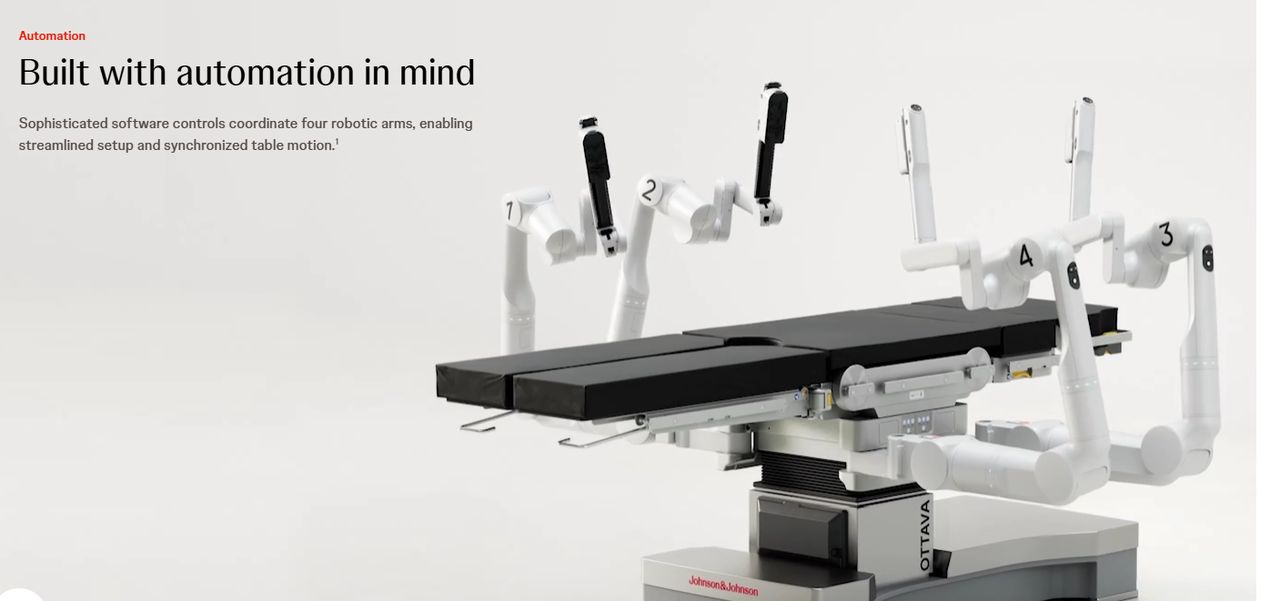
That may be changing. On July 22, 2026, Johnson & Johnson received FDA De Novo authorization for OTTAVA, a soft-tissue surgical robot that takes a radically different approach to the operating room. Rather than rolling a large robotic cart up to the patient, OTTAVA integrates four robotic arms directly into a standard-size operating table. J&J calls it the world’s first table-integrated soft-tissue robotic system.
For the 3D printing industry, this story is about much more than another medical robot. It points toward a future in which robotics, artificial intelligence, sensing, digital twins and advanced manufacturing converge around the physical delivery of healthcare.
J&J’s Long Road Into Surgical Robotics
The roots of J&J’s involvement in robotic surgery go back to the early 2000s, when its Ethicon organization and related businesses had relationships with the emerging da Vinci ecosystem. But J&J was not yet a direct competitor in robotic surgery.
That changed as da Vinci became increasingly dominant. According to a 2026 Delaware Supreme Court opinion concerning J&J’s acquisition of Auris Health, the company came to view robotic surgery as strategically important because hospitals adopting da Vinci were buying Intuitive’s instruments instead of traditional surgical instruments from Ethicon. J&J considered Intuitive’s growth an existential threat to its surgical-instrument business. In 2012, the company began developing its own robotic-assisted surgical device.
That effort eventually produced Verb Surgical, a joint venture established in 2015 between J&J and Google’s life-sciences organization, now part of Alphabet. Verb combined J&J’s surgical expertise with Google’s strengths in software, artificial intelligence and machine learning. Its system also used a table-mounted center and multiple robotic arms, making Verb an important conceptual predecessor to what would become OTTAVA.
Verb proved difficult to perfect. Dexterity and stability problems pushed the program behind schedule, and by 2018 J&J began looking outside the company for additional robotics expertise. That search led to Auris Health, founded in 2012 by robotic-surgery pioneer Fred Moll. J&J acquired Auris for US$3.4 billion in 2019.
Auris brought another important piece to the puzzle: Monarch, a robotic endoscopy platform designed to navigate the lungs, and iPlatform, a bed-mounted surgical robot with six robotic arms. iPlatform’s architecture was already pointing toward a smaller-footprint operating room and a broader combination of laparoscopic and endoscopic capabilities.
OTTAVA emerged from this accumulated experience.
What Makes OTTAVA Different?
OTTAVA’s most obvious innovation is architectural.
Traditional surgical robots generally occupy significant floor space. OTTAVA puts its robotic arms underneath and around the operating table, where they can be deployed when needed and stowed when they aren’t. J&J says the resulting footprint is 30% to 50% smaller than traditional boom- and cart-mounted systems.
That seemingly simple change has major consequences.
The operating room is a crowded environment. Surgeons, anesthesiologists, nurses, equipment and imaging systems all need physical access to the patient. A robot that occupies less floor space can potentially make it easier for people to move, communicate and respond to unexpected situations.
OTTAVA also incorporates what J&J calls “twin motion”: the surgical table and robotic arms can move together. That allows the patient to be repositioned while maintaining robotic access to the anatomy, potentially reducing the need to interrupt a procedure and manually reconfigure the system. Its software can also coordinate predefined robotic poses to simplify setup and breakdown. In July 2026, OTTAVA was FDA-greenlighted, making it the world’s first table-integrated soft tissue robotic system.
The system is initially authorized for multiple upper-abdominal general-surgery procedures, including gastric bypass, gastrectomy, cholecystectomy, splenectomy, gastric sleeve, small-bowel resection and appendectomy. J&J plans a selective U.S. commercial launch while expanding indications over time.
Perhaps most importantly, OTTAVA isn’t being positioned simply as a mechanical replacement for a surgeon’s hands. J&J is building a digital ecosystem around it, including Polyphonic, which brings learning, media and data-driven insights into the surgical workflow.
That gets us closer to the real story.
Was OTTAVA Born From Cognitive Load?
Partly, but the answer is more complicated.
Robotic surgery already reduces some of the physical burdens of minimally invasive surgery. But cognitive workload remains a serious issue. A 2024 review of cognitive ergonomics in robotic surgery found that robotics can improve visualization, posture and manipulation while simultaneously introducing new problems, including team separation and reduced situational awareness.
Other research has demonstrated relationships between cognitive workload, technical skill and surgical errors.
So the next generation of robotics is not simply about making a surgeon’s movements more precise. It is about making the entire surgical environment easier to understand and manage.
That is where OTTAVA’s automation and data architecture become important.
But there is another technological development that deserves attention.
Norbert: A Different Kind of Healthcare Robot
Norbert Health approaches healthcare robotics from the opposite direction.
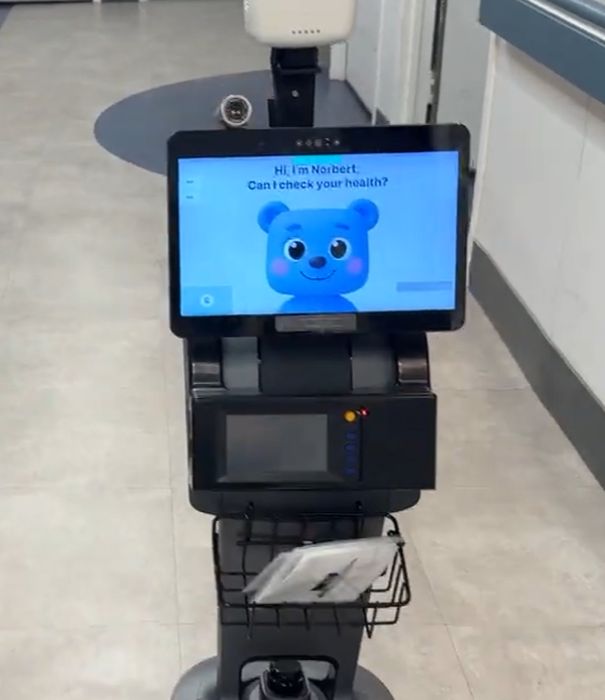
Instead of operating on patients, Norbert’s robots monitor and interact with them. The company, founded in 2019 by Alexandre Winter and Patrick Collins, developed an AI module that can turn an off-the-shelf mobile robot into a healthcare assistant. Winter describes the company’s origins as a response to a healthcare system moving increasingly into homes and post-acute facilities while facing severe staffing constraints.
Norbert combines cameras, infrared sensing, radar, audio and computing to understand patients and their surroundings. Its system is designed to measure vital signs without physical contact, assess mobility and behavior, interact with patients, generate clinical notes and escalate problems to human caregivers.
The development challenge was substantial. According to Winter, Norbert’s team spent its first three to four years focused primarily on contactless medical measurement. The system is now being used in post-acute environments, where robots can make repeated rounds, identify changes in behavior or vital signs and alert staff.
Norbert is still an investigational system in the United States, and its current website notes that it is pending FDA clearance.
Yet its importance goes beyond whether one particular robot succeeds commercially.
Norbert demonstrates a different model of healthcare automation: the robot becomes an extension of the care team rather than merely a machine that performs a task.
OTTAVA moves that idea into the operating room.
From Automation to a New Healthcare Architecture
Put these technologies together and a larger pattern emerges.
A patient could be monitored continuously before surgery. AI-enabled systems could detect changes in mobility, vital signs or behavior and alert clinicians. Imaging and diagnostic robots could gather additional information. Surgical robotics could then use that information within a highly controlled operating environment. After surgery, autonomous systems could monitor recovery and identify warning signs before a human caregiver might otherwise notice them.
This isn’t a prediction that robots will replace doctors and nurses. In many ways, it suggests the opposite.
Robots can absorb repetitive physical and information-processing work, allowing clinicians to spend more time on judgment, communication and care.
J&J itself describes OTTAVA as part of a future in which surgical data and insights can support surgeon judgment. Norbert’s experience points toward a similar model outside the OR: nurses aren’t necessarily asking for fewer robots. They want robots to take away repetitive work so they can spend more time with patients.
Medtronic
Another competitor in the robotic – surgery space is Medtronic. Medtronic’s major surgical robotics offering is the Hugo™ Robotic-Assisted Surgery (RAS) System, a modular platform designed for minimally invasive procedures. It features an open console and portable arm carts. Medtronic also provides the Mazor™ Robotic Guidance System for spine and orthopedic procedures.
The Medtronic Hugo™ Robotic-Assisted Surgery (RAS) System is officially FDA – cleared in the United States for urologic procedures, a milestone achieved earlier in December 2025. It is currently used in active clinical procedures at major institutions like the Cleveland Clinic.
The healthcare delivery system of the coming decades may therefore look less like a collection of isolated medical devices and more like a network of physical AI systems working alongside humans.
The Research and Development (R&D) Tax Credit
Developments like J&J’s OTTAVA, Norbert Health’s patient-monitoring robots, and other “physical AI” systems may create strong opportunities for IRC §41 R&D credits because they involve solving technical problems through engineering, computer science, sensing, robotics, and AI. OTTAVA integrates four robotic arms into a standard-size operating table and uses “twin motion,” where the table and arms move together during patient repositioning. Norbert combines cameras, infrared sensing, radar, audio, and computing to measure vital signs without contact, assess mobility and behavior, interact with patients, generate clinical notes, and escalate issues to caregivers.
Those activities may fit the IRC §41 framework when a company is developing or improving a business component and the work is intended to improve function, performance, reliability, or quality.
For example, designing smaller surgical footprints, testing robotic arm coordination, improving AI-enabled sensing, or evaluating alternative software architectures may involve technological uncertainty and a process of experimentation under Reg. §1.41-4.
Eligible costs may include qualified employee wages, supplies used in qualified research, certain computer-use costs, and generally 65% of qualifying contract research costs under IRC §41(b).
The key is documentation: companies should connect each project to specific uncertainties, alternatives tested, engineering or software principles used, and the resulting product or process improvement.
Below is a table that presents the recent R&D expenditures that the three leading robotics companies today have made in comparison to their human capital.
| Surgical Robot Companies: Research & Development (R&D) Book Per Capita | ||||
| Company | Year | Research and development expenses | Human capital | R&D per capita |
| Johnson & Johnson | 2025 | 14,665,000,000 | 140,800 | $ 104,155 |
| 2024 | 17,232,000,000 | 139,800 | $ 123,262 | |
| 2023 | 15,085,000,000 | 134,400 | $ 112,240 | |
| 2022 | 14,603,000,000 | 155,800 | $ 93,729 | |
| Medtronic | 2025 | 2,732,000,000 | 95,000 | $ 28,758 |
| 2024 | 2,735,000,000 | 95,000 | $ 28,789 | |
| 2023 | 2,696,000,000 | 95,000 | $ 28,379 | |
| 2022 | 2,746,000,000 | 95,000 | $ 28,905 | |
| Intuitive Surgical | 2025 | 1,311,800,000 | 17,021 | $ 77,070 |
| 2024 | 1,145,300,000 | 15,638 | $ 73,238 | |
| 2023 | 998,880,000 | 13,676 | $ 73,039 | |
| 2022 | 879,000,000 | 12,120 | $ 72,525 | |
[Source: R&D Tax Savers]
The Message for 3D Printing
This is where the additive manufacturing industry should pay close attention.
The August 17, 2026, Business section of the New York Times featured a piece on how China currently dominates the Humanoid market. One CEO, Teddy Haggerty, is trying to change that dynamic by building a new generation of humanoids in the US. But is a herculean task, because as of 2024, China already has 2 million humanoids operating in manufacturing facilities. That number is greater than the global number of operating humanoids combined.
OTTAVA is not simply a new robot. It represents the merging of robotics, software, sensing, surgical instrumentation, data and physical infrastructure into one integrated machine.
That creates a manufacturing problem.
The next generation of American healthcare equipment will require increasingly complex components, rapid design iteration, specialized tooling, low-volume production, customized fixtures and intricate robotic mechanisms. These are precisely the environments where additive manufacturing can become strategically important.
The opportunity isn’t necessarily to print an entire surgical robot.
It is to manufacture the thousands of difficult parts, fixtures, end-effectors, surgical tools, prototypes, jigs and customized components that make sophisticated robotic systems possible. Additive manufacturing can shorten development cycles, enable geometries that conventional machining struggles to produce and support economically viable production when volumes are too low for traditional mass manufacturing. J&J can leverage its vast infrastructure and capital to expand on this technology.
OTTAVA is therefore worth watching not just as a medical breakthrough, but as a signal. The next frontier of U.S. manufacturing may not be another consumer product or another factory robot. It may be the physical infrastructure of an increasingly automated healthcare system.
For an industry built around turning digital designs into physical objects, the shift should be impossible to ignore.