
Here’s an unusual idea from IBM: what if a 3D printer could decide exactly where crystals should begin growing inside a print?
That’s the concept behind recently published patent application US20260252052A1, “Method and System for Selective Crystallization During 3D Printing.” The applicant is International Business Machines Corporation, a.k.a. IBM.
This isn’t about printing decorative crystals. Instead, IBM is looking at the microscopic crystal structures that form as certain polymers, ceramics, metals and other materials solidify.
Why bother controlling them? Because those structures can affect strength, brittleness, thermal conductivity, electrical properties and even surface finish.
Normally, much of that crystallization simply happens naturally as the material cools. IBM’s idea is to give the process a push in selected locations.
Putting Seeds Into The Print
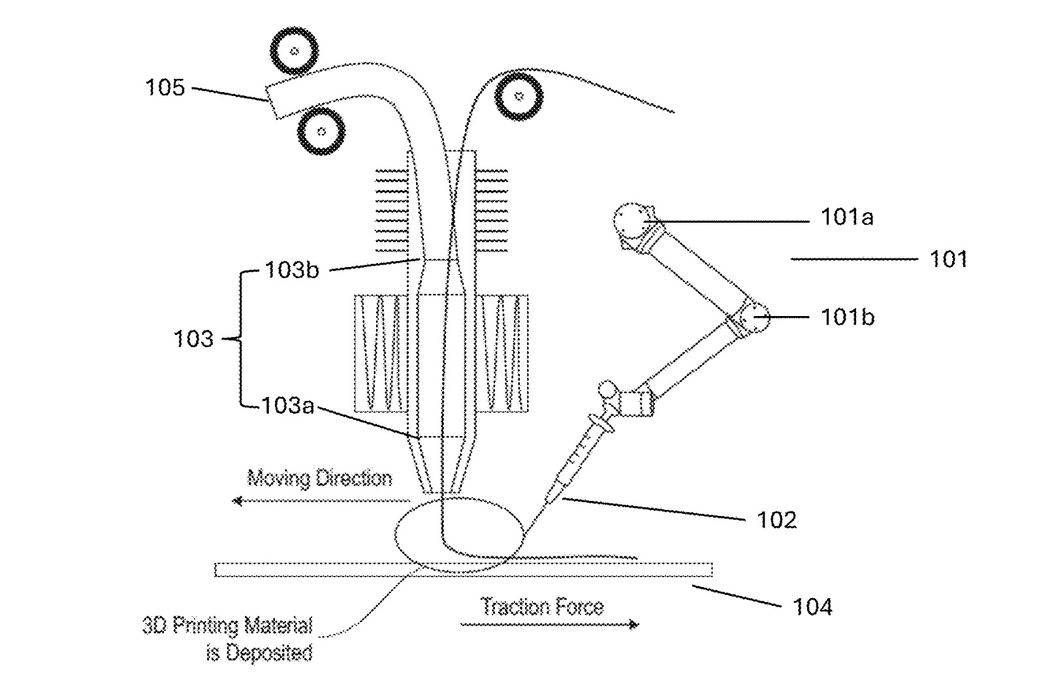
The proposed system looks a bit like a conventional material extrusion 3D printer, but with an extra robotic arm operating alongside it.
The printer deposits a layer, and then the arm places tiny “seed crystals” at specific points on the fresh material. The patent drawings show an end effector that could be a syringe, although IBM also describes claws and other mechanisms.
These seeds would provide convenient places for crystallization to begin.
More importantly, they wouldn’t simply be sprinkled around the print. The system could choose the seed type, size, location and timing according to the material being printed and the crystalline structure desired in the finished part.
That timing could get interesting.
A seed might be deposited immediately behind the nozzle, or perhaps after waiting for the material to reach a particular condition. Obviously the robot arm and printhead would also have to keep out of each other’s way, so IBM describes coordinating their movements.
The main method claim ties together several operations: print some material, measure its characteristics, select an appropriate seed crystal, and then have the robot place it.
Those measurements could include viscosity, melting point and thermal expansion. Elsewhere, IBM mentions things such as hardness, conductivity, chemical reactivity, lattice structure and surface energy.
In other words, this isn’t really a second material extrusion system. The seeds are there specifically to persuade the surrounding material to crystallize in a particular way.
And There Is AI
Things get considerably more elaborate from there.
IBM proposes sensors and cameras to watch what is happening during the print. A database could store results from previous builds, including measurements of strength, thermal conductivity and surface finish.
The system could then compare a new job against that history and recommend which crystals should be used and where they should go.
There are even references to a U-Net model for examining layer images, a regression diffusion model for cleaning up sensor data, and Runge-Kutta calculations for predicting crystal growth.
That sounds impressive, although I’m not convinced all of that machinery would necessarily be required to make the basic idea work.
The more interesting part is the feedback loop: print a layer, measure it, place the crystals, see what happened and use the results to improve the next job.
Potentially, that could give 3D printer operators another way to tune material properties during a build instead of relying entirely on the material formulation, print parameters and subsequent heat treatment.
But there’s a catch. Actually building such a system could be challenging.
You’d need another precision motion system operating around the printhead, some method of storing and dispensing tiny seed crystals, careful synchronization and likely quite a bit of calibration. The seed chemistry would have to match the material, and its placement temperature and timing could be critical.
And, as always, this is a patent application, not an announcement of an IBM 3D printer you’ll be able to order next week.
This idea is pretty intriguing. Most 3D printers spend enormous effort controlling where material goes. IBM is proposing that they might control what happens inside that material as well.
Via Espacenet
