
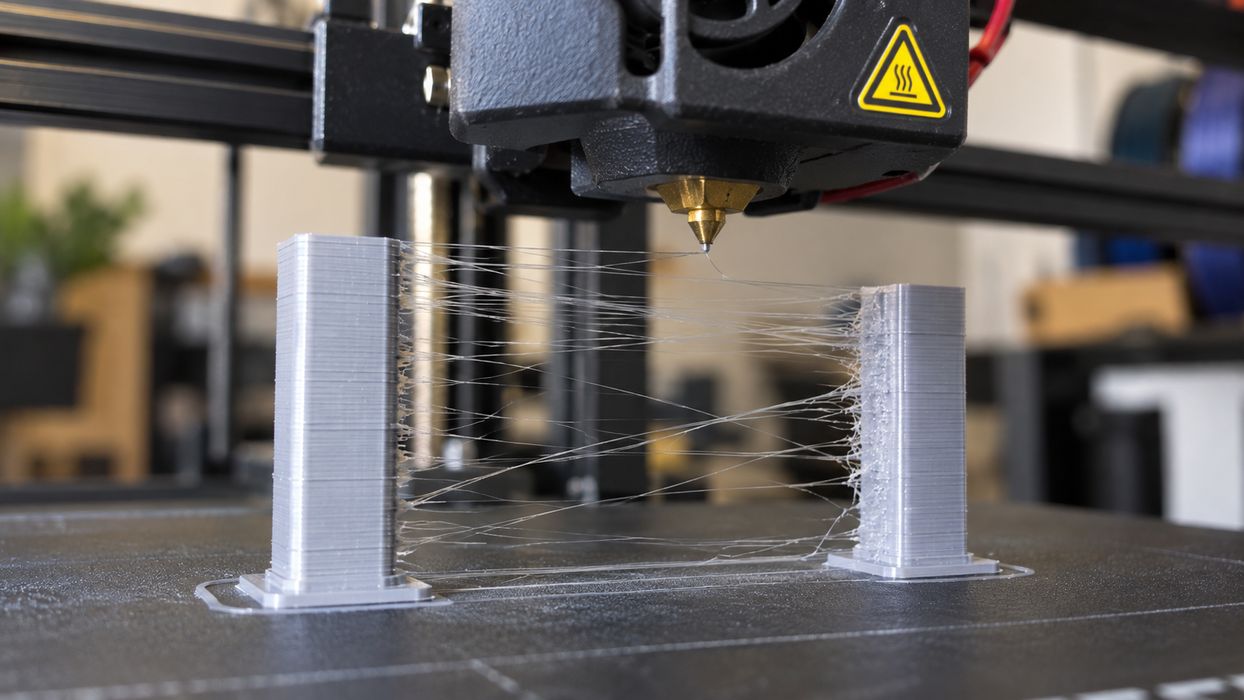
Researchers have proposed an online, closed-loop way to spot and correct FFF stringing before a build is finished.
Stringing is about the most familiar visual failures in fused filament fabrication. A nozzle travels between separate vertical features, residual melt oozes from the tip, and fine plastic threads end up stretched across openings, cavities, and finished surfaces.
Sometimes a few strings are harmless and quickly removed. But on production parts, they can obstruct small channels, damage cosmetic finishes, interfere with a following toolpath, or send an operator back to a machine for manual cleanup. The settings involved are also frustratingly interdependent: nozzle temperature, retraction, travel speed, material moisture, melt pressure, cooling, and filament behavior all play a role.
Most desktop and industrial FFF workflows still handle the problem before or after printing. Operators tune a profile, run a test, inspect the output, and adjust settings for the next attempt. That is ok for a stable material and part family, but not so good when machines run varied jobs or when the material condition drifts during a long production run.
Detection Is Only Half The Job
The paper, titled Online detection and closed-loop correction of stringing defects in fused filament fabrication using a mixed-input multi-head network, combines two ideas that are often discussed separately: machine vision or other in-process observations, and automated parameter correction.
Its “mixed-input” description signals that the neural network takes more than one kind of information. That can mean pairing observations of the printed part with process data or print parameters. A vision system can see an unwanted filament, but it may not know whether excess nozzle temperature, poor retraction behavior, or another condition caused it without additional context.
A shared network can learn common features from its inputs, then send them to separate output branches for related decisions. One branch might identify a defect condition, while another helps select or rank a corrective action. The paper’s central claim is the more valuable one: detection feeds a closed loop that changes the process instead of merely logging a bad event.
In other words, the system tries to treat stringing as a controllable process deviation.
A Difficult Feedback Loop On A Moving Process
There is a catch. FFF has delay built into it. An adjustment to temperature or motion may take time to influence melt behavior, and a string may only become visible after the nozzle has moved away. Any closed-loop controller needs to avoid chasing noise and making rapid, conflicting changes that produce underextrusion or weak interlayer bonding.
Stringing also has material-specific causes. A correction that works on a dry PLA spool may be a poor response to moisture-affected PETG, a flexible filament, or something else. A deployable version of this concept will need training data covering many different machines, lighting conditions, nozzles, materials, geometries, and travel moves. Otherwise, it would need retraining whenever the material or equipment changes.
Print farms already collect GCODE, temperatures, motor behavior, and increasing amounts of camera data. Adding a system that can connect a visible defect to a restrained correction would reduce operator intervention more directly than another dashboard full of defect alerts.
Via Springer
