
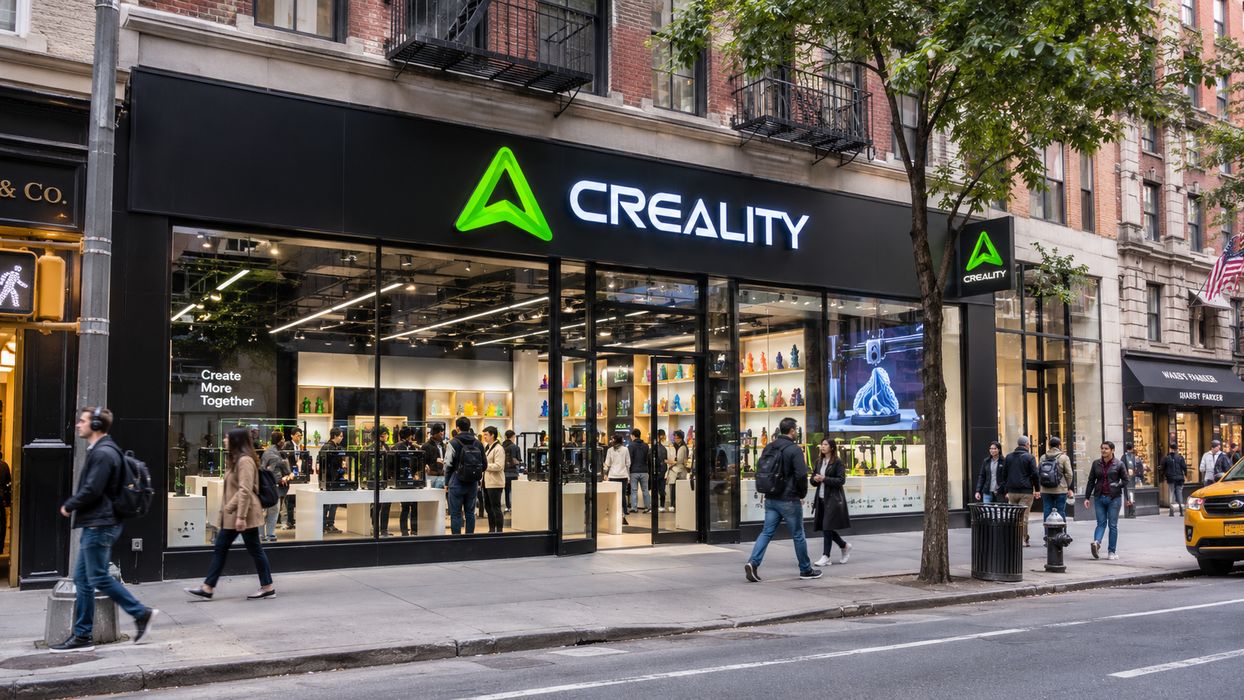
Creality has been building something that could become a worldwide network of its own dedicated 3D printing stores.
A recent report from GMT Eight examines Creality’s expanding retail operations, which already include a substantial collection of physical locations across China.
The company’s flagship store in Shenzhen occupies more than 600 square metres, with live 3D printers, scanning demonstrations, workshops, training sessions and other activities. It’s considerably more elaborate than a typical equipment showroom.
Creality also has “experience stores” in Shanghai, Nanjing, Xiamen, Shenyang, Chengdu and other Chinese cities.
But what about the rest of the world?
Creality already has an enormous international distribution network. According to the report, the company has 2,422 distributors across approximately 140 countries and regions. That has to be one of the biggest 3D printing sales network on the planet.
In the US, Creality equipment is now appearing in mainstream retail chains including Costco, Best Buy and even Michaels. The report claims Costco generated more than 10,000 K2 Combo orders in five months.
Interestingly, Creality intends to establish more than 2,000 overseas retail display points by the end of 2026. These would presumably be locations within existing retail stores, instead of thousands of dedicated Creality shops.
Nevertheless, I suspect something bigger may be coming.
From Retail Displays To Dedicated Stores
Creality has actually already experimented with international retail.
In November 2025 the company opened a temporary store at Westfield Century City in Los Angeles. The operation included live printing, scanning demonstrations and opportunities for visitors to try the technology. It ran through December and was explicitly described as an overseas retail pilot.
Meanwhile, the company’s main competitor, Bambu Lab, has been following a very similar strategy, as we recently reported. In addition to its Chinese stores, Bambu Lab has established international retail locations in Tokyo, Bangkok and the Philippines.
These operations use local partners, with different combinations of sales, demonstrations, training and customer support.
I suspect Creality could follow a comparable pattern, although perhaps with a different order of operations.
Its existing distributors provide a good starting point. Certain partners could establish small branded Creality experience stores in major metropolitan areas, perhaps initially inside shopping malls or existing electronics retailers.
The company could then experiment with larger flagship stores in particularly promising markets. Each stage would allow Creality to learn more about the local market and allow for adjustments.
Los Angeles would be an obvious first location because of the previous experiment. London or Berlin might provide European opportunities, while major Southeast Asian shopping centres could be attractive locations for partner-operated stores.
The likely progression would be temporary demonstrations, permanent branded areas inside existing retailers, distributor-operated experience stores, and eventually a handful of major flagship locations.
Why A Store Might Work
There’s a fundamental problem with selling 3D printers online: the average consumer still doesn’t really understand what these machines can do.
A functioning multicolor printer producing a fun or useful printed item in a shopping mall could generate interest in someone who would otherwise never think of searching for a 3D printer. They might ultimately buy a machine, and then filament, accessories and perhaps another printer could follow. It’s good business, an approach proven years ago by Apple when it reached out directly to the market with their chain of retail stores.
Creality has a pretty wide product catalog, including 3D scanners and laser equipment, so they have a lot more to show than just 3D printers.
And there’s also an important service opportunity. A local store could provide training, troubleshooting, spare parts, supplies and even a place for makers to meet.
The challenge would be of course, financials. Dedicated stores require staff, rent, inventory and technical support. They also have to coexist with established retailers that already sell Creality equipment. They would also requite quite a bit of advertising and promotion because, again, the public wouldn’t have a clue who they are until told.
I don’t think Creality needs hundreds of dedicated stores immediately. A few carefully selected international locations would allow it to determine which retail formats actually work.
The company has already tested the concept in China and briefly in Los Angeles. It also has thousands of potential partners worldwide.
What I’m watching for now is whether one of those temporary experiments becomes a permanent Creality store.