
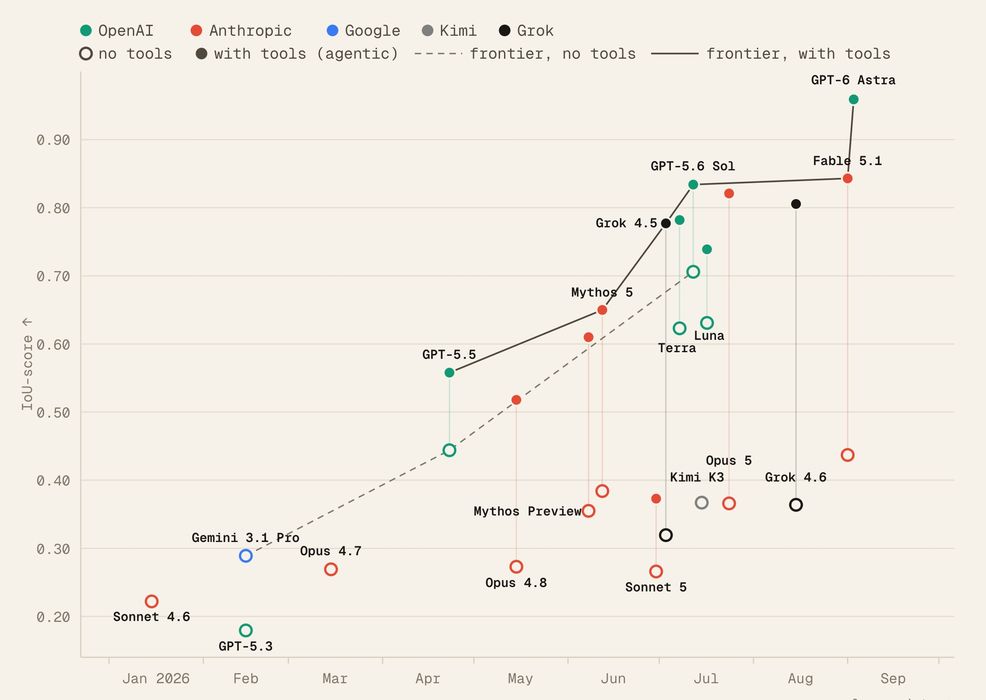
Are we getting dangerously close to 100% accurate AI CAD?
For many years, 3D design has been done by highly skilled experts using sophisticated 3D CAD tools, like SOLIDWORKS, Fusion, etc. But recently, many have begun applying new AI tools into the 3D design world, and the results are definitely heading into an interesting direction.
Initial attempts at 3D modeling with AI tools were quite limited. Typically, an image (sometimes AI created itself) would be presented to an AI, which would then “imagine” a 3D model that matched the image, perhaps modified with a simple prompt. The resulting 3D model was basically a shape, exported as a mesh for 3D printing or use as a visual asset.
That is pretty incredible itself, but that process does not produce properly formed parts. Dimensions are inevitably wrong, and you simply cannot produce mechanical parts in this way.
A subsequent wave of AI 3D modeling uses a different approach. Instead of generating the shape, generate the steps in a CAD tool to build an object.
CAD tools typically record a sequence of actions that build and modify a design. That’s what allows the user to roll back changes, or to change the diameter of that hole they created yesterday.
These steps are precision maneuvers done by the user to achieve the final design. If an AI can reproduce those same steps, then the AI can, in theory, produce a usable CAD design for a mechanical part.
But can they? How would you know?
One answer is a very specific AI benchmark. (Note: there are countless benchmarks for AI systems that measure all kinds of things.) BenchCAD is a benchmark designed to measure an AI’s ability to generate proper CAD designs.
BenchCAD has a large database of thousands of 3D part designs, most of which are “spec-faithful, manufacturable parts”. The AI under test is shown a random selection of 106 spinning 3D views of parts, and is requested to reproduce the CAD query sequence to build them. It’s basically a series of “can you make one of these?” questions. The results are measured geometrically to see how close the AI came to reproducing the actual part.
You can see in the chart at the top that tracking started earlier this year — literally only months ago — with scores in the low 20% range.
But as the year progressed, different and better AI models increased their scores. Even open-source AI models, like Kimi K3, began to appear.
The interesting part is that a couple of weeks ago, OpenAI released GPT-6, a.k.a. “Astra”, as their most powerful flagship AI model. On BenchCAD, it scored a whopping 95.9%.
The AIs have gone from 20% to 96% in eight months.
Now, 96% is not 100%. But it is close, and as you can see, there is a definite trend here. It is quite possible that a future AI model, perhaps GPT-7, might actually score 100% on BenchCAD.
Does this mean that CAD will then become AI-only?
Not at all. BenchCAD shows only that an AI could reproduce a CAD model from a spinning image. That is a powerful capability, but it would have to be wrapped in tools that leverage the capability to design new parts. For example, another AI system might be used to accept input parameters and generate a spinning image of a new part, which in turn might be fed into a BenchCAD-like system for conversion into a full CAD model.
The point here is that we seem to be converging on an entirely new — and mainly automated — method of creating 3D designs for mechanical parts.
I can’t imagine what the CAD landscape will look like in a couple of years.
Via BenchCAD
