
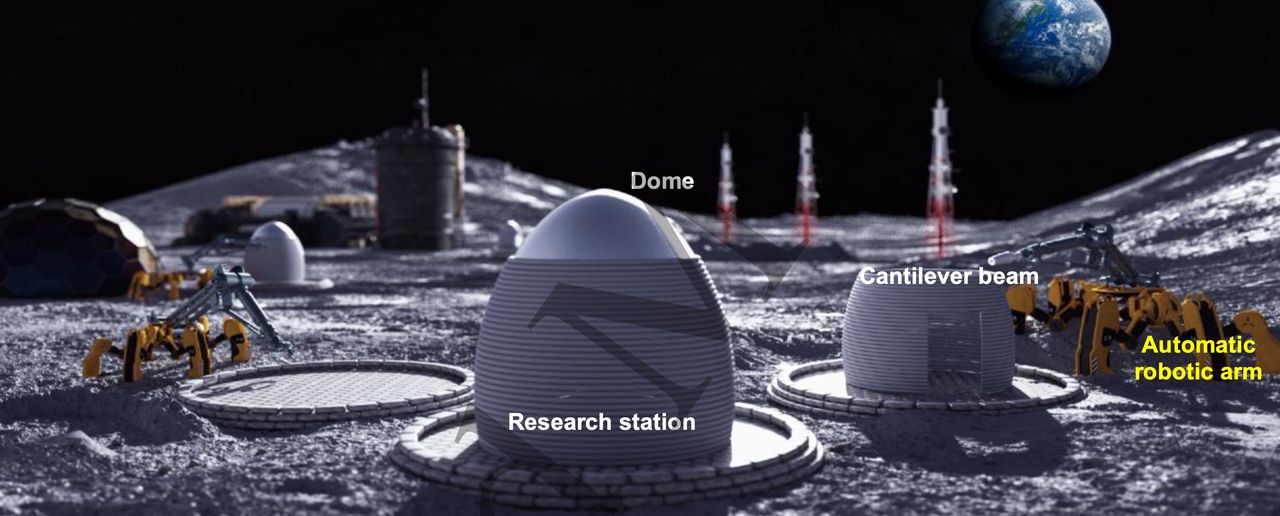
A UV cured skin may let lunar construction printers deposit unsupported structures before their flowable material collapses.
Researchers at Southeast University and partner institutions have developed a photothermal hardened composite, or PTHC, for ultraviolet assisted direct ink writing (DIW). Their target is autonomous lunar construction, where conventional binders face big problems: the material must flow through a nozzle, it must survive vacuum, low gravity, and violent temperature changes immediately after deposition.
That is much harder than it sounds. Water based cementitious and geopolymer mixes can quickly evaporate components in vacuum, and slowly curing materials need formwork or supports to hold overhangs in place. Sintering lunar regolith, another proposed approach for lunar 3D printing, avoids liquid binders, but requires temperatures above 1,000C and therefore considerable energy, which isn’t readily available.
The team’s solution is a paste containing simulated lunar regolith and a dual curing epoxy based binder. Regolith is basically lunar soil: dust that does not contain organic matter. Two 150W UV lamps sit beside the DIW nozzle. As material is extruded, 365nm UV illumination cures only its exterior, creating a thin load bearing shell.
A Shell First, Then A Structural Core
The outer shell is the genuinely useful idea here. It locks in a filament’s shape within roughly five seconds, while also enclosing the still liquid interior against vacuum driven volatilization. At the reported illumination levels, the researchers found a shell strong enough to support 30 subsequent layers after five seconds of exposure.
Heat then triggers a second curing reaction through the shaded interior. At 100C, full thermal cure took less than five minutes. The resulting composite reached compressive strengths up to 166 MPa and flexural strength up to 72 MPa at higher regolith loadings. Impressive!
In other words, the process separates two requirements: rapid shape retention and deep curing of a highly filled, UV opaque paste. UV alone cannot penetrate very deeply into a regolith filled bead. The reported cured depth grew only from 0.16mm after three seconds to 0.49 mm after 60 seconds. That shallow cure becomes an advantage when it is deliberately used as a temporary structural skin.
The researchers printed unsupported 40cm horizontal cantilevers, springs, curved structures, and spiral spherical lattices. The 40cm limit was set by the lab printer’s travel range, they say, rather than any material limits. Their mechanical model predicts that a 20mm diameter cantilever could reach four meters before failing, although their setup lowered the practical length to about one meter.
A lunar system would need sealed heated paste delivery, UV lamps that can maintain uniform coverage over changing nozzle sizes and complex geometry, robotic motion, and a reliable power supply.
The team already noticed a scaling problem on Earth. Unsupported 2mm and 4mm beads held their dimensions within 5.2%, but an 8mm bead showed roughly 35% width deviation. Larger beads sag more before the UV shell fully forms, and the researchers suggest more UV illumination as a fix. Lunar gravity, at one sixth of Earth’s, should reduce sagging, but not completely.
Durability results are pretty encouraging but are only lab tests. After 40 thermal shocks between -196C and 120C, samples retained about 90% of their mechanical properties. The composite also retained 95% strength after a gamma dose described as equivalent to roughly four lunar years, and survived a modest 53.3 m/s projectile test with a crater rather than catastrophic fracture.
For Earth-based large format 3D printing, the same “shell first” strategy might be something worth investigating. A printhead that gives every extrusion a rapid protective shell before a slower bulk cure just might expand the range of possible geometries that can be printed.
