
Charles R. Goulding describes how Josh Dean’s new book chronicles the remarkable career of Lockheed engineer Kelly Johnson and the Skunk Works culture that transformed aerospace. Its lessons about rapid development, manufacturing and innovation remain remarkably relevant to 3D printing today.
What if one of the most important lessons for the future of 3D printing was developed nearly a century ago?
Long before additive manufacturing became a technology industry, Kelly Johnson was asking engineers to do something that remains surprisingly difficult today: design extraordinary products, manufacture them quickly, control costs and get them into operation without being buried in bureaucracy.
The results included some of the most remarkable aircraft ever built.
Josh Dean’s new book, The Impossible Factory, tells the story of Johnson’s 47-year career at Lockheed and the legendary Skunk Works organization he created. It is a story about aerospace, but it is also a story about engineering culture. For anyone interested in advanced manufacturing, there are lessons here that feel remarkably contemporary.
A young engineer at a fledgling Lockheed
Johnson joined Lockheed in 1933 with a master’s degree in aeronautical engineering from the University of Michigan. He arrived at a company that was still struggling to establish itself after its assets had been purchased out of bankruptcy and the company reorganized in 1932.
Johnson’s university experience with wind tunnels gave him an immediate technical advantage, but his abilities extended well beyond aerodynamics.
His early Lockheed work included wind-tunnel testing, tool design, aerodynamics, structural stress and weight analysis and flight testing. This broad exposure would become central to his engineering philosophy.
Johnson wasn’t simply interested in designing an aircraft on paper. He wanted to understand how it would actually be built.
That distinction would become one of his greatest strengths.
The birth of Skunk Works
During World War II, Lockheed received an urgent assignment to develop America’s first operational jet fighter. Johnson assembled a small team and, working under extraordinary time pressure, developed the XP-80.
The project demonstrated what would become the defining characteristic of Skunk Works: a small group of highly capable people given the authority to make decisions and solve problems without the normal layers of corporate bureaucracy.
Skunk Works officially emerged in 1943 as Lockheed’s Advanced Development Projects operation. Its name became synonymous with secrecy, speed and unconventional engineering.
Johnson developed a management philosophy that emphasized small teams, direct communication, minimal bureaucracy and personal accountability.
It worked.
And it worked repeatedly.

From the P-38 to the Blackbird
Johnson’s career reads almost like a history of 20th-century aviation.
The P-38 Lightning became one of America’s important World War II fighters. The XP-80 helped usher the United States into the jet age. The Constellation transformed long-distance commercial aviation.
Then came the aircraft that made Skunk Works legendary.
The U-2 reconnaissance aircraft operated at altitudes that made it extremely difficult for conventional aircraft to reach. The A-12 and SR-71 Blackbird pushed aviation technology even further, combining extraordinary speed and altitude with demanding requirements for materials, structures, engines and manufacturing.
These weren’t simply engineering exercises. They were production challenges.
Johnson was renowned for combining technical intuition with practical manufacturing knowledge. He understood that an aircraft could not succeed merely because its aerodynamic design was brilliant. It had to be built, tested and delivered.
And it had to be built within a budget.
That mindset is especially relevant to additive manufacturing.
The Skunk Works connection to 3D printing
The modern 3D printing industry often talks about design freedom, rapid prototyping, digital manufacturing and reducing the distance between design and production.
Those concepts would have made sense to Johnson.
Additive manufacturing gives engineers the ability to rethink components rather than simply reproduce traditionally manufactured designs. Internal channels can be redesigned. Parts can be consolidated. Tooling can sometimes be eliminated. Components can be produced directly from digital files.
Most importantly, engineers can iterate.
That is where the Skunk Works philosophy becomes particularly interesting.
Johnson’s teams were expected to solve problems quickly. They worked closely with manufacturing and flight testing. Instead of creating a rigid boundary between engineering and production, they treated the two as parts of the same process. That is increasingly how advanced additive manufacturing is being used.
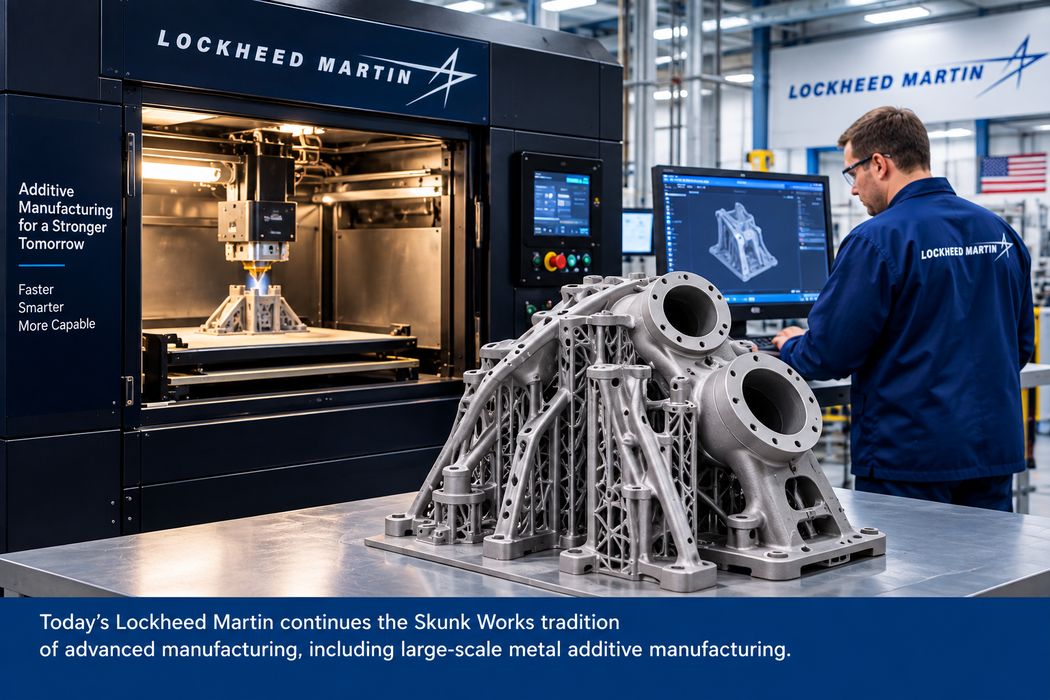
Lockheed Martin embraces additive manufacturing
The company Johnson helped build has grown far beyond the Lockheed of 1933.
In 2025, Lockheed Martin reported approximately US$75 billion in sales and approximately 123,000 employees. The company says roughly 72,000 of those employees are engineers, scientists and information-technology professionals.
Yet despite its enormous scale, the organization continues to invest in the kind of advanced manufacturing that would have been familiar to Johnson.
Lockheed Martin has reported thousands of 3D printed parts across its spaceflight hardware portfolio. The company has also expanded its additive manufacturing infrastructure, including a 16,000-square-foot facility in Grand Prairie, Texas, supporting production with large-format, multi-laser systems as well as heat treatment and inspection capabilities.
Several recent applications demonstrate where the technology is headed.
3D printing a hypersonic missile component
Lockheed Martin’s Mako hypersonic missile program provides a striking example. The company has used additive manufacturing to produce the missile’s guidance section and fins.
According to Lockheed Martin, the additively manufactured guidance section met engineering requirements at approximately one-tenth the cost of the conventionally manufactured version and could be produced significantly faster.
This is more than a demonstration of printing technology. It illustrates the economic potential of redesigning aerospace components around additive manufacturing.
Rethinking the hydraulic manifold
Another example is a 3D printed hydraulic manifold.
Traditionally, such components can be machined from a relatively large block of metal, with internal passages drilled through the material. Additive manufacturing allows engineers to rethink those internal pathways.
Instead of starting with a block and removing material, engineers can build the required geometry directly.
The result can be a lighter component with more efficient internal fluid paths.
This is exactly the sort of manufacturing problem in which additive manufacturing can offer value beyond simple part replacement.
The Research and Development (R&D) Tax Credit
Under IRC § 41, The R&D tax credit, generally requires qualified research to satisfy a four-part framework: qualifying domestic research expenditures, technological research, development or improvement of a business component, and substantially all activities being part of a process of experimentation for a qualified purpose. Research may qualify even if it fails, but it must address uncertainty about capability, method, or design. A process of experimentation generally involves identifying uncertainty, testing alternatives, and evaluating results through modeling, simulation, or systematic trial and error.
These developments can help companies tell a stronger IRC § 41 story because they suggest technical uncertainty and iterative engineering – not just routine production. The developments described are excellent indicators of eligible activities that Lockheed claims when substantiating its Research and Development (R&D) tax credits.
The R&D tax credit is available for all for-profit companies to claim for designing or developing new and/or improved products or processes. R&D Tax Savers has helped hundreds of companies claim these credits since the credit’s inception in 1981.
Below is a table that presents the research and development investments Lockheed has made in R&D over the past few years in comparison to its human capital.
| Research and Development (R&D) Book Expenses Per Capita | ||||
| Company | Reporting Year | R&D Book Expense | Human Capital | R&D Book Expense Per Capita |
| Lockheed Martin Corporation | 2025 | $ 2,000,000,000 | 123,000 | $ 16,260 |
| 2024 | $ 1,600,000,000 | 121,000 | $ 13,223 | |
| 2023 | $ 1,500,000,000 | 122,000 | $ 12,295 | |
| 2022 | $ 1,700,000,000 | 116,000 | $ 14,655 | |
Printing the future before building it
Lockheed Martin is also using additive manufacturing in a different way: to create full-scale physical mockups.
The company’s space business has used 3D-printed models of spacecraft to rehearse assembly procedures before working on the actual hardware.
That may sound simple, but it represents an important advantage of digital manufacturing. Engineers can rapidly turn a digital design into a physical object and use it to identify problems before those problems become expensive.
Again, the connection to Johnson is obvious.
Build. Test. Learn. Improve.
An engineering philosophy that still matters
Today, we readily recognize technology leaders such as Steve Jobs, Elon Musk and Jensen Huang. Their companies and products have become part of everyday life, and their names are closely associated with innovation.
Kelly Johnson belongs to an earlier generation of technologists whose work was often hidden from public view.
Much of Skunk Works’ work was classified. Johnson wasn’t designing consumer products that could be demonstrated at a press conference. He was developing military aircraft whose very existence was sometimes secret.
As a result, his accomplishments remained largely unknown to the general public.
That changed somewhat when Johnson appeared on 60 Minutes in 1982, introducing a much broader audience to the man behind some of America’s most extraordinary aircraft.
The legacy of the Impossible Factory
In my view, Johnson laid much of the foundation for Lockheed’s emergence as one of the world’s leading aerospace companies.
But his larger legacy may be the engineering culture he created.
The lesson isn’t that every 3D printing company should try to become a Skunk Works. It is that technology works best when talented engineers are given the freedom to solve problems, when manufacturing is involved early in the design process and when organizations are structured to move from idea to physical reality quickly.
That is precisely the opportunity presented by additive manufacturing.
The machines are different. The materials are different. The software is different.
But the fundamental challenge is the same one Johnson faced: take an ambitious idea and figure out how to make it real.
The Impossible Factory is therefore more than an aerospace history. Josh Dean has given us a valuable reminder that some of the most important innovations come not just from technology, but from the way talented people are organized to use it.
For today’s 3D printing industry, Kelly Johnson’s example remains surprisingly relevant.
The impossible factory may still be the right model for building the future.