Charles R. Goulding and Preeti Sulibhavi take readers inside IMTS 2026 to explore how companies ranging from FANUC and Boston Dynamics to Standard Bots, KUKA and Yaskawa are helping transform robots from factory-floor tools into increasingly versatile manufacturing platforms.
The sheer number of robots on display at IMTS 2026 in Chicago was one of the most striking aspects of this year’s show. Walking through McCormick Place, it was difficult to go very far without encountering a robotic arm, autonomous mobile robot, collaborative robot or some other form of intelligent automation.
And the scale of the event was impressive. IMTS organizers reported that the 2026 show opened with 1,788 exhibiting companies, including 400 first-time exhibitors, occupying approximately 1.17 million square feet of exhibit space. Attendance was on pace to exceed 90,000 people representing all 50 states and 113 countries.
For someone interested in both robotics and additive manufacturing, the show provided an especially interesting perspective. Robots are no longer simply machines that move parts around a factory. Increasingly, they are becoming flexible manufacturing platforms—and that makes them natural partners for 3D printing.
FANUC Was Everywhere
One of the companies that seemed to be everywhere at IMTS was FANUC.
FANUC had its own large exhibition presence, but its yellow robots also appeared throughout the show as components of automation systems built by other companies and system integrators. One example was Weldon, which incorporated FANUC robotics into its own automation offerings.
That ubiquity says something important about the industrial robotics market. A robot manufacturer does not necessarily have to own the entire manufacturing cell to be central to the process. Robot platforms can become building blocks that integrators configure for particular applications.
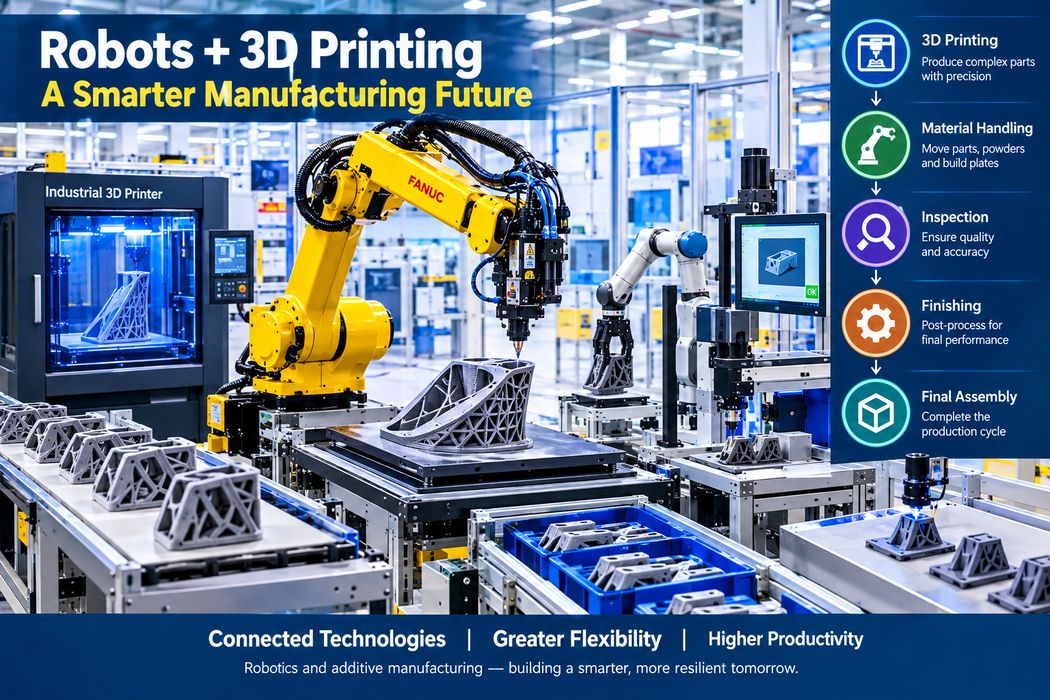
FANUC is also increasingly relevant to additive manufacturing. Its ARC Mate welding robots support additive manufacturing applications, including processes in which digital toolpaths are converted into physical structures. FANUC also has experience automating 3D printing operations.
A particularly interesting example is Athena 3D Manufacturing, which used a FANUC CRX collaborative robot to automate the changing of print beds across multiple 3D printers. According to FANUC, the automated system nearly doubled part production and increased machine utilization by 40%, while enabling lights-out operation.
This is an important distinction: robotics doesn’t necessarily have to perform the actual printing to transform additive manufacturing. A robot that loads, unloads, inspects or transfers parts can make a fleet of 3D printers significantly more productive.
Fabbaloo has previously explored the evolution of FANUC and AI in our article, “Google and FANUC Want to Build the First Truly Intelligent Factory Robots.” That story provides additional context for the convergence of robotics, artificial intelligence and manufacturing.
Boston Dynamics Draws a Crowd
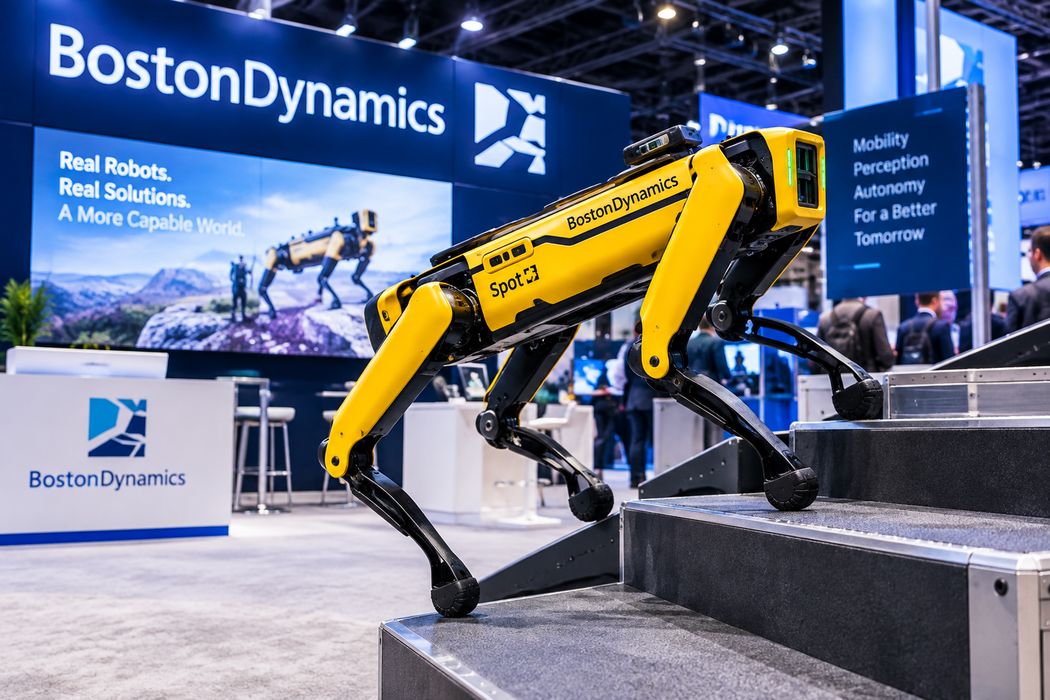
Boston Dynamics provided one of the most visually engaging demonstrations I encountered.
The company’s recognizable robotic dog, Spot, was highly visible as it climbed a stairway. It was the sort of demonstration that naturally attracted attention because the machine’s movements look surprisingly familiar while remaining distinctly robotic.
Boston Dynamics is particularly interesting from an additive manufacturing perspective because the company has publicly documented its own use of 3D printing.
In one Boston Dynamics project involving conversational capabilities for Spot, engineers 3D printed a vibration-resistant mounting system for a speaker and microphone array. The custom component allowed additional audio hardware to be integrated with Spot’s existing payload architecture.
That example illustrates an important role for additive manufacturing in robotics: customization.
Robots frequently need specialized brackets, mounts, grippers, covers, fixtures and other components that may not justify conventional tooling. 3D printing makes it possible to design and manufacture those parts quickly, modify them and produce another iteration without waiting for a conventional manufacturing process.
Boston Dynamics therefore represents both sides of the robotics-AM relationship: sophisticated robots can use 3D printed components, while robotic systems can potentially become production tools for manufacturing large or complex 3D printed structures.
Standard Bots Brings Robotics Closer to Home
Another particularly interesting exhibit was Standard Bots, the Long Island-based robotics company.
Its booth was large, well attended and located adjacent to Boston Dynamics, making for an interesting contrast between two very different approaches to industrial robotics.
Standard Bots emphasizes American manufacturing and describes its robots as designed and assembled in the United States. The company has also described itself as America’s fastest-growing robotics company.
The company was demonstrating the concept of making industrial robotics more accessible, with an emphasis on intuitive programming and AI-enabled capabilities.
For Fabbaloo readers, however, one detail was especially relevant: Standard Bots actively discusses using robot arms for 3D printing.
The company describes robotic additive manufacturing as the combination of a robotic arm with a 3D printing extrusion head. Rather than moving parts to a conventional printer, the robot itself becomes the motion platform for the printing process.
That approach can be particularly useful for large-format additive manufacturing. A conventional 3D printer is constrained by the dimensions of its build chamber. A robotic arm mounted on an appropriate platform can potentially operate over a much larger area and approach the workpiece from different angles.
Standard Bots also provides software capabilities for controlling complex paths, including applications such as welding and 3D printing.
The company’s presence at IMTS demonstrated how the robotics industry is attracting newer American manufacturers alongside established global players.
KUKA Connects Mobility and Additive Manufacturing
KUKA was another major robotics presence at IMTS. The company, now part of Midea Group, demonstrated its mobility platform and other automation technologies.
KUKA’s relationship with additive manufacturing is particularly well established.
The company has developed robotic systems specifically for industrial 3D printing, including large-format applications. KUKA robots can be combined with extrusion, laser and other deposition technologies to produce components substantially larger than those possible in many conventional 3D printers.
KUKA has documented applications involving aerospace components, automotive parts, construction, shipbuilding and other large structures.
One example is robotic production of boats. KUKA robots have been used in projects involving 3D printed marine structures, demonstrating how a robot’s reach can turn additive manufacturing into a large-scale production process.
This is one reason KUKA’s presence at a manufacturing show like IMTS is relevant to 3D printing. The boundary between a “robot” and a “3D printer” becomes increasingly difficult to define when the robot is carrying the deposition system.
Fabbaloo previously examined Midea’s broader manufacturing and innovation activities in “Midea: From Bottle Lids to 3D Printed Innovations.”
Yaskawa and the Motoman Connection
Yaskawa was another major global robotics and automation company at IMTS, with its familiar Motoman brand represented at the show.
Yaskawa’s additive manufacturing activities provide another example of the growing convergence between robotics and 3D printing.
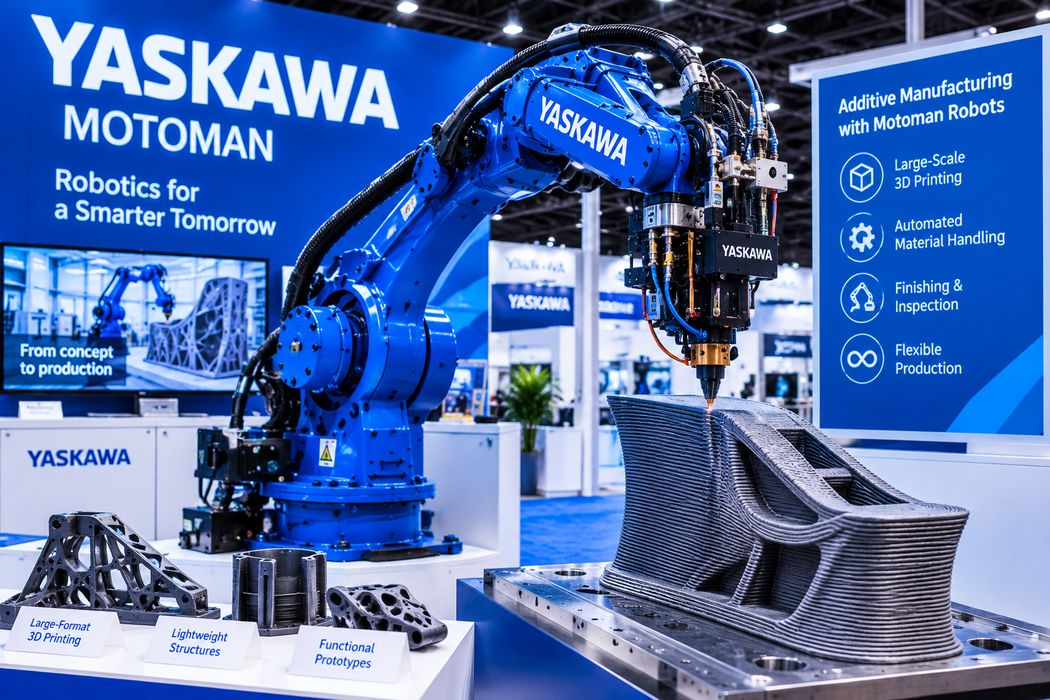
The company describes Motoman robots being used both around 3D printers and as direct motion platforms for additive manufacturing. Robots can automate tasks such as unloading printed parts, powder management, finishing, inspection and transportation.
But the more interesting application may be direct robotic printing.
By mounting an extrusion or deposition head on a Motoman robot, manufacturers can create large-format or free-form structures. External axes, rotary tables and linear tracks can further expand the robot’s working envelope.
Yaskawa identifies applications ranging from large-volume free-form parts and molds to prototypes and hybrid components that add material to existing surfaces.
This is particularly important as additive manufacturing moves beyond prototyping.
The Research and Development (R&D) Tax Credit
Manufacturers and systems integrators implementing industrial automation, digital twin simulations, and additive Manufacturing Execution Systems (MES) to scale 3D printing can claim the Section 41 R&D Tax Credit for Qualified Research Expenses (QREs). As firms transition additive manufacturing from prototyping to serial production using solutions like Yaskawa’s Motoman robots, Boston Dynamics’ specialized brackets, as well as mounts, grippers, covers, fixtures and other components, they frequently incur eligible expenses by resolving technical uncertainties related to software integration, robotic part-handling, and factory-scale simulation.
To qualify under IRC Section 41, the engineering and software development activities surrounding 3D printing automation must satisfy the IRS Four-Part Test:
- Permitted Purpose: Developing new or improved automated workflows, predictive maintenance algorithms, or integrated MES platforms (like Plex) to manage additive serial production, materials tracking, and robotic post-processing.
- Elimination of Uncertainty: Resolving technical unknowns, such as determining if a robotic arm can reliably achieve precise geometric tolerances during laser cladding (e.g., LaserBond), or if digital twin models can accurately predict factory floor thermal bottlenecks.
- Process of Experimentation: Utilizing systematic trial and error, including digital simulation (via Emulate3D), pilot-line trials, sensor integration testing, and iterative coding to evaluate automated cell configurations.
- Technological in Nature: Relying on hard sciences such as mechanical engineering, robotics, computer science, materials science, and data analytics to bridge the gap between standalone 3D printers and connected smart factory systems.
Firms adopting and integrating industrial 3D printing technologies may capture significant QREs, including:
- Wages: Compensation for robotics programmers, automation engineers, data scientists, and systems integrators designing and testing additive manufacturing production lines.
- Supplies: Costs of consumables used during pilot runs, prototype robotic end-effectors, test fixtures, and materials consumed during the experimental printing process.
- Cloud and Software: Expenses tied to simulation platforms, AI/ML model development, and cloud computing necessary for additive MES algorithms or digital factory modeling.
- Contract Research: Up to 65% of fees paid to third-party engineering firms, software developers, or external testing labs assisting with the automation integration.
By proactively identifying and documenting these automation and software development efforts, manufacturers can accurately capture QREs. This allows companies to offset federal and state tax liabilities, effectively preserving capital to reinvest in the continued expansion of their smart manufacturing capabilities.
For startups recently entering the industry there is a provision where startups can receive cash in the form of R&D payroll tax rebates. To qualify the startup must have had less than US$5 million in annual receipts for the past five years. The benefits can be as much as US$500,000 annually for up to five years, amounting to US$2,500,000. R&D Tax Savers has been helping companies navigate the complexities of the R&D credit since it was introduced into law in 1981.
Robots and 3D Printing Become a Dynamic Duo
The most significant takeaway from my experience at IMTS 2026 was not simply that there are more robots in manufacturing. It was that robots are becoming increasingly intertwined with the entire digital manufacturing workflow.
The relationship works in both directions.
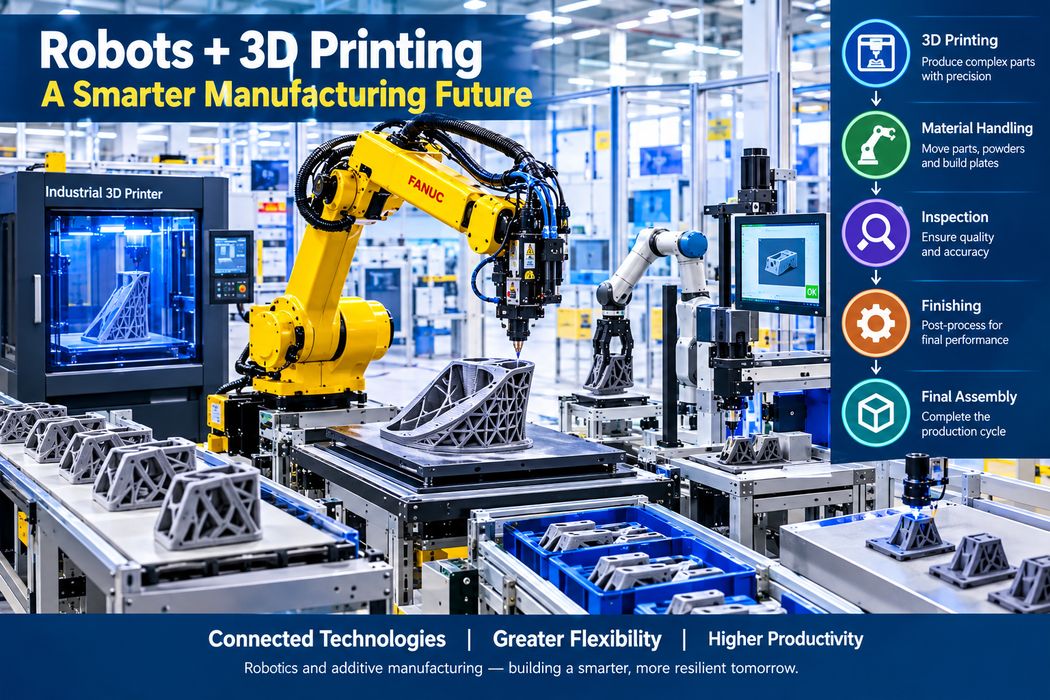
Robots can manufacture 3D printed parts. They can tend to 3D printers. They can move printed parts between machines. They can perform finishing and inspection. And, as Boston Dynamics demonstrated, robots themselves can incorporate 3D printed components as part of their funcitionality.
At the same time, additive manufacturing can make robots more adaptable by providing customized tooling, end effectors, brackets and other components without the expense and delay of conventional tooling.
As high-volume production 3D printing continues to expand, these capabilities become increasingly complementary.
The future factory may therefore contain fewer isolated machines and more interconnected manufacturing systems. A robot may not simply be standing next to a 3D printer. It may be operating the printer, inspecting its output, moving the parts to another machine and even using 3D printed tooling to perform the next operation.
That was perhaps the most compelling lesson from walking the robotics exhibits at IMTS 2026: the robot and the 3D printer are increasingly becoming a dynamic duo.