
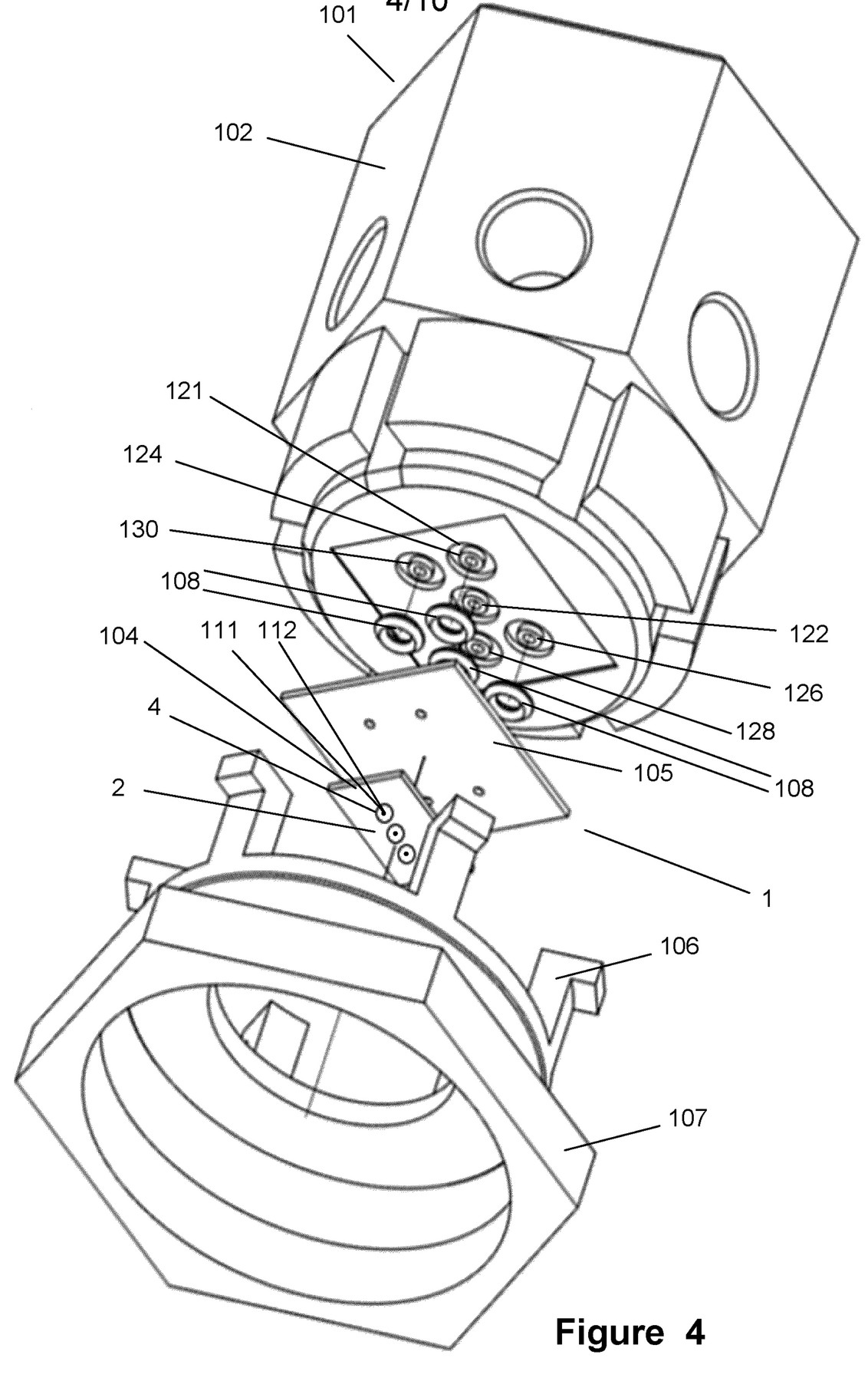
A printer head that dispenses three different fluids through the same tiny nozzle could bring atomic layer processing closer to a genuinely 3D workflow.
That is the unusual idea in a new filing from Danish applicant Atlant 3D ApS. The company is proposing a machine that combines spatial Atomic Layer Deposition (ALD) with selective etching, doping and cleaning. Its patent, WO2026180515, describes both the printer and a replaceable printer head designed to make the process faster and more flexible.
Three Fluids, One Tiny Nozzle
ALD normally builds an extremely thin film through a carefully controlled chemical sequence. A first precursor reaches the surface, excess material is cleared away, and a second precursor reacts with what remains. Repeating the cycle adds material in very small increments. Atomic Layer Etching, or ALE, follows a similar pattern, but removes material.
Atlant’s design puts the fluid delivery directly above the workpiece instead of filling a large chamber. Each nozzle can have a first opening for one precursor, a second opening for another precursor and a third opening for an inert gas such as argon. The head can also include exhaust openings that pull away fluids which did not react with the surface.
That setup is easier to imagine as a tiny chemical printhead than as a conventional 3D printer nozzle. The machine moves the substrate beneath it, depositing or removing material only where the nozzle passes. The filing says the substrate holder can move in X, Y and Z, rotate and tilt, allowing the head to stay properly aligned with surfaces that are not flat.
The three fluids are routed through separate channels, then distributed across an array of nozzles. A shared chamber, with internal walls and flow dividers, is intended to equalize pressure so each nozzle sees similar conditions. The drawings show three nozzles in a row, although the claims cover other arrangements, including triangular and curved arrays.
Three separated lines can be deposited during one pass, or several openings can work together to make a thicker continuous line. The filing also describes changing the nozzle plate to alter the opening size and therefore the resolution, without replacing the entire printer head body.
A Modular Head For Nanoscale Work
The proposed head plate may be made from materials such as alumina, silicon carbide, silicon nitride, quartz or silicon dioxide. The plate can be clamped or otherwise attached to a reusable body, making it possible to install different nozzle patterns for different jobs. One version could favor finer lines; another could favor higher flow or parallel coverage.
The application gives a claimed pattern resolution from 20 nm to 1 mm, depending on the opening size and the gap between the head and substrate. It also includes micrographs showing deposited lines made with a three-nozzle array. Those images support the basic multi-line demonstration, but they do not establish that every material, geometry or nanoscale application in the broad claims has been proven.
For semiconductor work, ALD can coat complex surfaces, while ALE can remove selected material with fine control. A spatial system also uses fluid locally instead of filling an entire chamber, which may reduce cycle time and chemical consumption. The exhaust system could help clear unreacted fluids before the next chemical step begins.
The printer needs tiny, evenly matched channels, precise spacing and motion in several axes. Precursor chemicals can be hazardous, and keeping them separated inside a compact head will require careful sealing and maintenance. Tilting a substrate while maintaining a gap measured in micrometers is another serious calibration problem.
For now, their patent filing looks like an attempt to give nanoscale manufacturing the geometry and workflow of additive manufacturing. We may be looking at a near atomic-scale 3D printing technology here.
Via Espacenet
