
Shining 3D has been thinking about a new way of getting each cured layer to let go in resin 3D printing.
In bottom-up resin printing (MSLA/DLP), the part is built against a transparent window or film. Each new layer cures there, and then the printer has to separate that fresh layer before moving on to the next one.
That release step is one of the required mechanical movements inside every resin machine. When it works, you barely notice it. When it doesn’t, you get failed prints, distorted layers, slow print cycles, or material limitations.
Shining 3D’s patent applications, US20260264337A1 and US20260257425A1, suggest quite a different way to perform that release, or “peel”.
Instead of depending only on mechanical peeling, tilting, lifting, or film flexing, the idea is to use controlled air pressure.
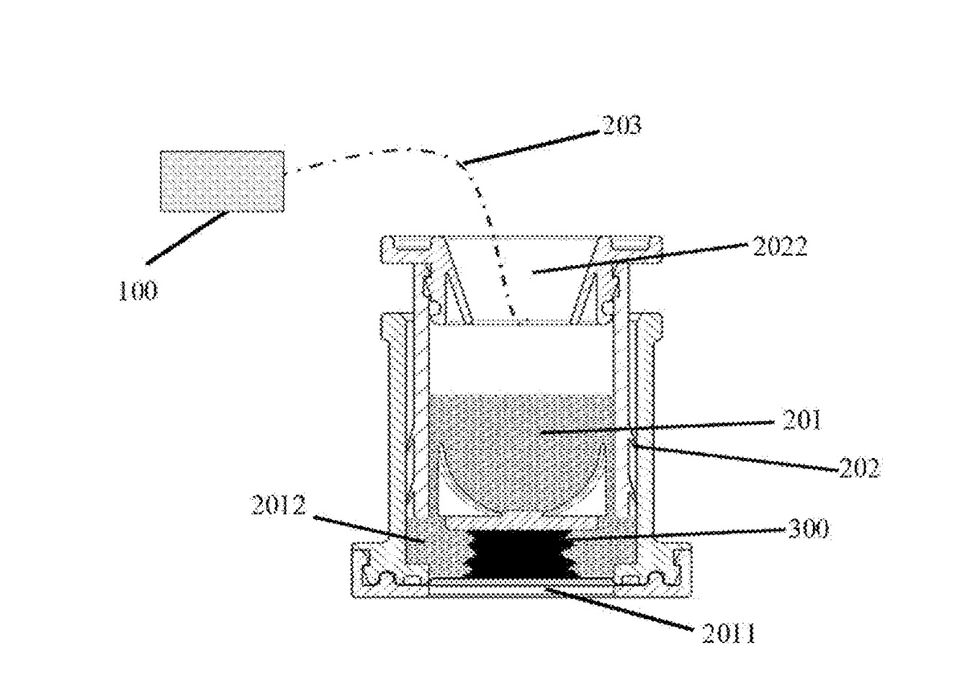
The patents describe a receiving cavity below the forming area. After a layer is cured, the system can inject gas into that cavity, raising the pressure and helping push the forming platform away from the light transmissive assembly.
In other words, it gives the printer a pneumatic assist during the peel step.
The documents describe sensors, air pumps, pressure relief, sealing checks and control logic. One version checks whether the cavity is properly sealed before attempting the release. Another describes using pressure feedback so the system can adjust how much air is used.
Resin printing is not always dealing with easy, watery materials. The applications specifically refer to high viscosity resin, ceramic resin and biomaterial resin. Those are exactly the types of resin materials where release behavior can become a problem.
Thicker resins do not flow back into place as easily, sometimes they are like molasses. Ceramic-loaded resins can be quite heavy and stubborn. Biomaterial resins may have their own handling requirements. In those cases, a cleaner and more controllable release step could be very important, and possible enable printing that otherwise could not be attempted.
All of this air pressure engineering is trying to better solve these questions:
- How reliably does the printer separate each layer?
- How much force does that create on the part?
- How quickly can the vat recover before the next exposure?
- How often does this all go wrong?
These questions become more important as manufacturers try to print larger resin parts, tougher (more viscous) materials, ceramic slurries, dental materials and more specialized photopolymers. At that point the release system becomes part of the machine’s real material capability.
This is a more controlled way to perform the most troublesome part of resin 3D printing: the peel.
There are some questions. Air pumps, sensors and seals mean more hardware. More hardware means more things to calibrate, maintain and eventually troubleshoot. They also mean the system will cost more. The trick would be making the pneumatic system simple enough that it improves reliability, and is low cost.
If Shining 3D can make resin release more reliable, especially for difficult materials, that could genuinely improve the performance of resin 3D printers.
Via Espacenet
