
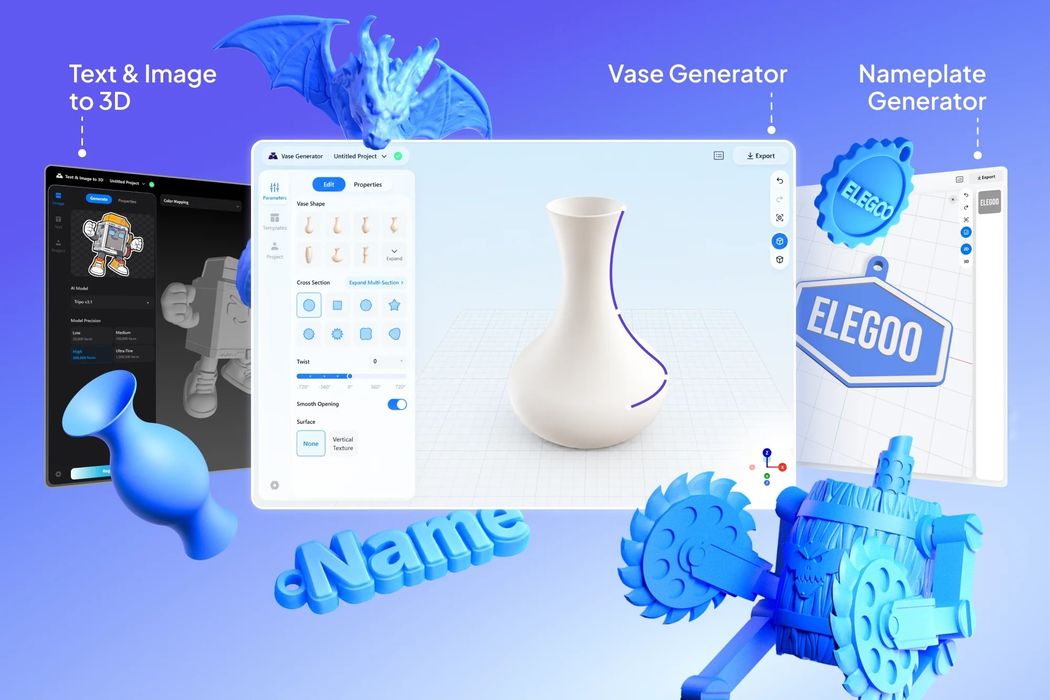
Elegoo has launched something that isn’t a 3D printer.
That’s the part that caught my eye in its announcement of three new Nexprint model generators. One creates models from text prompts, another converts images into 3D forms, and a third turns simple sketches into printable geometry. On the surface, this looks like yet another typical AI feature drop. But I think Elegoo is aiming at a more specific problem.
The hard part of desktop 3D printing has never really been the printer itself. Machines are always becoming cheaper, easier to operate, and generally far more reliable than they were a few years ago. The real bottleneck for many people is getting a model worth printing.
Where, exactly, do these 3D models come from?
If you can’t design in CAD, your choices are usually to download someone else’s file, pay a designer, or spend a lot of time learning software, and often pay a lot for that software. That’s a very big gap for a company like Elegoo, which sells hardware to a market full of hobbyists and occasional makers. In fact, the largest market available to sell 3D printers into is the segment that does not have the capability to design their own 3D models with CAD tools: consumers.
Selling someone a printer is one thing. Making sure they can keep feeding it printable content is quite another. This is the reason why many desktop-level 3D printer manufacturers offer big repositories of 3D models, and why they have apps that easily connect to that content.
So Nexprint’s three-generator approach makes a lot of sense. Text-to-model is the obvious AI play, because it promises instant creation from a written idea. Image-to-model is probably even more useful for many newbies, since a lot of people already have the images, product concepts, cosplay ideas, or some character art they want to turn into physical objects. Sketch-to-model may be the most interesting of the three, simply because it lowers the barrier even further. If you can draw the rough shape, the system tries to take it from there.
That isn’t the same as saying it can create anything you imagine. We’re nowhere near that.
These systems generally do best with decorative forms, simple objects, figurines, concept shapes, and early-stage ideas. They are typically useless when you need precise dimensions, mechanical fit, repeatable tolerances, or a mechanical that has to undergo strong forces. In other words, they can help create printable content, but not necessarily production-ready engineering parts.
For Elegoo, that might be perfectly fine. A huge proportion of desktop resin and FFF activity involves visual objects, prototypes, accessories, miniatures, props, ornaments, and one-off experiments. For those applications, “good enough to print” can be ideal for the consumer market segment.
I also can’t help noticing that this shifts the competitive battlefield a bit. Printer manufacturers used to compete mostly on speed, resolution, build volume, or material compatibility. Now the some companies are moving upstream into model creation itself. That’s a smart move, because if a company can keep customers inside its own content ecosystem, it becomes much easier to sell them the rest of the workflow too.
And there is a workflow angle here. If a beginner can go from idea to rough model without opening Blender or Fusion, then a lot of frustration disappears. You still need slicing, orientation, supports, and probably some repair work, but the empty-screen problem goes away. For many junior 3D printer operators, that’s the moment where 3D printing starts becoming actually useful.
The big promise in Elegoo’s announcement is creative freedom, and that’s the usual marketing line. What seems more realistic to me is that these tools compress model sourcing into a few minutes. That’s already a big deal. Plenty of operators with an idea give it up because they can’t find exactly what they imagined.
Will AI tools eventually let almost anyone create whatever they can imagine? Probably, at least for certain classes of objects. But that future won’t arrive all at once. It’ll show up as small workflow steps like this one, where one more skill barrier disappears.
Elegoo isn’t just adding an AI novelty. It’s just trying to remove the excuse that you had nothing to print.
Via Elegoo
