
A metal 3D printer patent from Divergent Technologies proposes using changing magnetic fields to stir the melt pool and break up structures that can become pores or cracks.
That sounds like a strange thing to do inside a laser powder bed fusion machine. The laser is already melting tiny regions of metal powder. Why add magnets to the process?
The answer is hiding in what happens immediately after the laser moves on. Liquid metal begins to solidify, and tree-like crystal structures called dendrites can form as it does so. Those structures can encourage coarse grains, residual stress and cracks. Small pores are another problem: if they join together, the finished part becomes weaker.
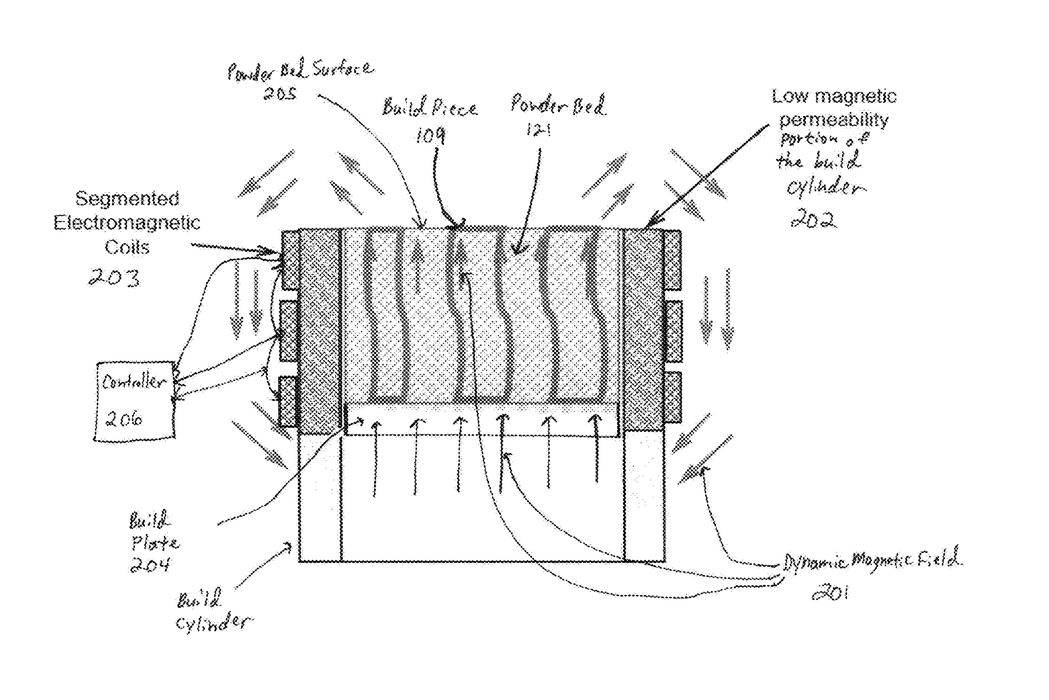
Divergent Technologies, the Los Angeles-based applicant, provides metal 3D print services to industry, particularly automotive aerospace and defense. Their patent describes how to make a melt pool move before those defects become permanent. Its patent application, US20260264149A1, describes a printer with an energy beam and an electromagnet generating a dynamic magnetic field across the build area.
The patent proposes pulsing or reversing a magnetic field, using waveforms such as square, sawtooth or sinusoidal patterns. Segmented coils around the build cylinder could be controlled independently, allowing the field to vary across the build plate.
How does that move molten metal? The patent points to a thermal electromagnetic force. The energy beam creates sharp temperature differences between the hot melt pool and the surrounding material. Those differences generate a thermoelectric current, and the changing magnetic field acts on that current. The result, according to the filing, is a force that drives fluid flow through the liquid metal.
Picture the laser making a small puddle while an invisible stirrer pushes liquid through it. The flow can create a return current between the growing dendrites. That backflow applies force to the dendritic arms, producing small fractures and breaking particles away from them.
Those fragments are not necessarily waste. The patent describes them as new nucleation sites: places where solidification can begin again. More sites could produce finer grains instead of a few large crystal structures. The proposed result is a denser part with improved strength and ductility, plus fewer residual stress cracks.
The patent claims cover the basic method of depositing layers, melting material into a pool and generating the dynamic magnetic field. They also cover a printer system with the energy beam, build plate, electromagnet and controller. A nickel build plate is one specific version, while other drawings show magnetic coils coupled to inlet and exhaust ducts to influence gas flow over the powder.
That last detail hints at how much hardware this could involve. A machine would need coils, power electronics, control software and a build plate designed to guide magnetic flux. The field would also have to be coordinated with laser position, material temperature and solidification timing. Getting the stirring wrong could disturb the powder surface or change the shape of the melt pool.
I like the basic idea. Metal additive manufacturing already tries to control heat, cooling and melt-pool geometry; this adds another way to influence the print results. More controls usually means that someone will figure out how to drive the machine in a better way.
Via Espacenet
