
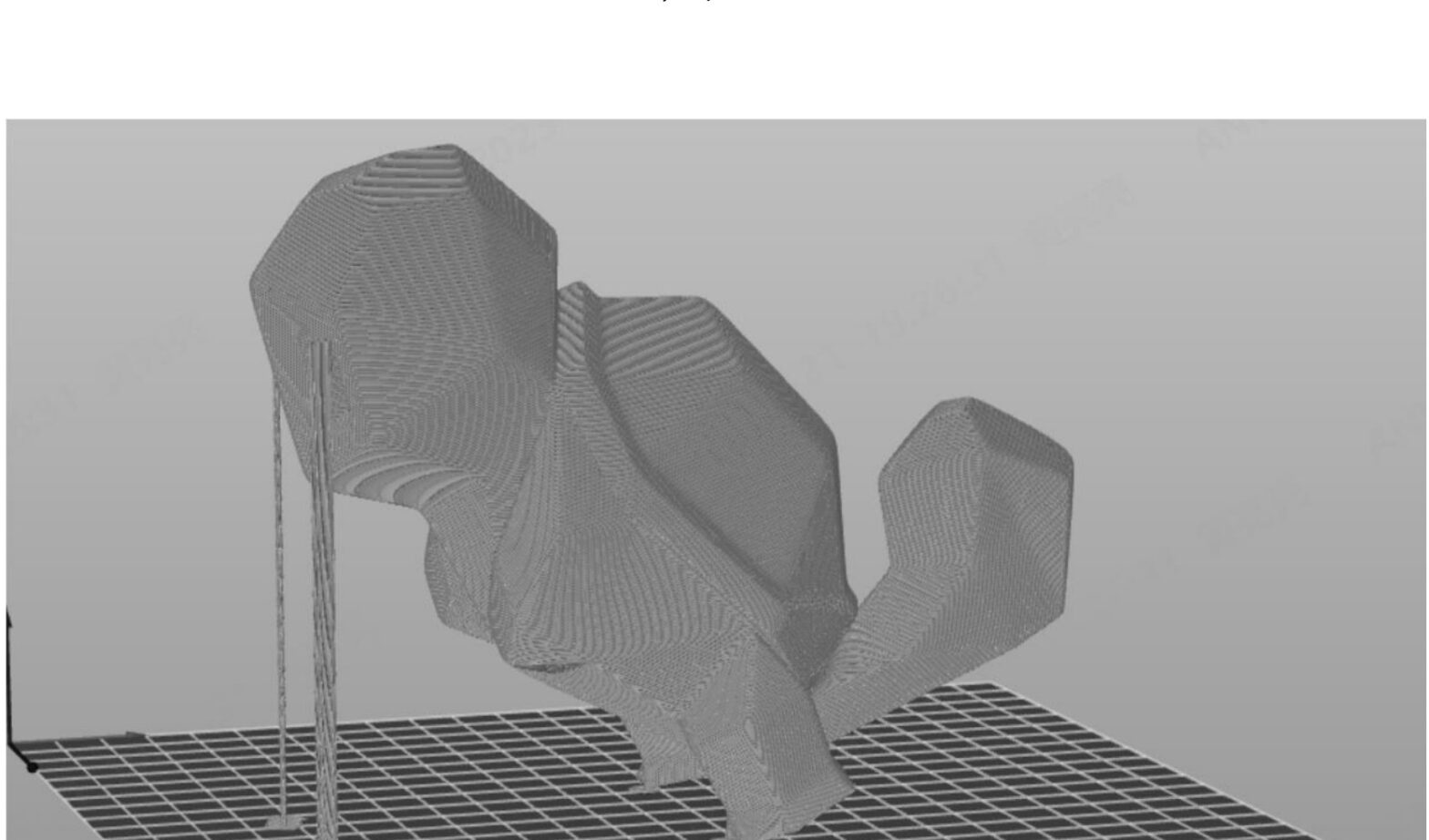
A single colored line may be too little color.
That is the problem hiding inside a recent Anycubic patent application. The filing proposes making each slice’s colored contour thicker before turning it into the image that a color 3D printer will actually print.
The applicant is Shenzhen Chuangwei 3D Technology Co., Ltd., the company better known internationally for Anycubic equipment. Published as CN122724021A, the Chinese patent application concerns slicing colored 3D models, with particular attention to the boundary between the model’s geometry, its texture map and its support structures.
Here is the difficulty: A textured model contains a polygon mesh and a material texture. When slicing software cuts through a triangle in the mesh, it finds an intersection line. The software can calculate the line’s 3D position, but it also has to determine what color belongs at every point along that line.
Anycubic’s method converts the texture coordinates into pixel coordinates, then samples or interpolates the color between the line’s endpoints. The filing lists nearest-neighbor, bilinear and cubic interpolation, along with downsampling approaches. That sounds like regular image processing, but it is necessary if a diagonal slice is to avoid jagged color transitions.
Then comes the more interesting operation: contour thickening.
The original colored contour can be offset inward or outward. The strip between the original line and the offset line becomes the target color region. Colors for the new contour are inherited by matching its intersection points to the original points, followed by pixel-space interpolation along each segment.
Why bother? The patent says a one-line outer wall can make color discontinuous and difficult to attach during color printing. A wider colored region gives the print process more area to work with, and should make the surface color look less broken. Inward offsetting preserves the outside boundary while building thickness inside it; outward offsetting does the opposite, potentially changing the visible edge.
I like this part of the proposal because it treats color as a physical printing problem instead of a texture-rendering problem. A texture may look perfect on your screen and still be delivered by not enough printable pixels or too little material on the actual surface.
But expanding the colored contour creates a second problem. The support geometry generated from the original model may no longer line up with the enlarged color region. Claim 7 in the patent therefore covers adjusting the support information after the contour has been offset.
The support strategy is also tailored to color deposition. The filing describes projecting unsupported mesh regions onto the slice plane, then generating support layers from those coordinates. It suggests selecting the unsupported region with the largest support surface and using solid support near that area, while more distant layers can be hollow.
That setup makes sense if colored ink or coating must be placed accurately on a surface that would otherwise flex. Solid support consumes more material, but a hollow structure under a delicate overhang could allow the target region to shift during printing. The patent also mentions support density, angle and generation algorithm as adjustable parameters.
Another part of the patent is about compatibility. The application describes generating single-color interior voxels and color contour images so that existing monochrome slicing processes can continue handling parts of the job. In theory, that allows a color workflow to be added around an established image-based pipeline instead of replacing everything at once.
The claims are pretty wide, covering the general combination of colored contour information, support information and a generated slice-layer image, along with narrower contour-offset and interpolation techniques. They do not at all confirm that Anycubic has been building a product with these color features, but they do reveal where Anycubic foresees issues in the future with color textures.
Via Espacenet
