
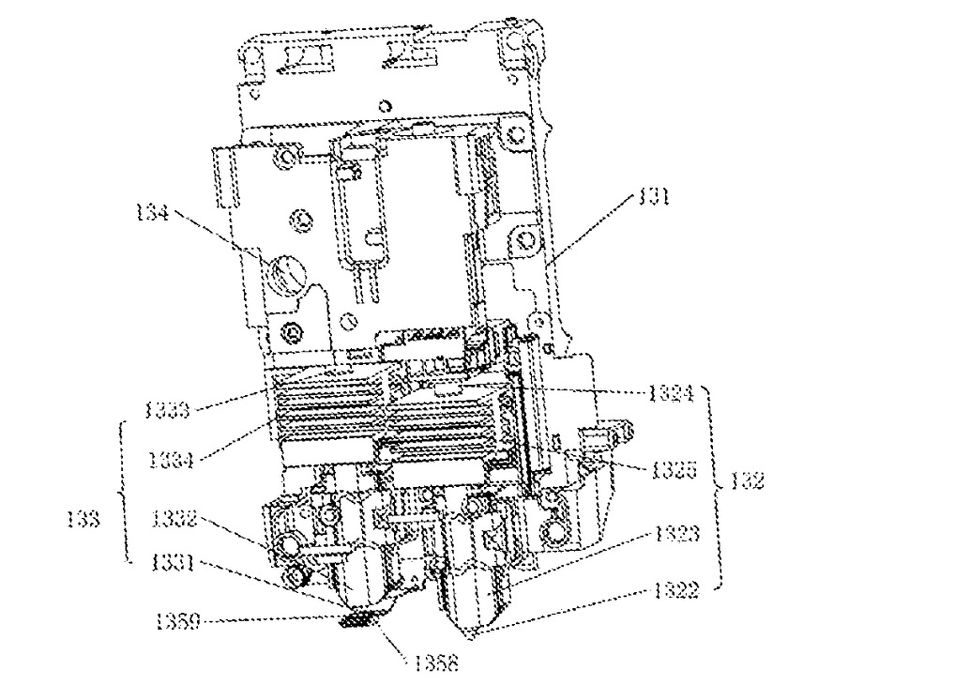
What if a dual-hot end 3D printer could switch nozzles without carrying around another motor?
That’s the idea in Chinese utility patent CN224766075U, assigned to Shenzhen Tuozhu Technology Co., Ltd. If that name isn’t familiar, it should be: Tuozhu is the corporate entity behind Bambu Lab.
The patent describes a printhead carrying two hot end assemblies, with a mechanical system that moves one or both vertically. That part isn’t especially unusual. The interesting bit is what makes them move.
The printhead bumps into the printer, deliberately.
A dual-nozzle system has an obvious problem to solve. While one nozzle is printing, the other needs to stay safely above the work plane. Leave both at exactly the same height and the idle nozzle could drag across freshly printed material, collect blobs, scar the surface or, in a worst case, knock the print loose.
Some mechanism therefore has to raise one nozzle while lowering the other into a repeatable printing position.
You could put a motor, solenoid or some other actuator on the toolhead to do this. That works, but it also means adding more stuff to one of the worst possible places to add stuff: the moving printhead.
There would be extra weight, wiring, controls and additional components that have to survive thousands of rapid movements.
Bambu Lab’s patent takes a much more mechanical approach. The toolhead includes a contact element connected to the hot end lifting mechanism. When the printer wants to switch hot ends, it moves the toolhead to a particular location in the machine. There, the contact element bumps into a corresponding structure on the printer housing. That physical contact operates the lifting mechanism.
One hot end moves out of the way and the other takes its place.
This means the printer itself becomes part of the actuator. There’s no need to carry a dedicated motor around merely to move a nozzle a few millimetres every once in a while.
And moving mass matters quite a bit on a fast desktop 3D printer: The heavier the toolhead, the harder the motion system has to work every time it accelerates, decelerates or changes direction. More mass can contribute to vibration and may require more conservative acceleration or more sophisticated compensation.
The patent doesn’t provide figures showing faster printing or improved print quality from the arrangement, so we shouldn’t assume either. But there’s a clear engineering benefit to removing a motor, associated hardware and wiring from the carriage.
There is also an interesting historical wrinkle here.
This “bump switch” idea will look very familiar to anyone who has spent time around certain Stratasys equipment. Stratasys has used mechanically actuated nozzle-lifting arrangements in professional systems for many years, where movement of the carriage against a fixed feature changes which nozzle is in position. I also saw this technique used on the now-defunct Kodak dual extrusion machine.
That makes Bambu Lab’s Chinese filing particularly interesting.
CN224766075U is a Chinese utility model rather than a US patent, and the filing by itself doesn’t tell us what rights Stratasys may or may not already hold in China, nor whether the precise Bambu Lab mechanism differs enough to stand on its own. Patent protection is territorial, so a technology that has long been protected or used elsewhere doesn’t automatically answer the question of who controls a particular implementation in China.
But it does raise an obvious question: is Bambu Lab attempting to secure Chinese protection around a mechanism whose basic operating principle has existed in Stratasys machines for a very long time?
That would make this patent interesting for reasons beyond the mechanism itself. It may also be a reaction to Stratasys’ recent patent lawsuit against Bambu Lab, which they won in the US. Here, it may be that Bambu Lab is setting up for a reverse scenario in the future.
Via Espacenet
