
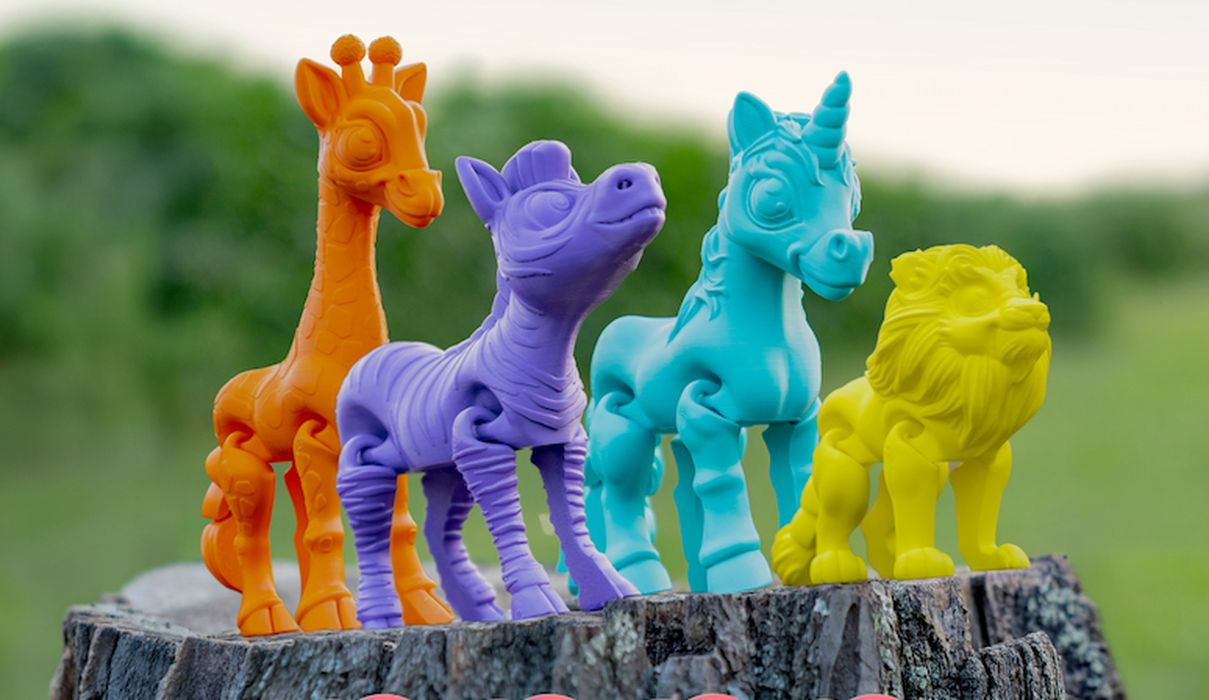
Polymaker has introduced an entirely new material: CoPE.
The company is well known for its extraordinarily broad range of 3D printing materials, and especially its range of colour options, which is far into three digits.
The new CoPE material is part of their Panchroma brand, which mainly focuses on visual appearance, as opposed to their functional material brand. It’s currently available in no less than 27 different colours, at a rather low price point: US$17 per 1kg spool. That seems to be a discount, for some reason; perhaps they’ve dropped the price during the launch period.
But what exactly is this material? The “PE” part of the product name suggests that it is a polyester, and the “Co” suggests it’s a copolyester. You’ve probably used a copolyester already: PETG. PETG is actually PET modified with some glycol.
PETG is a popular 3D print material, like PLA. So what’s the deal with CoPE?
It seems to have very PETG-ish characteristics, with some notable exceptions.
The major difference is that the heat required to print is lower, only 190-230°C. The lower heat requirement also leads to another benefit: high-speed printing.
They say CoPE can be printed at up to 400mm/s, where many materials, especially PETG, fail. It seems that Polymaker has specially designed CoPE for 3D printing at speed.
Polymaker also claims that it provides excellent bridging and overhang performance, as well as excellent bed adhesion on standard PEI-coated print plates. In fact, they even say that it may stick too well on textured plates, so they recommend using smooth plates.
And it’s lower cost than PETG.
So what we seem to have here is a material that is like a low-temperature PETG, but with PETG-like characteristics, unlike standard low-temperature PLA. In other words, a better material to print than PLA. They even say that you can use PLA print settings with CoPE.
Another interesting side effect use for CoPE is as a support material for PLA prints. The idea here is that CoPE does not bond well at all with PLA; in fact, Polymaker designed it that way. This means that if used as a support for PLA, it will easily come off. This could be called “breakaway” support material for PLA.
This means that PLA prints would not have any rough edges from underlying support material, since the model would lie directly on the smooth support surface and cleanly break away after printing.
CoPE looks to be quite an interesting material, and some may even consider it as their default material over PLA due to its interesting properties.
Via Polymaker
