
Charles R. Goulding and Preeti Sulibhavi describe how 3D printed dissolving microneedles could deliver skin cancer drugs directly through the skin, demonstrating a new pharmaceutical application for DLP additive manufacturing.
Skin cancer presents an enormous treatment challenge simply because there is so much of it.
The American Cancer Society estimates that more than 5 million basal cell carcinomas and squamous cell carcinomas are diagnosed in the United States each year, although these cancers are not routinely reported to cancer registries. Melanoma is less common but considerably more dangerous: the ACS estimates that approximately 112,000 new invasive melanoma cases will be diagnosed in the US in 2026, with 8,510 deaths from the disease.
Treatment varies substantially depending on the type and stage of skin cancer. Surgery is commonly used to remove localized tumors, while other approaches can include cryotherapy, radiation, topical medications, immunotherapy and other systemic treatments.
For some superficial skin cancers and precancerous lesions, topical 5-fluorouracil (5-FU) is already an established treatment. But applying a drug to the surface of the skin creates an obvious problem: the skin is very good at keeping things out.
That is where a new combination of drug delivery and additive manufacturing becomes interesting.
A 3D printed drug delivery system
Researchers at Queen’s University Belfast have developed dissolving microneedle patches designed to deliver two active compounds, 5-FU and curcumin, directly into the skin.
The work, published in Advanced Healthcare Materials, is described in the paper “Biphasic Co-Delivery of Curcumin and 5-FU using 3D printed Dissolving Microneedles for Skin Cancer Therapy”.
The concept is relatively simple. Instead of applying a drug-containing cream to the surface, the researchers created an array of microscopic needles on a patch. When the patch is pressed against the skin, the needles penetrate the outer barrier. They then absorb moisture, release their drug payload and dissolve.
That approach could address one of the fundamental limitations of conventional topical drug delivery: getting enough active pharmaceutical ingredient past the stratum corneum and into the tissue below.
It also avoids some of the disadvantages associated with conventional hypodermic needles. The microneedles are designed to dissolve, meaning there is no array of sharp needles that needs to be removed after administration.
For the additive manufacturing industry, however, the most interesting question is not simply why microneedles are useful. It is why 3D printing is particularly well suited to making them.
Why 3D printing makes sense for microneedles
Microneedles occupy an awkward manufacturing space. They are too small for many conventional manufacturing techniques to handle efficiently, but their performance depends heavily on extremely precise geometry.
The height of each needle matters. So does the diameter of its base, the sharpness of its tip and the distance between neighboring needles. Change those parameters and you can change how the patch penetrates the skin, how much drug it can contain and how the material behaves after insertion.
Additive manufacturing provides a digital way to control all of those characteristics.
Several 3D printing technologies have been investigated for microneedle production. Fused deposition modeling is relatively inexpensive, but its resolution can be limiting for structures at this scale. Technologies based on photopolymerization offer much finer control.
Two-photon polymerization can produce exceptionally small features, but it is comparatively slow and requires expensive equipment. That makes stereolithography and digital light processing, or DLP, more attractive for many practical applications.
DLP is particularly interesting because it cures an entire layer of photopolymer at once using projected light rather than tracing every feature individually. That makes it possible to build complex microneedle arrays rapidly while maintaining control over the geometry.
In the Belfast study, the researchers could modify the digital design to control the dimensions and arrangement of the needles before printing. In other words, the manufacturing process becomes partly a software problem.
That is an important distinction from traditional tooling.
A conventional manufacturing process might require new molds, tooling or process development to produce a different patch geometry. With digital additive manufacturing, changing the CAD file can be enough to alter the physical architecture.
For pharmaceutical applications, that flexibility could become particularly valuable.
Printing the drugs into the needles
The researchers went a step further than simply 3D printing a patch and subsequently coating it with medication.
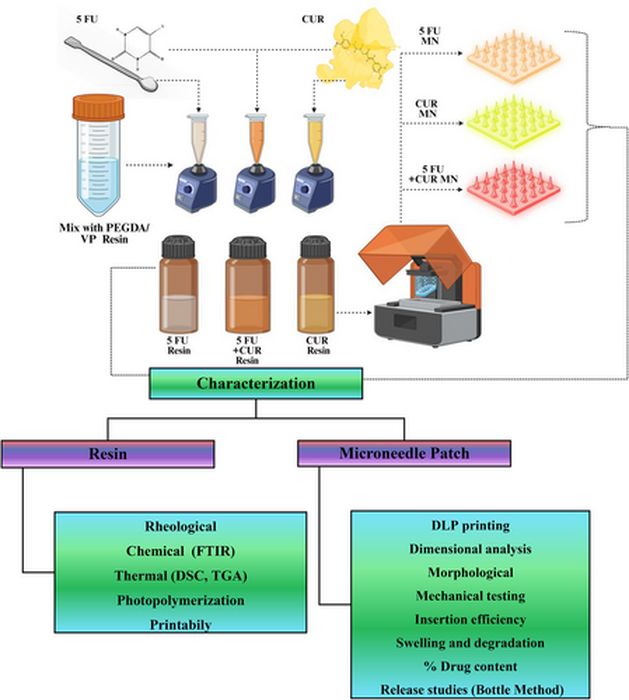
They incorporated curcumin and 5-FU into the photopolymer formulation used to produce the microneedles.
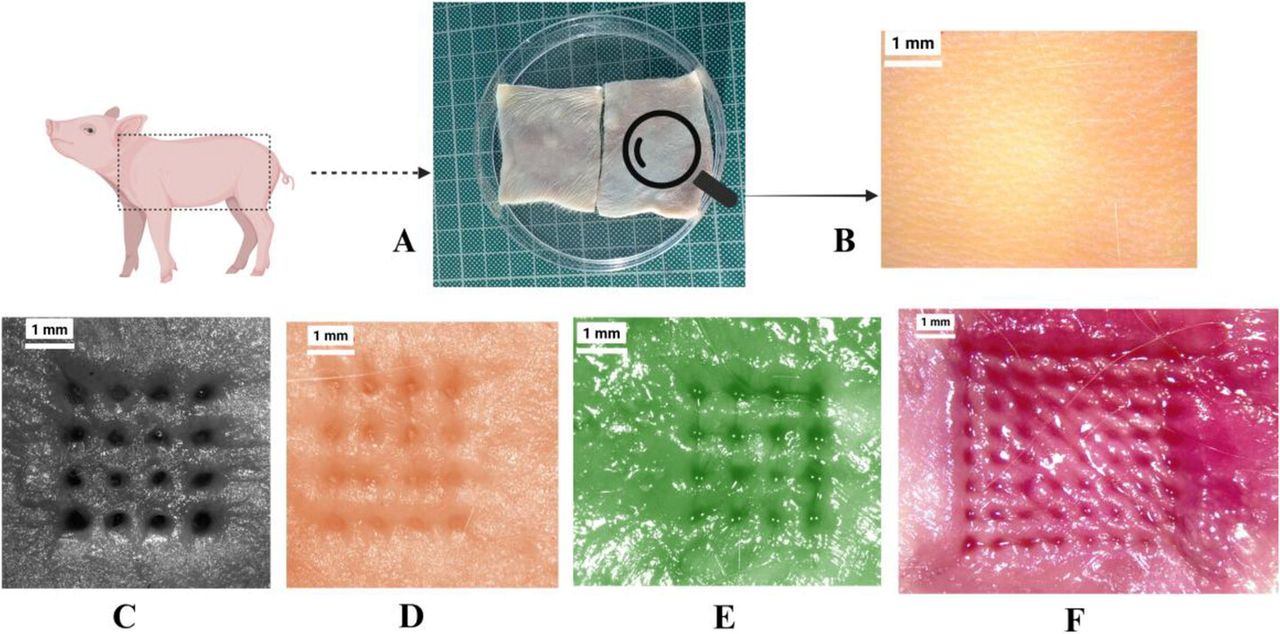
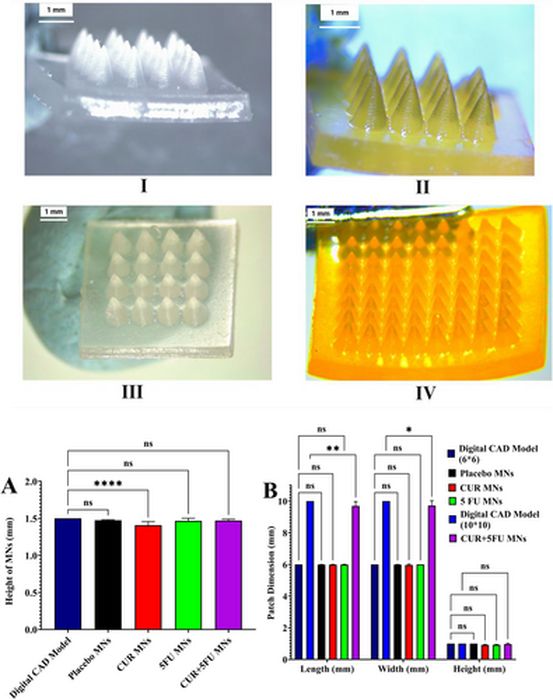
The resulting structures demonstrated high dimensional fidelity to their digital designs. The approximately 1.5-mm-high needles also produced consistent microchannels in laboratory skin models, suggesting that the printed structures had sufficient mechanical strength to penetrate tissue without simply breaking apart.
The drug-release behavior was also different for the two compounds.
5-FU is highly water soluble and was released relatively quickly. Curcumin, which has considerably lower water solubility, showed a different release profile, including an initial release phase followed by a slower release period.
That difference is important because it illustrates another potential advantage of engineering the drug-delivery system rather than simply applying medication to the skin.
The physical structure, polymer chemistry and drug properties can all contribute to how a payload is released.
The researchers describe this as a biphasic co-delivery system, essentially using one small patch to deliver two compounds with different release characteristics.
A potential manufacturing platform, not just a medical device
The larger significance for 3D printing may be the possibility of treating the microneedle patch as a digital pharmaceutical manufacturing platform.
A DLP printer can reproduce an array of thousands of tiny features from a digital design. Changing the design could potentially change the size of the patch, the number and spacing of microneedles or their geometry.
That opens the door to a manufacturing model that is difficult to achieve with fixed tooling.
A future system, for example, could potentially use different digital designs for different treatment areas. Smaller lesions might require smaller patches, while larger areas could use larger arrays. Different formulations could also potentially be developed around different release requirements.
This is not yet the same thing as printing a personalized cancer treatment in a doctor’s office. Significant challenges remain before such a system could become a clinical manufacturing process.
But the underlying manufacturing proposition is compelling: instead of treating the printer as a machine that makes a passive medical device, it becomes part of a process that creates the structure responsible for delivering the medicine.
That is a much broader role for additive manufacturing.
Scaling the technology
DLP also offers a potential route toward higher-volume production.
Unlike a point-by-point manufacturing process, DLP can expose an entire layer simultaneously. Once the printing parameters and material formulation have been established, the same digital design can theoretically be reproduced across multiple production cycles.
That could make DLP attractive for manufacturing microneedle arrays at scale, although laboratory demonstrations are a long way from validated pharmaceutical production.
Industrialization would require much more than simply increasing the number of patches printed per batch.
Manufacturers would need to demonstrate consistent drug concentration, needle dimensions, mechanical strength, dissolution behavior and sterility. The printed products would also need adequate shelf stability and packaging capable of protecting them from environmental conditions.
The researchers encountered some of these issues during their experiments. Curcumin can absorb the light used in photopolymerization, potentially interfering with the printing process. Increasing drug concentrations can also affect polymerization and the resulting needle geometry.
Storage presents another concern. The study found that the formulations and printed patches could be sensitive to factors such as light and temperature.
These are exactly the kinds of issues that become more important as laboratory technology moves toward manufacturing.
Still a long way from clinical treatment
There is also an important medical qualification.
The study demonstrates the fabrication, mechanical performance and drug-release behavior of the microneedle system. It does not establish that the patches are an effective or approved treatment for skin cancer in humans.
Further biological testing is required, including studies examining how the formulation interacts with cancer cells and tissue, followed by appropriate animal studies and, eventually, human clinical trials.
The use of curcumin also warrants caution. While the compound has been investigated extensively for potential biological and anticancer effects, that does not mean that adding curcumin to a 5-FU formulation has been shown to improve outcomes for skin cancer patients.
The current research should therefore be viewed as a promising drug delivery and manufacturing technology rather than a clinically available replacement for existing cancer treatments.
IRC § 41 R&D Credit Relevance of 3D Printing Developments
The 3D printing work described could support R&D qualification under IRC § 41. The DLP 3D printing of dissolving microneedle patches, where the digital design could be modified through CAD to control needle dimensions and arrangement, was developed by researchers using clinical guidelines and protocols. Those activities may satisfy the § 41 four-part test if the costs are eligible § 174A research expenses, the work relies on engineering, physical, biological, or computer-science principles, and the research is intended to improve a business component’s function, performance, reliability, or quality.
The strongest § 41 support is the apparent process of experimentation. The incorporation of 5-FU and curcumin into the photopolymer formulation, testing for microneedle dimensional fidelity and geometry, evaluation of microchannel formation and mechanical strength, and assessment of different drug-release behavior were rigorously developed and tested. These facts align with identifying uncertainty, evaluating alternatives, and using modeling, testing, or systematic trial and error. Further, scale-up potential and unresolved challenges – drug concentration, dimensions, strength, dissolution, sterility, photopolymerization interference, and storage sensitivity – evidence technological uncertainty rather than routine production.
R&D Tax Savers has been helping companies navigate the complexities of the R&D credit since it was introduced into law in 1981.
From 3D printing to digital medicine
The significance of this research extends beyond skin cancer.
3D printing has already demonstrated its value in medical models, prosthetics, implants and surgical tools. Microneedle systems suggest another possibility: using additive manufacturing to create structures that determine how a pharmaceutical compound enters the body.
That is a fundamentally different application of 3D printing.
The ability to digitally control microscopic geometry, combine multiple materials or active ingredients, and reproduce complex structures could eventually give manufacturers new ways to engineer drug-delivery systems.
For Fabbaloo readers, that may be the most important takeaway from this research. The future of medical 3D printing may not be limited to printing something that a doctor puts into a patient. It could also involve printing the mechanism that determines where, when and how a drug is delivered.
There is still substantial research and regulatory work ahead for these particular microneedle patches. But the technology points toward a future in which additive manufacturing and pharmaceutical formulation increasingly overlap.
Alongside preventative measures such as UV protection, skin examinations and early detection, new localized treatment technologies could change how patients receive care. If further research establishes their safety and clinical effectiveness, 3D printed dissolving microneedles could become one example of how additive manufacturing helps make treatment more targeted, adaptable and potentially easier to administer, contributing to better overall healthcare outcomes.