
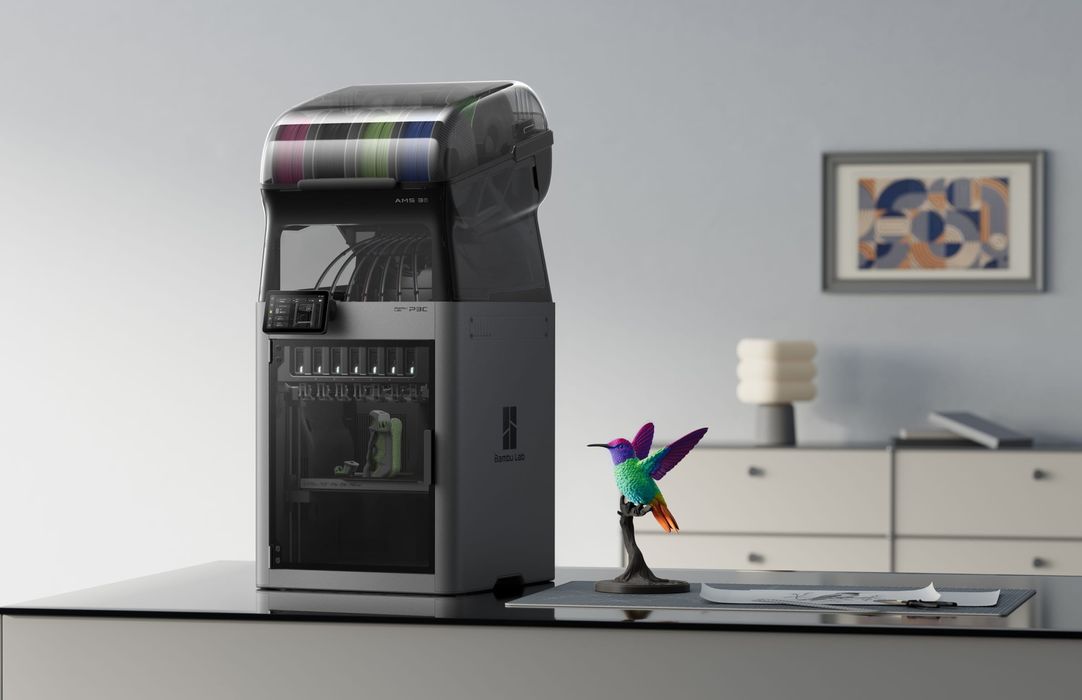
Well, this was a surprise: Bambu Lab announced the P3C yesterday.
I say it is a surprise, even though this particular model was rumored for months, following the company’s actual surprise announcement of the larger H3C system. It’s a surprise because typically the company tends to have a much longer wait for the smaller model to appear.
Nevertheless, we now have a mini-H3C system from Bambu Lab, called the P3C. You might be interested to look through our detailed hands on review of the H3C.
https://www.fabbaloo.com/news/hands-on-with-the-bambu-lab-h3c-3d-printer-part-1
Like its larger sibling, the P3C uses Bambu Lab’s fascinating SwapTek technology. This tech allows six-second color/material swaps to take place during a print job, with minimal material waste. In other words, it can efficiently print multicolor and multimaterial objects, a capability that is rapidly growing in demand.
While the P3C inherits much of the H3C tech, it is a different machine. But what, specifically, is different?
The build volume is one key difference. The P3C’s build volume is 256 x 256 x 260 mm, while the H3C is much larger at 330 x 320 x 325 mm.
The other major difference is in the number of print tools. The H3C has nine, while the P3C has “only” seven, but there are some complications. I’ll explain that shortly.
The build chamber on the P3C is not actively heated, meaning it might have slightly less quality on some 3D-printed parts as compared to the H3C. In addition, the P3C’s nozzles can be heated to 300C, vs 350C on the H3C. The P3C also does not feature automatic filament loading. Presumably, that means the operator has to manually feed the filament to each print tool. But you’d do that only once per job.
Let’s look at the print tool configuration. The H3C comes with eight 1.75mm tools, plus one 2.85mm tool specifically for printing softer TPU materials.
The P3C comes with five 1.75mm tools and leaves two slots empty. This is because they are offering some flexibility: you can add two more 1.75mm tools, or two 2.85mm tools, or a combination.
As for filament drying, the P3C can dry up to two spools at a time, but unlike the H3C, it is an optional feature.
Bambu Lab seems to recognize that there will be many different use cases for the P3C, and is providing several purchase options that allow you to get exactly what you need.
It’s likely a good idea to order the desired configuration from Bambu Lab, rather than later installing the extra optional tools yourself. This is because in my review of the H3C, I found that replacing a print tool is not particularly fun, and some less technically inclined operators would probably have challenges getting it done.
One slot on the P3C includes a buffer, meaning it can accept up to four separate AMS 2 units. In a fully complete configuration, the P3C could theoretically print up to 22 colors/materials in a single print job — but I can’t imagine why you would ever want to do so. Five colors would certainly cover most situations.
Will the P3C perform? It’s hard to say, as we haven’t tested one yet. However, having used the larger H3C I can say that the SwapTek technology does work extremely well, and that will likely be inherited by the P3C. There may be slightly less quality due to some lesser features, but overall I expect the P3C to produce great output in a very efficient manner.
Bambu Lab said:
“The P3C is designed to offer the best value of any tool changer on the market.”
Is this true? The pricing for the P3C is indeed pretty low, and there are several configurations:
- P3C Combo (5 x 1.75mm tools): US$1149
- P3C Multi Colorist Combo (7 x 1.75mm tools) US$1269
- P3C MultiMaterial Combo (6 x 1.75mm, 1 x 2.85mm tools) US$1299
This pricing should be quite competitive with alternative Chinese tool-switching devices, and is significantly less than Prusa’s flagship INDX system.
That company’s four-tool INDX system is currently priced at US$1,999, US$850 less than the five-tool base P3C. Prusa’s eight-tool INDX system is priced at US$2,249, US$950 more than the seven-tool P3C MultiMaterial Combo. I suspect Prusa will find the price points of the P3C systems devastating.
The Chinese competitors could find it challenging to beat the P3C at this price, since Bambu Lab equipment directly integrates with their vast ecosystem, which includes filaments, resellers, spare parts, 3D models, software tools, and more. For about the same price, Bambu Lab’s ecosystem is larger than the alternatives.
The P3C is available for order right now, and it appears they have units ready for shipping. If that is true, then competitors could be in a bit of a pickle if they don’t also have their machines ready to roll — and many have only announced their equipment and have yet to ship them.
Via Bambu Lab