There’s an interesting patent application from Stanford University and the University of North Carolina at Chapel Hill that shows how an existing 3D printing technology can be substantially improved.
And apparently patented, too.
The application, US20260294795A1, describes a high resolution resin 3D printing system capable of producing incredibly small structures, including features measuring only six microns across.
What’s interesting is that the researchers didn’t invent an entirely new 3D printing process. Instead, they took the established Continuous Liquid Interface Production (CLIP) process and developed a series of improvements that dramatically increase its resolution.
CLIP, originally developed by Carbon, is a resin 3D printing process that uses an oxygen permeable window beneath the resin. Oxygen creates a very thin uncured region that prevents the growing object from sticking to the window.
This allows printing to proceed continuously, avoiding the repeated separation steps required by conventional resin systems.
Carbon has commercialized this technology for years, and the patent even includes a comparison with the company’s L1 and M2 equipment. But there’s a problem with using CLIP for microscopic structures: resolution.
The Carbon machines have projected pixel sizes measured in tens of microns, which is perfectly reasonable for their intended applications, which lately seems to be footwear and sports products. However, that resolution isn’t fine enough to produce the tiny structures required for some biomedical applications.
The researchers’ solution was to substantially modify the optical system.
They developed a projection arrangement using a digital micromirror device, microscope objectives and additional lenses. By reducing the projected image, they were able to achieve pixel sizes as small as 1.5 microns. That’s an enormous improvement over typical commercial CLIP equipment.
However, having tiny pixels doesn’t necessarily mean you can print equally tiny objects. Resin behavior, light scattering and other effects interfere with the process.
The researchers demonstrated consistently printed lines measuring around six microns, along with holes as small as 18 microns. That’s impressive, but they found another issue. At these microscopic dimensions, focusing becomes extremely difficult. The researchers found that the optical system had a depth of focus of only around 14 microns. A slight movement of the resin window or build surface could ruin the print.
To overcome this problem, they developed an optical monitoring arrangement using a camera, beam splitter and strobe lighting. The system can examine the projected image and determine the correct focal position.
This could make the process considerably more reliable, especially when changing materials or optical configurations.
They also investigated resin flow during printing. At these dimensions, resin must move through extremely small gaps, and the researchers developed models to determine appropriate printing speeds.
The results are quite remarkable.
The researchers printed a 20mm tall lattice structure in approximately 90 minutes. For comparison, they report a much smaller 200 micron structure taking more than 48 hours using two photon polymerization, although the two examples aren’t quite the same.
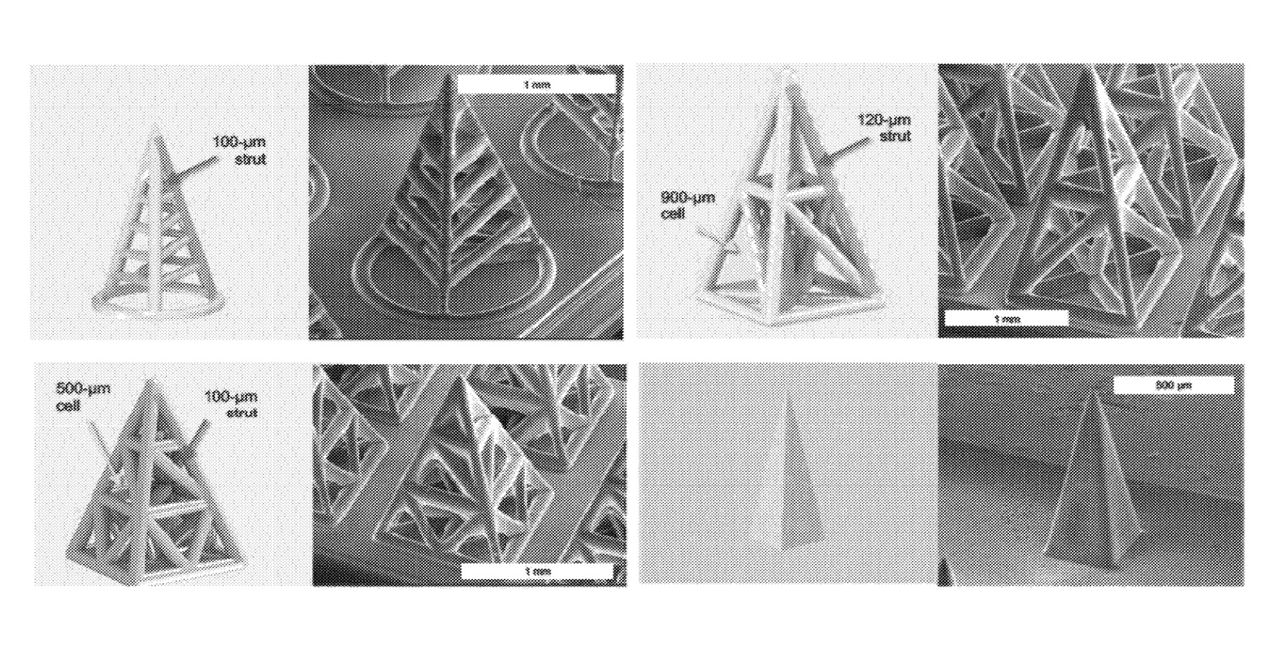
The intended application is quite fascinating: microscopic needles for medical use. These aren’t typical solid needles. They contain complex internal lattice structures, with different densities and geometries along their lengths. The structures could potentially carry medication, absorb biological samples or dissolve in controlled ways after insertion into the skin.
But I find another aspect of this patent particulary interesting.
The researchers have essentially taken an established commercial 3D printing process and engineered it to perform at a completely different scale.
There’s nothing inherently unusual about modifying existing equipment for research. Laboratories have been doing that for decades. What is interesting here is the patent coverage.
The application doesn’t just describe the resulting microneedles. It also includes claims directed at the printing system itself, including the specialized optical components, monitoring arrangements and production methods.
In other words, the applicants are seeking protection for specific improvements to an existing process, one that belongs to another company, along with the biomedical structures produced.
That doesn’t mean they’ve patented CLIP itself, nor does the application establish that the proposed claims will ultimately be granted. The specific combinations and methods described would have to satisfy the usual patentability requirements.
It also doesn’t necessarily mean the researchers modified a production Carbon machine. The disclosed system is a specialized CLIP implementation, while Carbon’s equipment provides a useful commercial reference point.
Nevertheless, this is a pretty intriguing example of how additive manufacturing technology can evolve.
A commercial process may be well established, but that doesn’t mean its capabilities have been exhausted. Quite substantial improvements remain possible through different optics, better controls and careful process engineering.
Via Espacenet