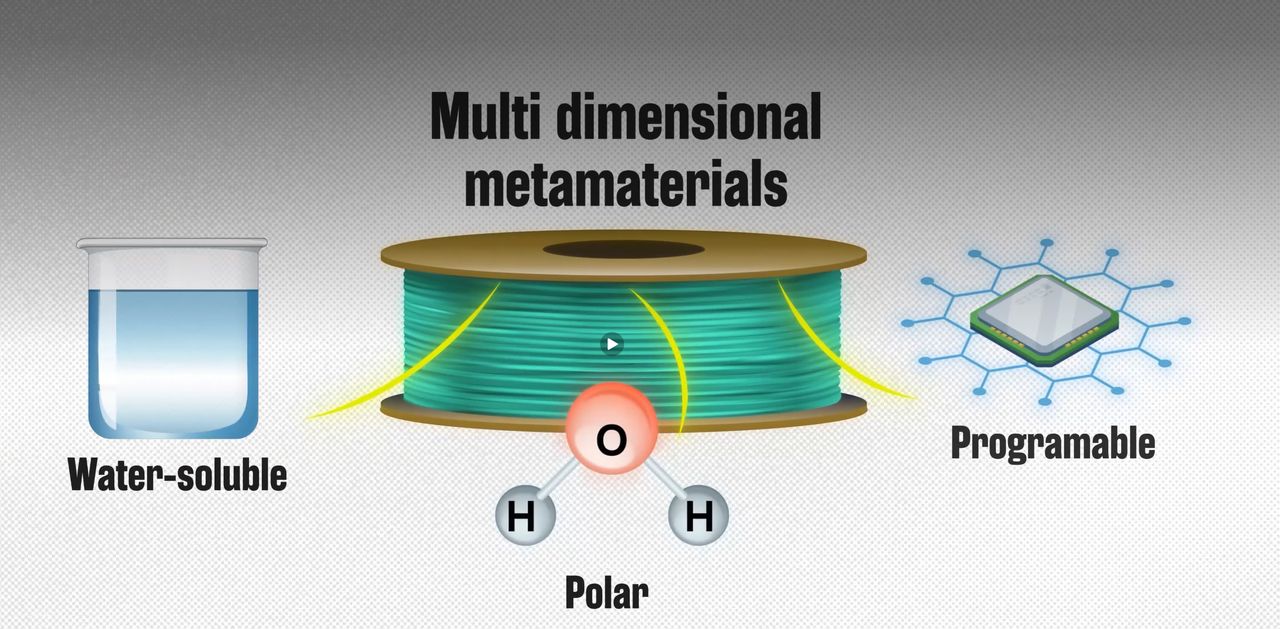
A startup company wants to purposely use wet filament.
Anyone operating an FFF 3D printer knows that moisture is the enemy. Wet filament can produce bubbles, inconsistent extrusion, poor surface quality, and weak parts. That’s why filament dryers have become standard accessories for many operators.
But a new patent application from Florida-based String Cubed proposes doing exactly the opposite: purposely loading filament with water.
Why the heck would you do this?
String Cubed is a company founded in 2023 by Manuel Rendon, who also founded Timeplast, a company we’ve covered previously. Timeplast has spent years developing polymers with programmable lifespans, including materials designed to dissolve under predetermined conditions. They can, for example, print bars of soap.
The two companies are closely connected. Timeplast markets specialty 3D printing filaments under its TimeMass brand, while String Cubed develops formulations and related technologies.
One of those technologies appears in patent application US20260061664A1, entitled Vapor Cooling 3D Printing for Bio Active and Heat Labile Materials.
Regular FFF print temperatures can destroy sensitive ingredients, including proteins, enzymes, pharmaceuticals, fragrances, and many more materials that have never been considered as 3D print materials. This prevents many possibly useful materials from being printed through typical hot ends.
String Cubed’s approach is to incorporate water directly into the polymer.
The patent describes saturating a water-compatible thermoplastic, preferably highly hydrolyzed PVA, until it forms a hydrated gel. This material is processed into pellets, which are then partially dried to produce a relatively dry exterior while retaining a lot of moisture inside.
The conditioned pellets could contain 20–40% water by weight. Heat-sensitive ingredients are added, and the resulting material can be processed into filament or fed directly into a pellet extrusion system.
When this material enters a hot end operating around 200C, the internal water begins vaporizing. That phase change absorbs considerable energy, potentially preventing the surrounding material from reaching the nozzle’s full temperature.
The idea is that sensitive ingredients can pass through the hot end without experiencing damaging temperatures.
String Cubed describes experiments using this approach, including producing 1.75mm filament containing soap ingredients. The patent reports successfully printing small soap bars at approximately 195C that retained their fragrance and foaming ability.
Other reported experiments involved cinnamon, dyes, probiotics, and seeds. The company says it has developed more than ten functional filament formulations.
The patent says that some experiments required reduced printing speeds and careful moisture management to avoid excessive steam generation. Some printed objects also exhibited porosity. These complications could make the process harder to implement reliably.
Nevertheless, the underlying concept might be sound — even though it sounds a bit crazy at first — and the potential applications could be interesting.
String Cubed has much larger ambitions involving biological materials and autonomous functional objects, although those remain far beyond what’s demonstrated here. You can see more at their website, but be warned: it is filled with a lot of suspicious-looking material.
Via String Cubed and Google Patents