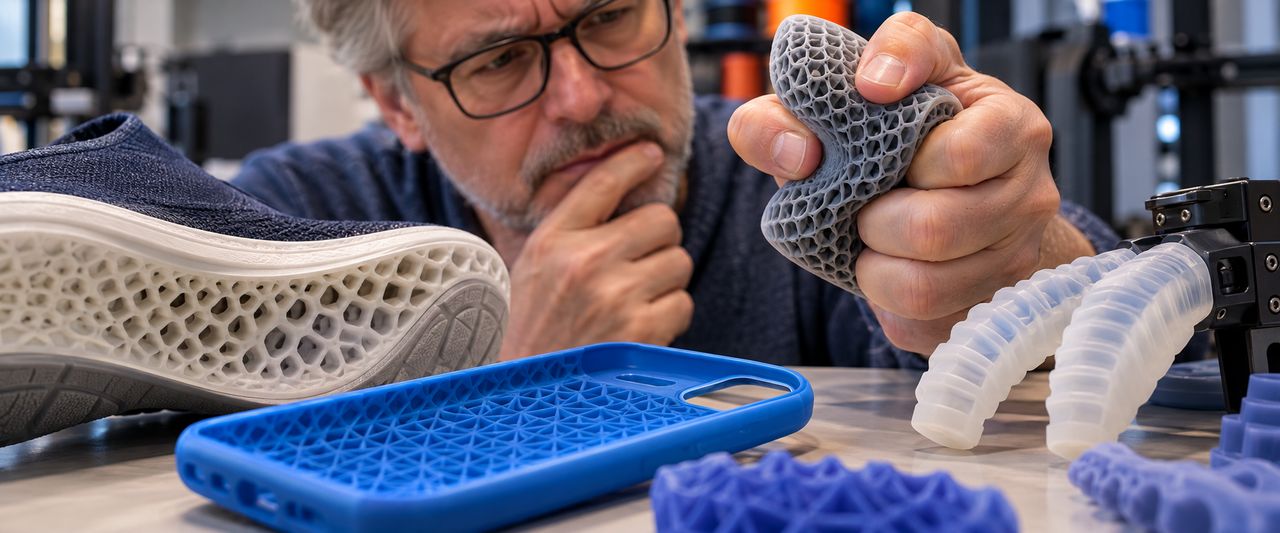
Soft 3D printed parts have a timing problem.
A phone case, shoe sole or flexible gripper doesn’t “deform” when force is applied. It might stretch easily at first, become harder to stretch, slowly relax under a held load, and react differently when squeezed quickly. That is the rather strange mechanical property described as visco-hyperelastic behavior.
The research behind 3D Printing of Soft Composites with Tunable Visco-Hyperelastic Properties examines that behavior. Their intriguing idea is that a soft printed object need not inherit one fixed property from its base material. By making it a composite, the response can be specifically designed.
That sounds obvious until you consider how soft parts are commonly specified. A material’s datasheet might list hardness, tensile strength and elongation, but those figures don’t fully tell you how a part will actually behave when used in a part. A soft polymer can be durable yet be stiff under a fast impact. Another can be stable initially but creep when left under load. You get the idea here: soft materials have all kinds of strange behavior.
Hyperelasticity describes the large, nonlinear deformation familiar to anyone who has stretched silicone or an elastomer. Viscoelasticity adds time: the material response changes with loading rate and can relax after deformation. Put them together and you have the sort of mechanical behavior needed for many biological, wearable and cushioning applications — but also a much harder design problem.
Composites provide another control knob. A compliant matrix carries most of the deformation, while a second phase can redirect stresses, constrain local stretching or stiffen selected regions. The twist in additive manufacturing is placement: A molded composite might spread reinforcement through a volume, but 3D printing can potentially put it only where a designer wants it.
That means the internal arrangement can be as important as the ingredient list. Change the amount, geometry or orientation of a reinforcing phase and a part may bend, compress and recover differently without changing its outside shape.
Designers of soft products often have to choose among separate materials to obtain different feel or function. A tunable composite approach suggests a different path: build variation into the part itself. One region could be intended to flex readily, another to resist compression, and a transition between them could be gradual rather than a troublesome bonded joint.
The paper focuses on characterizing that nonlinear behavior, rather than just a basic tensile test. That’s important for soft structures. A specimen pulled once until failure can reveal strength, but it says not much about repeated deformation, recovery or whether the response shifts when loading becomes faster.
I can see why this is interesting for soft robotic applications. A gripper finger, for example, has to be compliant enough to conform around an object while remaining firm enough to transmit force. Those requirements contradict each other when the finger is made from one uniform elastomer. A composite with tunable internal behavior could make that design a lot easier.
As 3D printing moves deeper into functional flexible parts, the question will increasingly be about exactly how it moves over time.
Via 3D Printing of Soft Composites with Tunable Visco-Hyperelastic Properties