
A multi-material 3D print can look perfect and still break apart where its materials meet.
That’s the concern raised by Catalin Croitoru, Ionuț Claudiu Roată and Arthur Olah of Transilvania University of Brasov in a new review of multi-polymer Fused Filament Fabrication (FFF) technology. They examined 231 references covering the ways different polymers are joined, including some surprisingly large differences in joint strength.
The timing of this report is quite appropriate. Automated filament switching, independent extruders and toolchanging systems are making it increasingly easy to print several materials in one job. A rigid body with a flexible grip, for example, can be printed as a single object without adhesives or assembly.
But printing two materials in the correct locations doesn’t guarantee that they’ll remain attached.
When a hot extrusion contacts previously deposited plastic, the surfaces must first make contact. While they’re warm enough, polymer molecules can move across the boundary and become entangled. That’s how a strong bond develops.
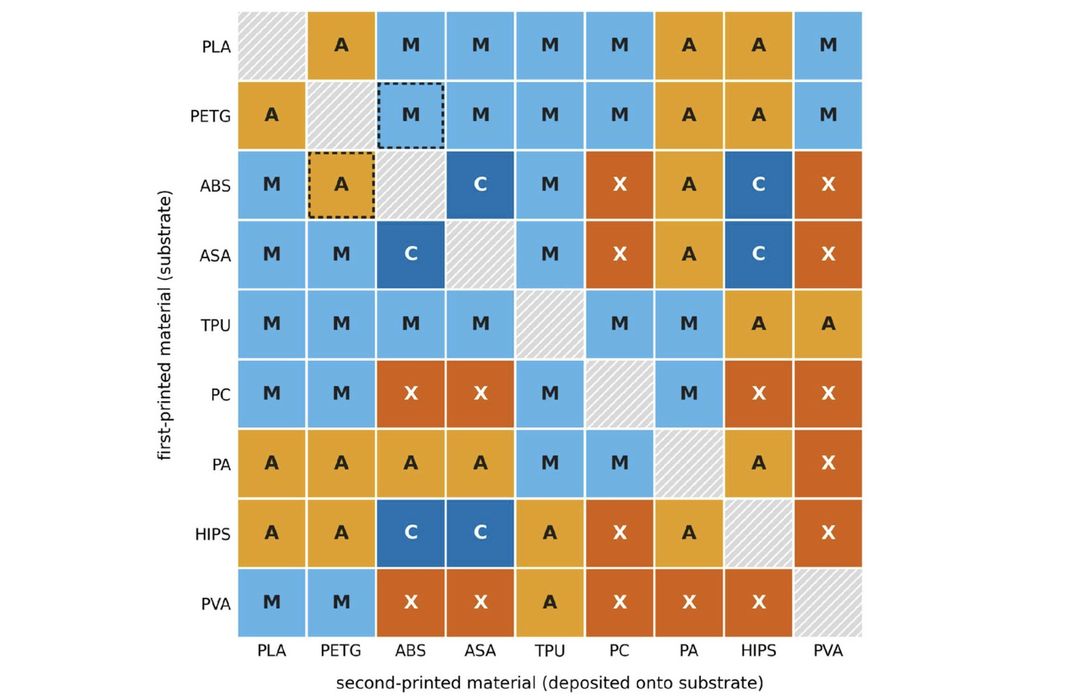
Different polymers complicate this process. Their molecules may have little affinity for each other, their processing temperatures may not overlap sufficiently, and they can shrink at different rates during cooling. The result is often a boundary much weaker than either material by itself. The review reports that some rigid–elastomer joints achieve only around 30–40% of comparable same-material strength.
One finding is particularly interesting: even the print order can change the result.
In research cited by the authors, depositing ABS onto PETG produced an interfacial tensile strength of approximately 23 MPa. Printing the same polymers in reverse order produced only about 13 MPa. Nothing fundamental changed about the material pair. The second material simply arrived with a different thermal history, and that seems to have changed how much bonding took place.
That suggests material selection alone isn’t enough. Print orientation, deposition sequence and the slicer’s handling of material boundaries deserve attention too.
Fortunately, there are ways around weak chemical bonding.
One is to make the two materials physically grab each other. Instead of a flat dividing line, a 3D designer can use interlocking teeth, for example. The review cites PLA–TPU interfaces whose fracture toughness increased by a factor of 16–18 using an interlocking geometry. That’s an impressive improvement, although such features can also introduce stress concentrations.
Another approach is to replace an abrupt material boundary with a gradual transition. Where the polymers can actually be blended, a graded region spreads the load instead of concentrating it along one joint. This requires the right pairs of materials and equipment that can actually blend them. Tip: there really aren’t any.
Heating the interface immediately before the next extrusion line arrives can help too. One cited study increased fracture toughness in carbon fibre reinforced polyamide/TPU joints from approximately 12.3 to 33.4 kJ/m² using near-nozzle heating. That’s a specific material combination, not a universal recipe. This is something that we could see appearing in future FFF systems.
There’s even a use for this problem: PLA and PETG bond so poorly that they can become breakaway supports for each other. Weak adhesion is sometimes exactly what the operator wants.
Because this paper is a review of previous research, there are no new printing experiments performed here. However, the researchers kept encountering a big obstacle: other researchers measure joint performance with many different test geometries and methods. Results aren’t easily comparable, especially for high-temperature materials, and long-term fatigue behaviour in particular is less understood.
As multi-material FFF moves beyond colourful objects toward functional parts, I suspect slicers will eventually need to treat the material boundary as carefully as they treat the object’s shape.