
Charles R. Goulding and Preeti Sulibhavi show how the humble home 3D printer is becoming a powerful fix-it tool for replacing hard-to-find parts and extending the life of everyday products.
It is always nice to see a leading publication like the Wall Street Journal have in-depth coverage of 3D printing. Its August 24, 2026, Personal Journal article, “Why Buy It When You Can Print It? A DIY Nation Has a Fix for Broken Doodads,” looks at a simple but increasingly useful idea: when a small household object breaks, you don’t necessarily have to replace the entire thing. You may be able to print the missing or broken piece instead.
The WSJ article profiles DIY enthusiasts who use desktop 3D printers, library machines and makerspaces to produce replacement parts and customized household objects. Examples include replacement tabs, levers, hooks and appliance components. The larger point is that 3D printing is becoming less about making decorative models and more about solving ordinary household problems. Find a suitable model online, measure the broken component or design a replacement, print it, test it and revise it if necessary.
That approach opens up a surprisingly broad range of possibilities.
Pet Accessories: Print the Small Parts That Disappear
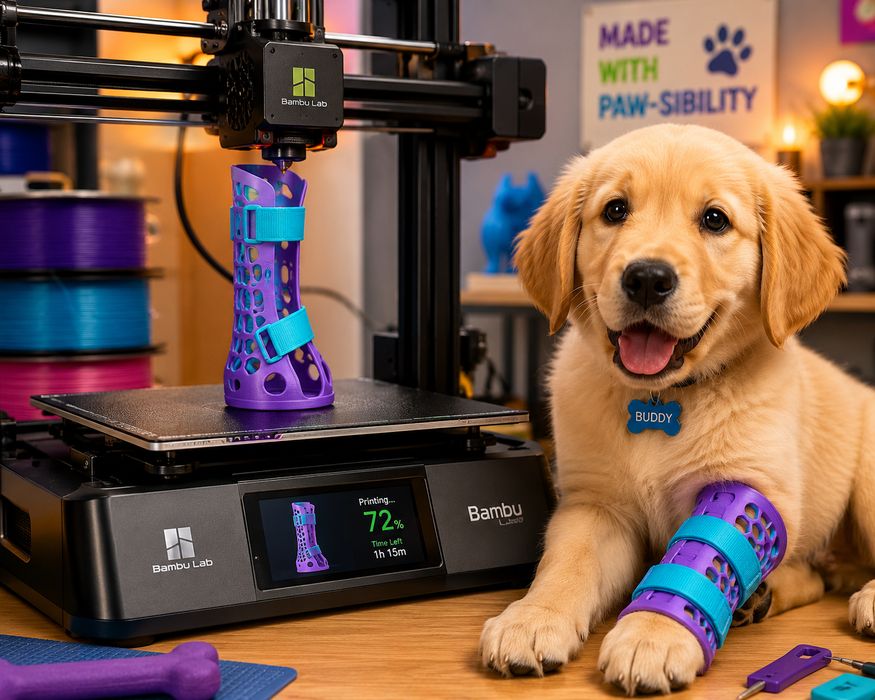
The pet industry is booming. According to data from the American Pet Products Association (APPA), approximately 95 million US households own at least one pet. Last year, Americans spent nearly US$158 billion on their pets. So, pet products are a natural fit for home 3D printing because they contain plenty of small, plastic components that can break, wear out or simply get lost.
A dog owner might print a replacement clip for a leash, a mounting bracket for a GPS tracker, a custom holder for a pet’s food or water bowl, or a replacement tab for a pooper scooper. Cat owners could make replacement feet for a scratching post, a custom wall-mounted toy holder or a small adapter for a feeding station.
The opportunity isn’t limited to replacement parts. A printer can also produce accessories customized to the animal. For example, a slow-feeder insert can be sized to fit an existing bowl, while an elevated bowl stand can be designed around the height of a particular dog.
Fabbaloo has previously looked at the broader role of additive manufacturing in pet care, including customized pet supplies, toys and even prosthetics. In “3D Printing Unleashed: Innovations for Pets and Vets,” the site noted that printable pet products can include personalized ID tags, collars, feeders and interactive toys.
Furniture: Don’t Throw Out the Chair
Furniture is another excellent example because a surprisingly small plastic component can make an otherwise perfectly usable piece of furniture unusable.
Imagine a sofa with a broken reclining lever, a desk missing a cable-management clip, a cabinet with a cracked drawer stop or an office chair with a missing plastic cover. In many cases, the manufacturer may no longer sell the individual component. Even when it does, shipping a tiny part can seem absurd.
A replacement can often be designed from the surviving piece. The owner can measure the original, create a basic CAD model and print several versions until the fit is right. For parts that need flexibility, impact resistance or greater strength, the choice of filament becomes part of the repair process.
That is consistent with the larger direction of furniture manufacturing. We have previously examined how additive manufacturing could affect office furniture in its coverage of HNI’s acquisition of Steelcase, including the potential for 3D printing to enable customized furniture components and products.
Bath and Plumbing: Print the Non-Critical Pieces
Bathrooms contain plenty of plastic accessories that lend themselves to 3D printing.
A homeowner could make a replacement shower-head holder, toothbrush holder, soap dish bracket, drain cover, toilet-paper holder component or mounting clip. A broken plastic collar or decorative escutcheon around a fixture could also potentially be reproduced if the geometry is straightforward.
There is an important distinction, however: a DIY printer isn’t a substitute for proper plumbing components where failure could cause a leak or other damage. A printed bracket or cover is one thing; a pressure-bearing fitting connected to a water supply is another.
Still, 3D printing’s ability to produce custom bathroom components has been explored for years. Our earlier coverage of touchless bathroom design showed how additive manufacturing can be used to create customized bathroom hardware and accessories.
The same principle applies to repairs: if the commercially available replacement doesn’t exist, customization can fill the gap.
HVAC: Small Parts, Big Convenience
Heating, ventilation and air-conditioning equipment might not seem like an obvious home 3D printing application, but there are plenty of non-critical accessories that could be made this way.
Think of a replacement vent cover clip, thermostat wall-mount spacer, cable-management bracket, air-filter holder component or small access-panel fastener. An owner could also print a custom adapter or bracket to organize wires and sensors around an HVAC installation.
Again, the key is knowing what should and shouldn’t be printed. Components exposed to high temperatures, combustion, pressure or safety-critical mechanical loads deserve appropriate engineered materials and professionally specified parts.
We have been covering both the HVAC industry’s growth and its connection to plumbing distribution. Those stories illustrate just how many components and accessories exist around these systems.
Kitchen Accessories: Customize Instead of Replace
The kitchen may be the ultimate DIY 3D printing laboratory.
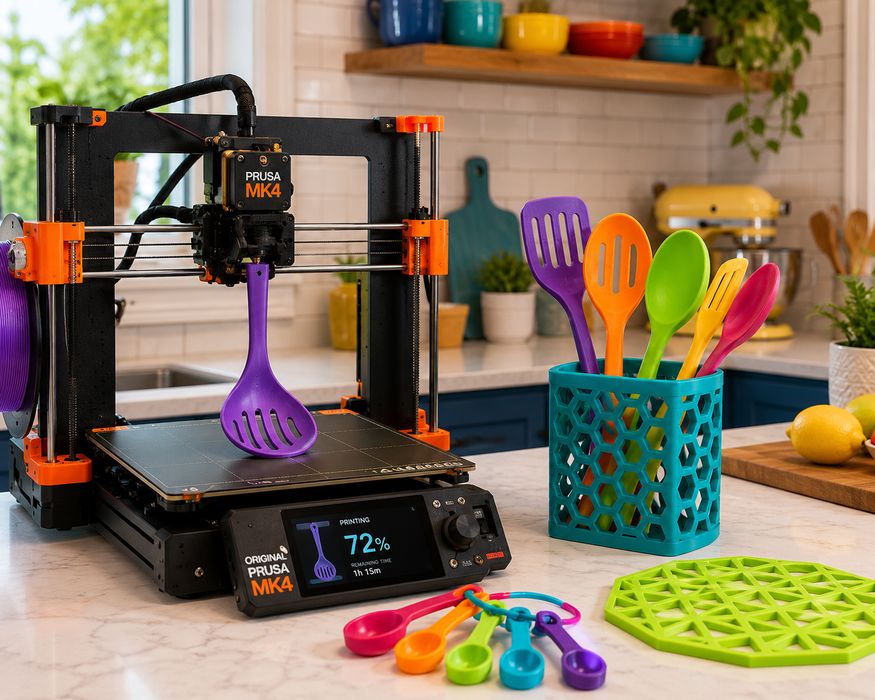
A broken refrigerator shelf clip, dishwasher rack wheel, cabinet bumper, drawer divider, appliance knob, pot-lid holder or under-cabinet mounting bracket can turn into a small repair project. Many of these objects are geometrically simple, making them relatively approachable for someone learning basic CAD.
There is also a customization opportunity. Instead of buying a generic spice rack, utensil organizer or cabinet insert, a homeowner can design one around the dimensions of a particular drawer or cupboard.
We recently explored the relationship between 3D printing and kitchen cabinetry, particularly the advantages of customization. The same idea applies at the household level: once you can manufacture a component to a precise dimension, you’re no longer restricted to what happens to be available on a store shelf.
The Desktop Printers Are Getting Better at This
The hardware ecosystem is also making the DIY repair idea more practical.
Fabbaloo has been following Bambu Lab’s A2L large-format desktop 3D printer, which gives makers a larger 330 × 320 × 325 mm build volume. That extra capacity isn’t necessary for a replacement clip, of course, but it expands the range of household objects that can be produced in one piece.
Kerry Stevenson has also been tracking Creality’s KliTek nozzle-swapping system. KliTek is aimed at reducing waste from filament changes and supports multiple TPU materials, which is particularly interesting for DIY users making flexible replacement components.
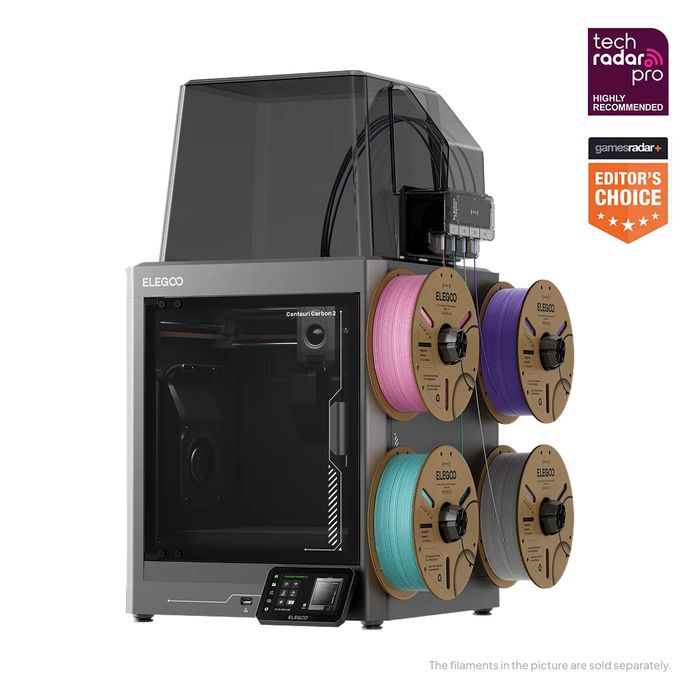
And Kerry has covered the developments of Elegoo’s Centauri 2 series, another example of desktop FFF systems becoming faster and more automated for everyday makers.
The Research and Development (R&D) Tax Credit
For those DIY-ers who become intrigued enough with their 3D printers and decide to become entrepreneurs, the U.S. has an engineering-based tax incentive called the research and development (R&D) tax credit that has a unique provision for startups.
For those building a business with less than five years of sales and under US$5 million in annual sales, the R&D payroll tax rebate can offer up to US$500,000 in payroll cash rebates for up to five years, amounting to US$2,500,000. The startup must meet stringent IRS criteria and must have qualifying expenses, like payroll.
R&D Tax Savers has been helping companies navigate the complexities of the R&D tax credit since it was introduced into law in 1981.
The Real Revolution Is in the Repair
The most interesting thing about the WSJ story isn’t that people can print plastic objects. We’ve known that for years.
What’s changing is the mindset.
A broken household object used to mean a trip to the hardware store, a search for an obscure replacement part or, in the worst case, throwing the entire object away. A desktop 3D printer introduces another option: make the missing piece yourself.
It won’t work for every repair, and safety-critical components should still be replaced with properly engineered parts. But for the growing category of clips, brackets, handles, covers, organizers, mounts and other everyday plastic components, the home 3D printer can become something much more useful than a gadget for making figurines.
It can become the fix-it tool sitting on the workbench, for a DIY culture that is becoming increasingly popular.