

A recently published patent application describes a way to make polymer powder 3D prints much stiffer.
The proposed treatment is straightforward: coat the printed object with epoxy resin and let it cure.
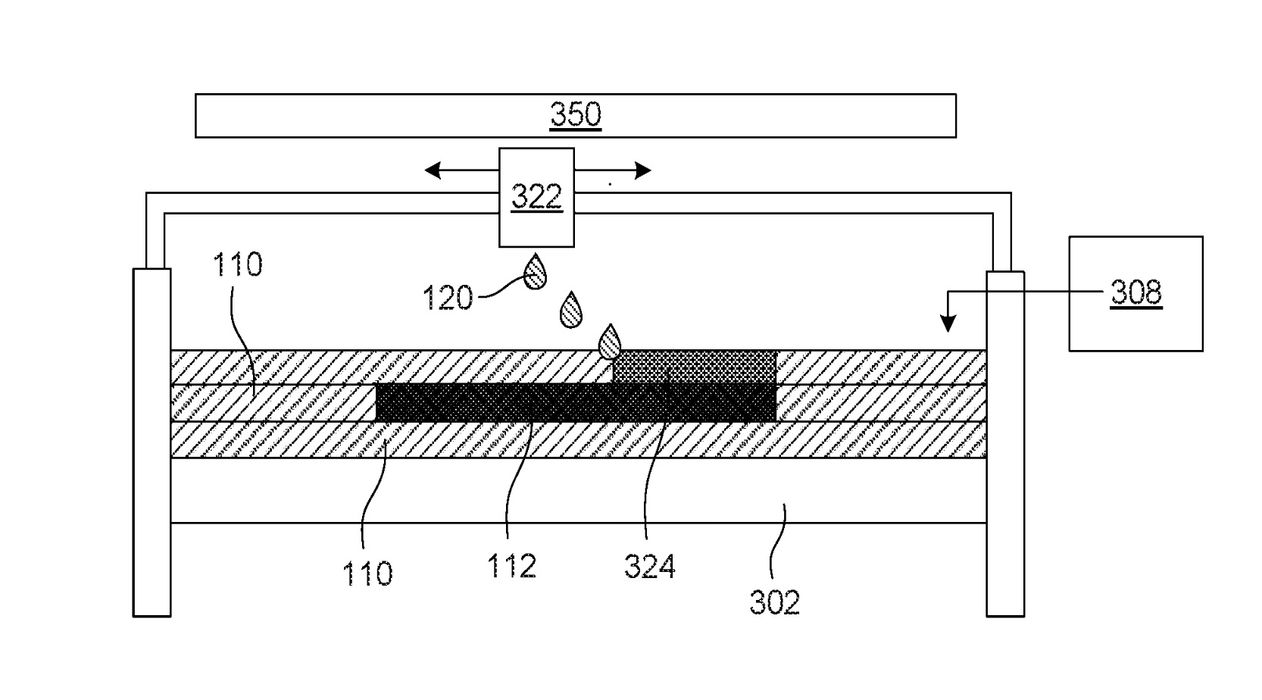
The application, US20260346541A1 from Peridot Print LLC, describes a process similar to Multi Jet Fusion (MJF). A printhead deposits a fusing agent containing a radiation absorber onto selected areas of polymer powder. When the layer is exposed to radiant energy, those regions heat up and fuse into solid plastic. More powder is spread, and the process repeats.
Then comes the epoxy.
The idea is to create a rigid coating around a thermoplastic part. The rough surface of a powder print gives the epoxy something to grip, while its small surface pores may allow some resin to penetrate. Once cured, the coating can carry some of the mechanical load, changing the behavior of the finished component without changing the powder or the printing process.
There are actual test results behind this proposal.
The inventors produced ten dogbone-shaped specimens using an HP MJF printer and polyamide powder. Five were brushed with a commercially available two-part epoxy and allowed to harden at room temperature. The other five remained untreated. All ten were tested using an Instron tensile testing machine.
The biggest difference was in Young’s modulus, a measure of how strongly a material resists deformation. The patent reports an increase of approximately 400–500% for the epoxy-treated specimens. That’s roughly five to six times the original stiffness.
Tensile strength improved much less dramatically. The untreated specimens clustered around 5–6 MPa, while coated specimens were close to 7 MPa. In other words, the treated objects were much harder to stretch, but only moderately harder to break.
So it’s not exactly a general strengthening solution. Stiffness and strength are different properties, and making something stiffer doesn’t make it more durable under every kind of load.
I was particularly interested in a lattice illustration included in the filing. It shows an open structure whose individual struts could all receive a coating. In principle, a designer might print a lightweight lattice and adjust its stiffness afterward by changing the epoxy or coating thickness.
The inventors also propose spraying or soaking parts instead of brushing them, potentially making the treatment easier to apply to larger batches. Those methods aren’t demonstrated by the reported test.
The November 2026 publication is also a divisional application of an earlier filing, so these experiments aren’t an entirely new development.
It’s also a pretty obvious thing to do, and I suspect many 3D printer operators have been doing epoxy dips on their parts for, well, probably decades. I’m wondering how this patent will play out, especially if Peridot Print makes a machine to automate the process.
Via Espacenet