
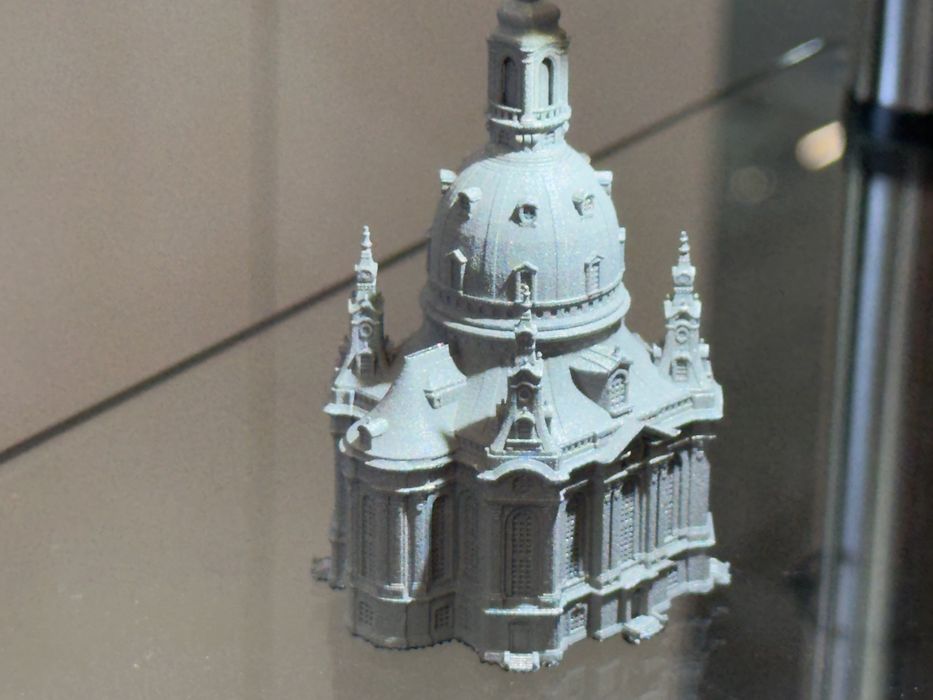
I had an interesting discussion with Xact Metal at Formnext.
The Pennsylvania company produces small-volume LPBF metal 3D printers and has been doing so quite successfully for the last few years. In fact, CEO Juan Mario Gomez hinted that their sales continue to grow significantly.
Well, I think they might be selling even more machines after what I saw at their Formnext stand.
There were two developments.
The first was a new type of powder, a “micro powder,” as they called it. It is metal powder, but with smaller grains in the 5-22um size. This, combined with a 25-50um laser spot, allows their systems to print with extreme resolution.
At top you can see a small building model, and unfortunately I did not include a banana for scale. The item is about 50mm tall, so you can see there is incredible detail visible.
Here’s another example:
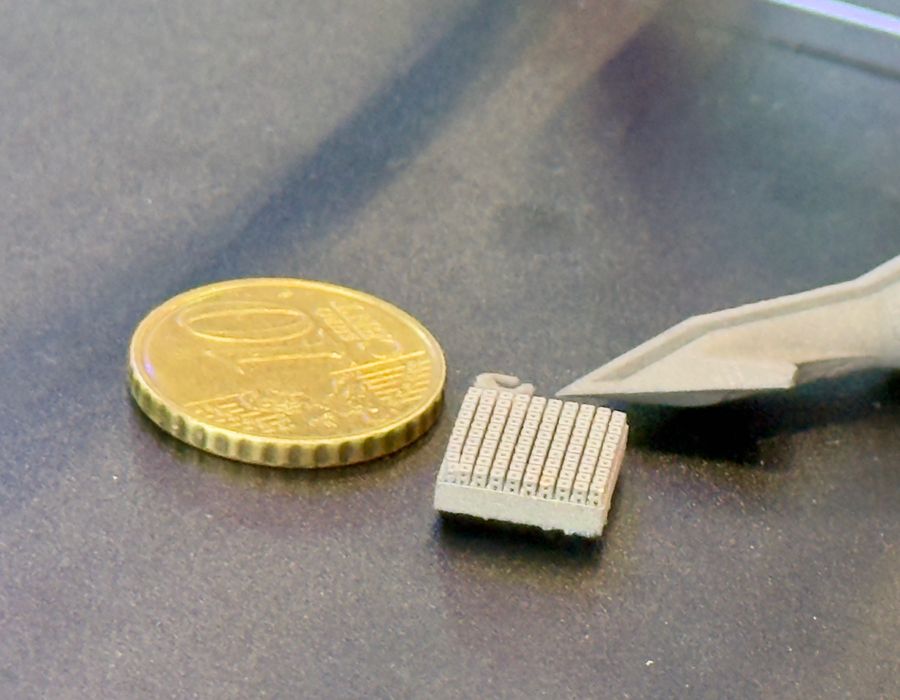
The features are so small on this; let’s look at the microscope view of those holes. They are extremely small.
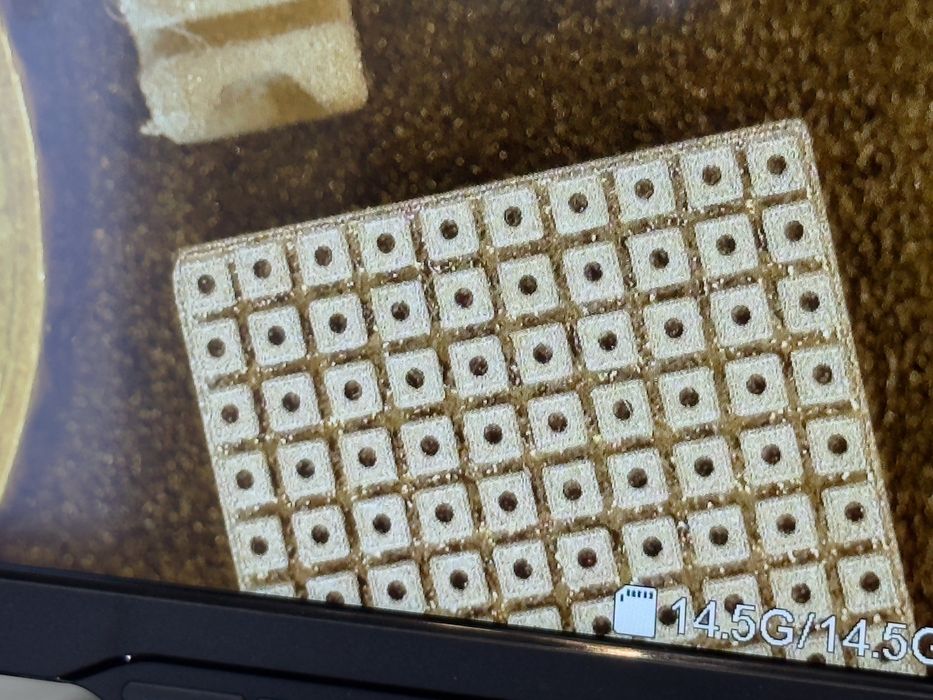
This added resolution just might open up some new markets for Xact Metal. I’m thinking of the markets that were addressed by Digital Metal with their ultra-high-resolution metal 3D printing tech. The Swedish company was acquired by Markforged and then fell into the Nano Dimension corporate abyss. While they are in limbo, that may open up an opportunity for Xact Metal to capture that market.
The other interesting development was Xact Metal’s partnership with Dyndrite, a maker of advanced 3D printer control software.
As it was explained to me, it turns out that the galvanometers used by the laser scanning systems of LPBF metal 3D printers are a standard industrial component. As such, they come with preloaded motion routines that are used by other industries.
Apparently, these are typically not used in the 3D print industry, where 3D printer manufacturers tend to build their own motion control software. Usually, this means that curves are built using a series of straight line segments, and to overcome the momentum when moving to the next segment, the laser has to loop around first. This causes some delays in scanning.
Meanwhile, the galvanometer already has curve motion controls directly built in. They’re just not used by most 3D printer manufacturers.
But in this case, Xact Metal gave Dyndrite the go-ahead to activate these routines. The result was that when printing curves, the scanning time is between 20–30% faster. That’s significant because curves are used frequently.
In addition, the resulting curves are smoother as they are continuous and not made from straight line segments.
This is quite an interesting development, and I now wonder whether competing LPBF manufacturers will opt for this very useful solution.
Via Xact Metal