
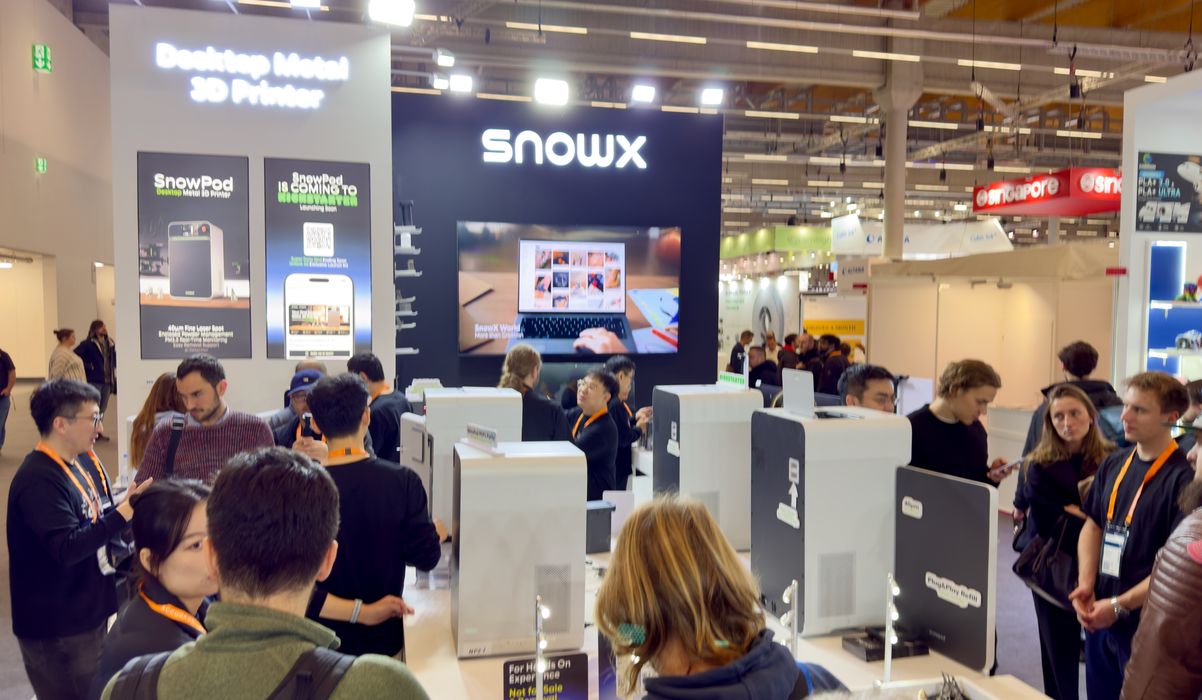
There was considerable discussion about SnowX at Formnext this year.
The company launched its SnowPod desktop metal 3D printer, a device that uses the same LPBF (Laser Powder Bed Fusion) process found in industrial metal 3D printers, but at a price below US$10,000.
Among media and attendees, I heard two quite different perspectives on the company’s future. Some believe SnowX could become an enormous company by opening up an entirely new market. Others wondered whether the company would survive the numerous barriers it will inevitably encounter.
Both perspectives could happen, we just don’t yet know which way it will go.
We’ve seen something like this before. Many years ago, polymer 3D printing escaped from the industrial world and became truly accessible to consumers. An entirely new industry emerged — desktop 3D printing — and today there are millions of desktop polymer 3D printers in operation.
But polymers are relatively easy to deal with. Metal is quite another matter.
If you’ve ever toured an industrial metal 3D printing operation, you’ll have noticed the extraordinary efforts to which operators go to ensure safe operations. There are specialized ventilation systems, powder storage facilities, protective equipment, special vacuum cleaners, waste disposal procedures and significant operator training. Oh, and there are usually metallurgists and engineers on hand to make sure it all works.
SnowX has attempted to engineer away a lot of this complexity by using enclosed powder cartridges, a transfer box for removing prints, filtration systems and other safety features.
But what happens when consumers begin doing what consumers always do with desktop 3D printers?
Someone will inevitably want to use less expensive third-party metal powder, because metal powder is indeed expensive. Someone else might decide to experiment with aluminum powder, which has far different fire and explosion hazards than the stainless steel powders supported by SnowX.
Someone will drop a powder cartridge. Someone might attempt to clean up spilled metal powder with a household vacuum cleaner. Someone will toss a contaminated filter in their household garbage.
What happens when one of these machines is in a residential fire? Will the firefighters even know there’s metal powder present?
There’s a bit of a precedent for this with desktop resin 3D printers. While commercially successful, these devices have introduced hazardous chemicals into countless homes: photopolymer resins and IPA. We still see images of people handling uncured resin without gloves, operating equipment in bedrooms and apparently believing that water washable resin can be washed down the drain. (It cannot.)
The consequences of mishandling certain metal powders can be far more severe.
Then there’s the part quality.
Industrial metal 3D printing operations spend huge amounts of money qualifying materials, machines and print parameters. They perform mechanical testing, examine internal structures and undertake carefully controlled heat treatments.
A desktop operator will in all probability do none of these things.
I suspect there will be a psychological difference when consumers begin producing metal parts. We instinctively know that a plastic part might break, but a substantial piece of stainless steel feels very strong indeed.
It actually might not be. There could be invisible internal defects that cause the part to fail unexpectedly, particularly after repeated loading. Imagine someone 3D printing and selling 3D printed bicycle components online without having performed any fatigue testing. That will almost certainly happen.
There are also entirely unknown scenarios in this new market. For example, will residential insurance policies cover the operation of LPBF equipment? Will specialized ventilation or non-standard fire protection equipment be required? What will it actually cost to safely dispose of waste materials? Will operators even know how to properly dispose of their waste materials?
Any of these scenarios could notably change the personal economics of owning an inexpensive metal 3D printer.
None of this means that SnowX has produced an unsafe machine. In fact, they appear to have put considerable effort into addressing many of these issues.
But SnowX is basically pioneering an industry in which the rules of operation have yet to be established. The company will likely encounter problems that are beyond just 3D printing metal objects.
So in the end, building an inexpensive LPBF 3D printer may turn out to be the easiest part.
Via SnowX