
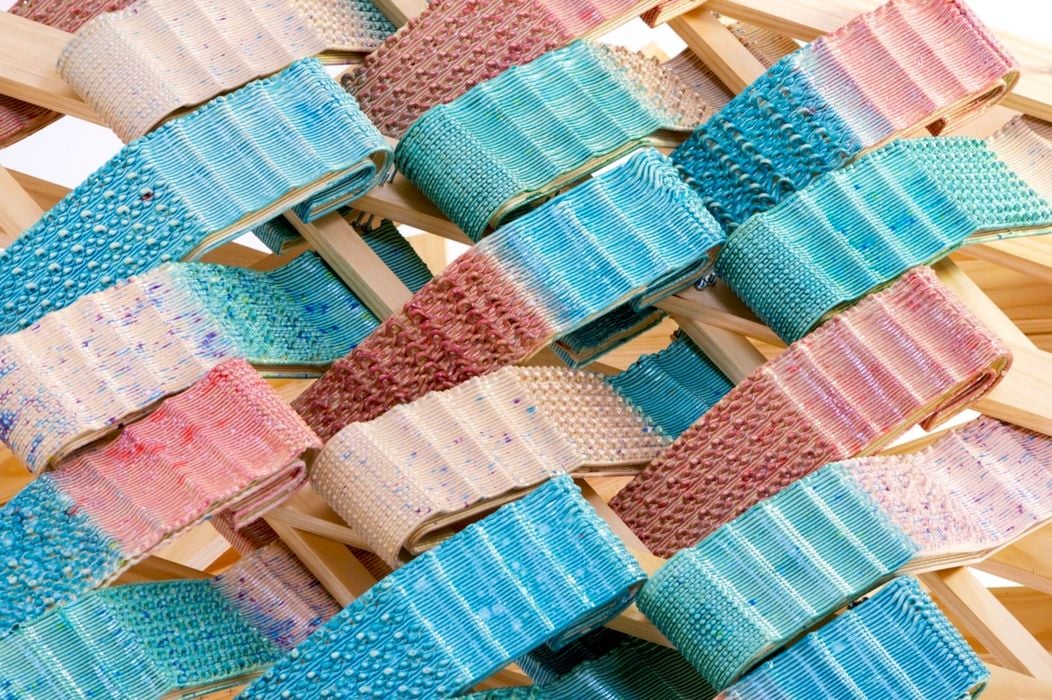
A new facade concept using 3D printed ceramic shingles shows how additive manufacturing adds light control and geometric variety to one of the oldest building components.
The project, recently highlighted by designboom, comes from architecture and design researchers exploring a facade skin made from clay-based 3D printed shingles. The pieces are not just decorative tiles. They are shaped to interact with light, creating a surface that changes appearance across the day while simultaneously acting as the exterior building layer.
Architecture is one of the few areas where additive manufacturing can justify complexity without immediately losing on cost. A facade usually benefits from variation: different angles for shading, different openings for airflow, or different surface textures for visual effect. Traditional ceramic production can certainly make tiles at scale, but once every part needs to be slightly different, the cost and tooling requirements rise quickly. That is where 3D printing starts to make sense: customized, not mass-manufactured.
Here, the light-responsive aspect is the real benefit. The shingle geometry is designed to catch and filter light rather than just cover a wall. In other words, the printed form is doing work that would be difficult or expensive to achieve with flat, conventionally pressed tiles. If the facade can deliver both environmental and aesthetic performance, then additive manufacturing is not merely adding style points. It is adding function.
You can see the implication here: 3D printing is not to print entire buildings, but instead high-value components with moderate scale and the need for customization. Facade elements, screens, connectors, and interior acoustic parts all fall into that category.
Ceramics are terrific for exterior use because they handle weather, ultraviolet exposure, and heat very well. But they are also very brittle, and that creates problems when transporting, during installation, and also long-term maintenance. A facade system has to survive impact, and repeated thermal cycling. It also has to be replaceable when one module breaks. Those are end-use issues, and if not solved, then the concept stalls.
Ceramic 3D printing is slowly finding applications where complexity, material performance, and architectural demand are combined. While there are many projects attempting to print entire buildings, well, at least the concrete walls, there is another major application area for 3D printing in architecture: components, an example of which is the shingle.
And a pretty complex shingle at that.
Via designboom
