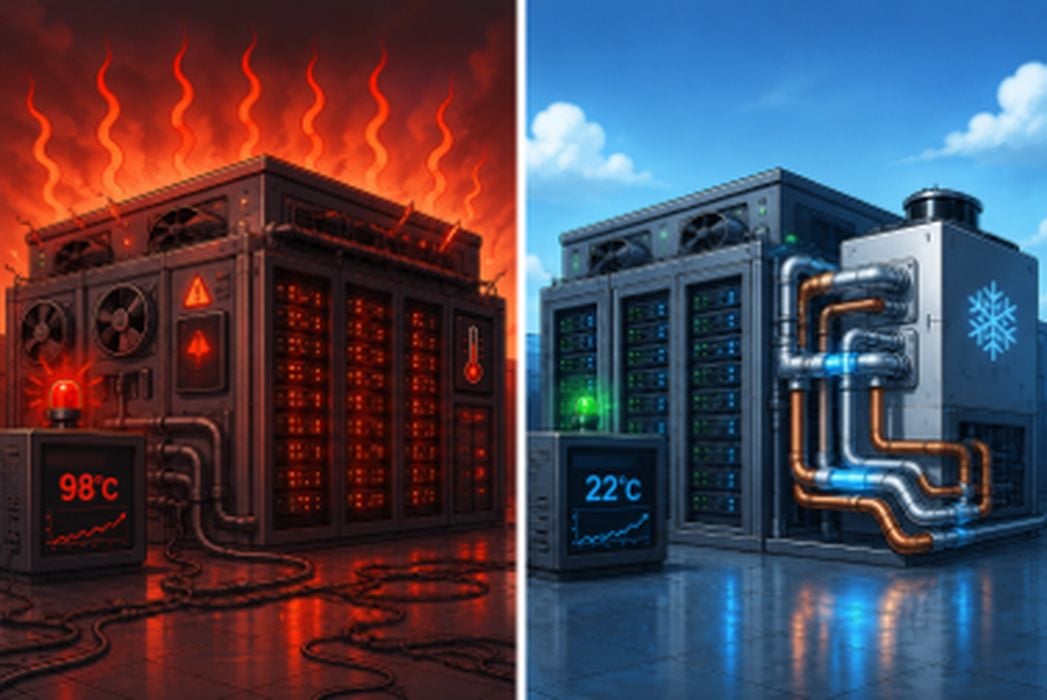
Charles G. Goulding examines how advanced 3D printing and copper engineering could unlock the next phase of AI expansion while easing pressure on power grids and critical infrastructure.
Cooling Is a Central Problem in AI
AI runs on data centers packed with advanced computer chips. An enormous amount of physical activity happens inside.
Those chips process huge amounts of information continuously. Electrons move through microscopic circuits at extraordinary speed. Tiny electrical interactions happen billions or even trillions of times per second. Each interaction generates resistance and heat inside the hardware. The more powerful the chip becomes, the more heat it tends to produce.
The scale is difficult to conceive. According to recent reporting, a single advanced AI chip can generate enough heat in one hour to boil roughly 50 cups of water. Modern AI data centers can contain hundreds of thousands of these chips operating simultaneously. Massive fans and liquid-cooling systems run continuously just to prevent overheating.
Cooling is therefore becoming one of the defining constraints in the AI economy. Many large data centers already devote roughly 30 to 40 percent of their total energy consumption to cooling systems alone. Every reduction in cooling demand potentially reduces electricity usage and operating cost and strain on the electrical grid all at once.
And the issue keeps growing as AI systems become larger and more power-intensive. The race to build more capable models increasingly collides with physical limitations involving heat, electricity, and industrial infrastructure.
Copper Permeates the Entire Buildout
AI infrastructure depends heavily on copper. Data centers have long required copper-rich electrical systems and cooling systems and grid upgrades. AI now adds another major source of demand on top of electric vehicles and renewable energy infrastructure.
The result is growing concern about long-term supply. Some analysts warn that mining output may struggle to keep pace with projected demand growth over the coming decade. Copper prices already rose sharply during parts of 2025 as industrial buyers reacted to tightening supply expectations and rising data-center demand projections.
The irony is difficult to miss. AI is often portrayed as something ethereal and digital. Its expansion increasingly depends on old industrial realities involving mines and smelters and transmission infrastructure.
Copper also appears directly inside cooling infrastructure itself. Cooling plates, piping systems, and electrical components all depend heavily on conductive material. More efficient cooling technologies may therefore reduce stress not only on the electrical grid but also on copper-intensive infrastructure systems underneath AI expansion.
3D Printed Copper Plates Could Radically Reduce Cooling Costs
Current cooling systems consume roughly 30 to 40 percent of total energy use inside AI-focused data centers. According to researchers at the University of Illinois Urbana-Champaign, a newly designed 3D printed copper cooling plate could potentially reduce data-center cooling energy use by roughly 97 percent under certain conditions
The Illinois researchers say their redesigned plates could reduce that figure to roughly 1.1 percent. Even if real-world deployment falls short of those projections, the implications are still highly significant.
Cooling plates sit directly against computer chips and help pull heat away before temperatures rise too high. Cool liquid flows through tiny channels inside the plate. The liquid absorbs heat and carries it away from the chip.
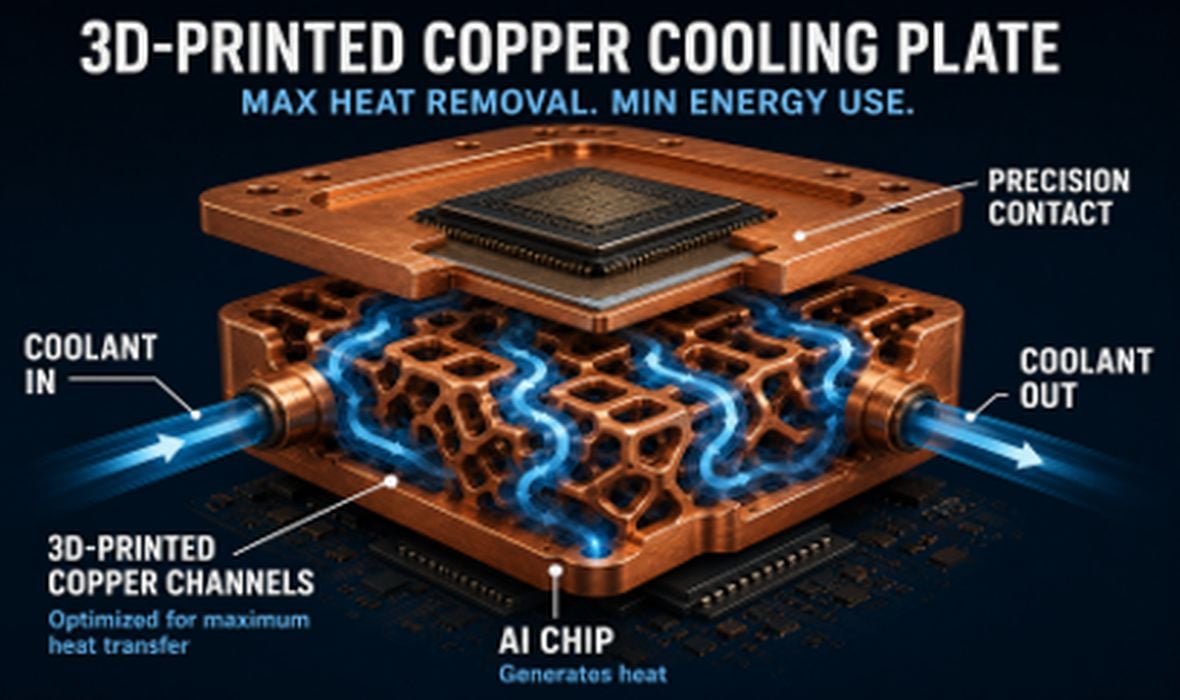
The Illinois team redesigned those internal channels almost from scratch. Conventional cooling plates usually contain relatively simple rectangular or cylindrical structures because those shapes are easier to manufacture economically. The researchers instead used a mathematical optimization process called topology optimization to redesign the internal copper fins around maximum heat transfer and lower pumping resistance.
The resulting structures reportedly look jagged and unusually intricate under magnification. Those geometries improve heat transfer while also reducing the energy needed to push coolant through the system. Traditional manufacturing would struggle to produce such fine structures economically at scale.
The researchers therefore used electrochemical additive manufacturing, or ECAM, to build the plates layer by layer from pure copper. The process reportedly allows detail down to roughly 30 to 50 micrometers across, which is smaller than the width of a human hair.
The claims still require commercial validation at large scale. Data centers operate under harsh real-world conditions involving maintenance, reliability, and continuous uptime demands. Still, the broader direction is clear: cooling infrastructure is starting to look like one of the central battlegrounds in the AI buildout.
Reducing Energy Helps Data Center Independence
If cooling systems become dramatically more efficient, data centers gain flexibility in how they source power. Facilities requiring less electricity for cooling become easier to pair with localized generation rather than relying entirely on large centralized grids.
That possibility has become increasingly important as tech companies explore small modular reactors and microreactors as dedicated energy sources. A highly energy-intensive data center can place enormous strain on local utilities and transmission systems. But if cooling demand falls sharply, localized energy generation becomes more realistic and economically attractive.
The security implications are likewise significant. A facility powered partly through localized generation may become less vulnerable to grid instability, transmission bottlenecks, and broader infrastructure disruptions. Energy independence increasingly looks attractive as AI infrastructure becomes strategically important.
There is also a public-policy angle developing underneath the issue. Communities have grown increasingly concerned that massive AI facilities could drive up local electricity prices or strain regional grids while ordinary households absorb part of the infrastructure burden indirectly.
Northern Virginia provides an example. The region has become one of the largest concentrations of data centers in the world, but rapid growth has led to criticism over electricity demand and pressure on transmission infrastructure. In response, utilities and technology companies have publicly discussed a range of solutions. Ultimately, advanced cooling may be one of those solutions.
More Cooling Choices Than Just Copper
When it comes to cooling, copper attracts attention because of its strong thermal conductivity. But researchers are exploring many other materials that could eventually influence high-performance cooling systems.
Graphene and synthetic diamond materials can transfer heat extraordinarily well under certain conditions. Advanced ceramics and liquid-metal cooling systems are also being studied for specialized thermal-management applications. Phase-change materials capable of absorbing and releasing large amounts of heat may eventually play a role in future infrastructure systems as well. The competition is especially crucial because cooling is not just downstream from computing power. Thermal management increasingly influences how powerful chips can become in the first place. If heat cannot be removed efficiently enough, then computing performance itself eventually becomes constrained.
That dynamic turns cooling into a materials race. Companies and research institutions are increasingly searching for substances that can move heat faster and more efficiently while remaining manufacturable at industrial scale.
Additive manufacturing may become deeply intertwined with that race. Many advanced materials become difficult to shape or optimize through conventional manufacturing methods alone. 3D printing potentially allows engineers to experiment with intricate internal structures and hybrid material combinations that would otherwise be difficult to produce.

Supply Chains A Constraint?
As the country of Peru helps explain, supply chains may constrain advanced cooling deployments. Peru ranks among the largest copper producers in the world and contains several massive mining operations that global manufacturers increasingly depend upon.
Yet expanding supply is rarely straightforward. Mining projects require years of permitting and financing before production begins. Environmental disputes and local political tensions can delay expansion plans significantly.
Ore grades also decline over time in many mature mining regions. Companies may need to process larger amounts of material to produce the same amount of copper they once extracted more easily.
And even when production rises the surrounding infrastructure may lag behind. Data-center expansion may happen in years while mining capacity expansion may require decades.
The Research & Development Tax Credit
Enacted in 1981, the now permanent Federal Research and Development (R&D) Tax Credit allows a credit that typically ranges from 4%-7% of eligible spending for new and improved products and processes.
Qualified research must meet the following four criteria:
- Must be technological in nature
- Must be a component of the taxpayer’s business
- Must represent R&D in the experimental sense and generally includes all such costs related to the development or improvement of a product or process
- Must eliminate uncertainty through a process of experimentation that considers one or more alternatives
Eligible costs include U.S. employee wages, cost of supplies consumed in the R&D process, cost of pre-production testing, U.S. contract research expenses, and certain costs associated with developing a patent.
On December 18, 2015, President Obama signed the PATH Act, making the R&D Tax Credit permanent. Beginning in 2016, the R&D credit can be used to offset Alternative Minimum Tax for companies with revenue below US$50 million. For the first time, pre-profitable and pre-revenue startup businesses can also obtain up to US$500,000 per year in payroll tax offsets and cash rebates.
Cooling May Become One of the Most Valuable Technologies in the AI Economy
The modern AI economy increasingly resembles a giant thermal-management problem. More powerful systems create more heat. More heat requires more cooling infrastructure.
Technology companies must now think about future infrastructure. Some firms have even explored orbital data centers, partly because outer space naturally provides extremely cold environments for heat dissipation.
Rising global temperatures may place additional pressure on the problem over time. Hotter ambient conditions can make cooling systems work harder and consume more energy. Data-center placement may increasingly become tied to climate and water availability and grid resilience.
That broader context helps explain why the Illinois cooling-plate research attracted so much attention. The story is not really about one copper component alone. It is about the possibility that cooling efficiency itself could become one of the central leverage points underneath the entire AI buildout.
Related innovations may eventually extend beyond cooling plates. Future applications could include specialized heat exchangers and electrical components and repair parts for critical infrastructure systems operating under extreme thermal loads.
The next phase of computing may depend as much on cooling systems and electrical grids and industrial materials as on algorithms themselves.
Charles G. Goulding is a practicing attorney.