
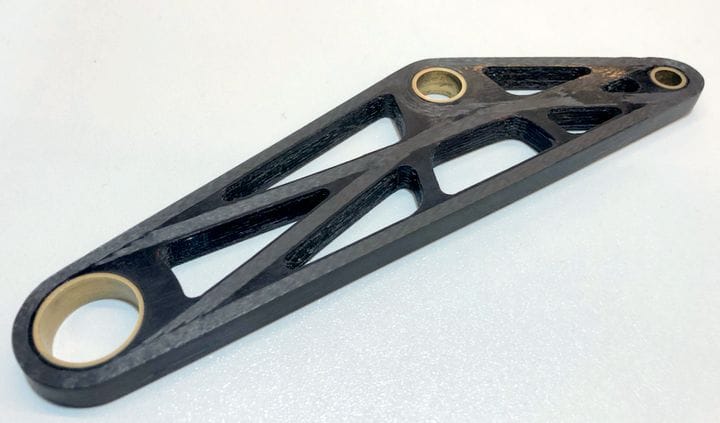
No one seems to have noticed, but 9T Labs appears to be gone.
The Swiss company made a big splash in the 3D print industry several years ago when they introduced an entirely new 3D printing process that was able to print parts with up to 60% continuous carbon fibre material. These parts were absolutely the strongest polymer items ever 3D printed.
Their Additive Fusion Technology (AFT) laid down the polymer and fibres, and then underwent a pressure treatment. This is where the company gets its name: nine tonnes of pressure.
Since 2019, the company had been raising money, with our last report on them in July 2021. In all, the company seems to have received US$22M in investments.
But I hadn’t heard much from them in quite a while. Then I saw a LinkedIn post advertising the sale of their assets:
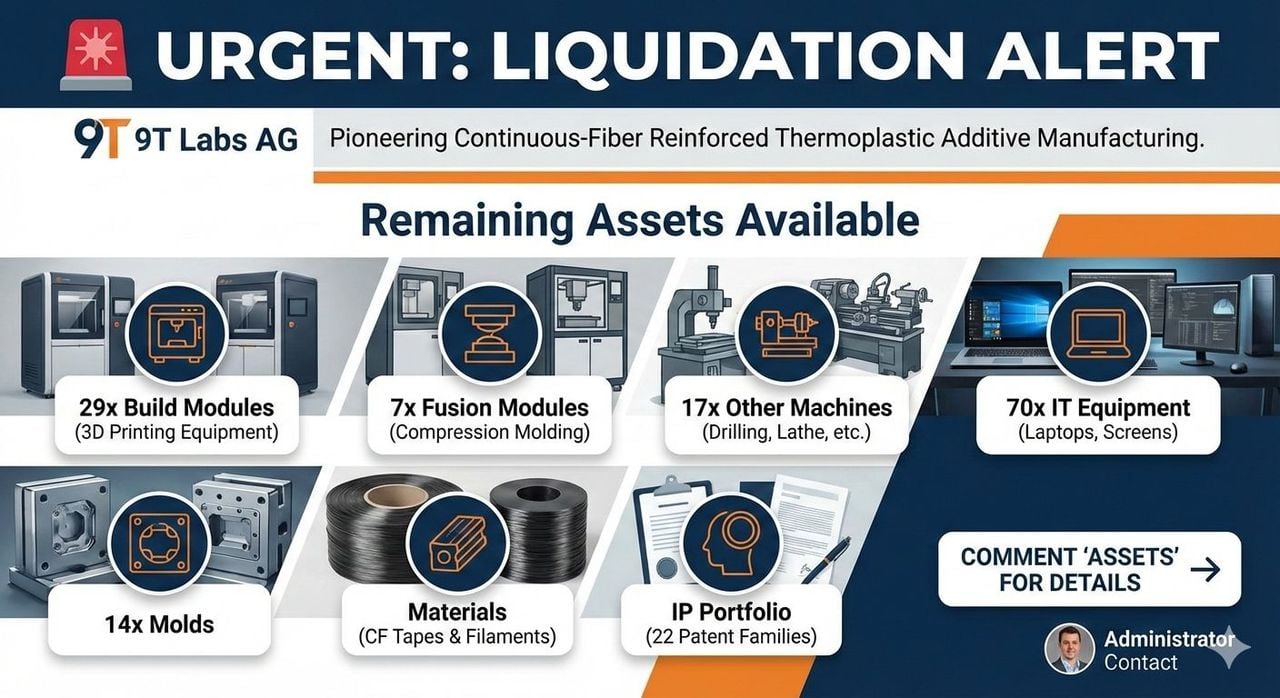
What’s going on? I had heard no announcement of a shutdown, or even a hint at issues at 9T Labs.
I went down the rabbit hole looking to find out what happened. First, their website no longer exists; it 404s. It appears to have been turned off in December 2025.
A report on the Swiss Official Gazette of Commerce indicates that 9T Labs AG is “in liquidation”. The report says:
“By judgment of 03.11.2025, the Bankruptcy Court of the District Court of Zurich opened bankruptcy proceedings against the company effective 03.11.2025 at 10:00; accordingly, the company is dissolved.”
9T Labs is officially gone. Evidently, they went bankrupt, in spite of receiving US$22M in investment over several years.
This is yet another example of the challenges in starting a new 3D print company, especially one with an unusual — and niche — feature set. With the rise of inexpensive desktop FFF systems, much of the potential for companies like 9T Labs has already been absorbed: Do you really need a super-strong, mostly carbon fiber part, or can you make do with an FFF-produced PA12-CF part?
Sure, some might require the super-strong part, but the number of those customers is far smaller, drastically limiting 9T Labs’ potential market.
So does 9T Labs’ technology fade away? Possibly yes, possibly no. It all depends on the sale of the assets. You’ll note that the assets for sale in the image include some printer hardware, but more importantly, they include the IP (intellectual property). That’s the designs, blueprints, research, trademarks, etc., associated with the 9T Labs project.
It is possible that a company might purchase the IP at a discount from the liquidator and try to run with it. That’s a pretty slim proposition, however, as 9T Labs, even with tremendous funding, could not make a go of it.
The only possibility I can see is if one of the major 3D print companies, like HP, Stratasys, Nikon, etc., took on the IP. They would have the financial backing to keep the tech warm while a proper market was developed through more extensive business networks.
And even then, it might not work.
